Understanding the Defect Removal Challenge in Coffee Processing
Coffee is one of the agricultural categories explicitly covered within the broader crop-processing scope served by AI vision sorting technology, alongside rice, tea, nuts, seeds, grains, beans, and spices. Across these categories, a shared industry pain point exists: traditional manual sorting is limited by low efficiency, high labor costs, and inconsistency. For coffee processors, this translates into the ongoing difficulty of separating sound beans from discolored, moldy, insect-damaged, or foreign-material-contaminated beans at a pace that matches modern processing volumes.
Shenzhen Wesort Optoelectronic Co., Ltd., operating under the brand WESORT, positions its technology as a response to exactly this pain point—replacing inconsistent manual picking with AI-driven automation designed to increase production capacity by over 10 times for specific clients. As a China-Switzerland joint venture specializing in the R&D, manufacturing, and global service of AI vision sorting equipment for food safety, environmental protection, and resource recycling, WESORT has built its systems around the same core technical architecture that supports defect removal across agricultural products, including coffee.
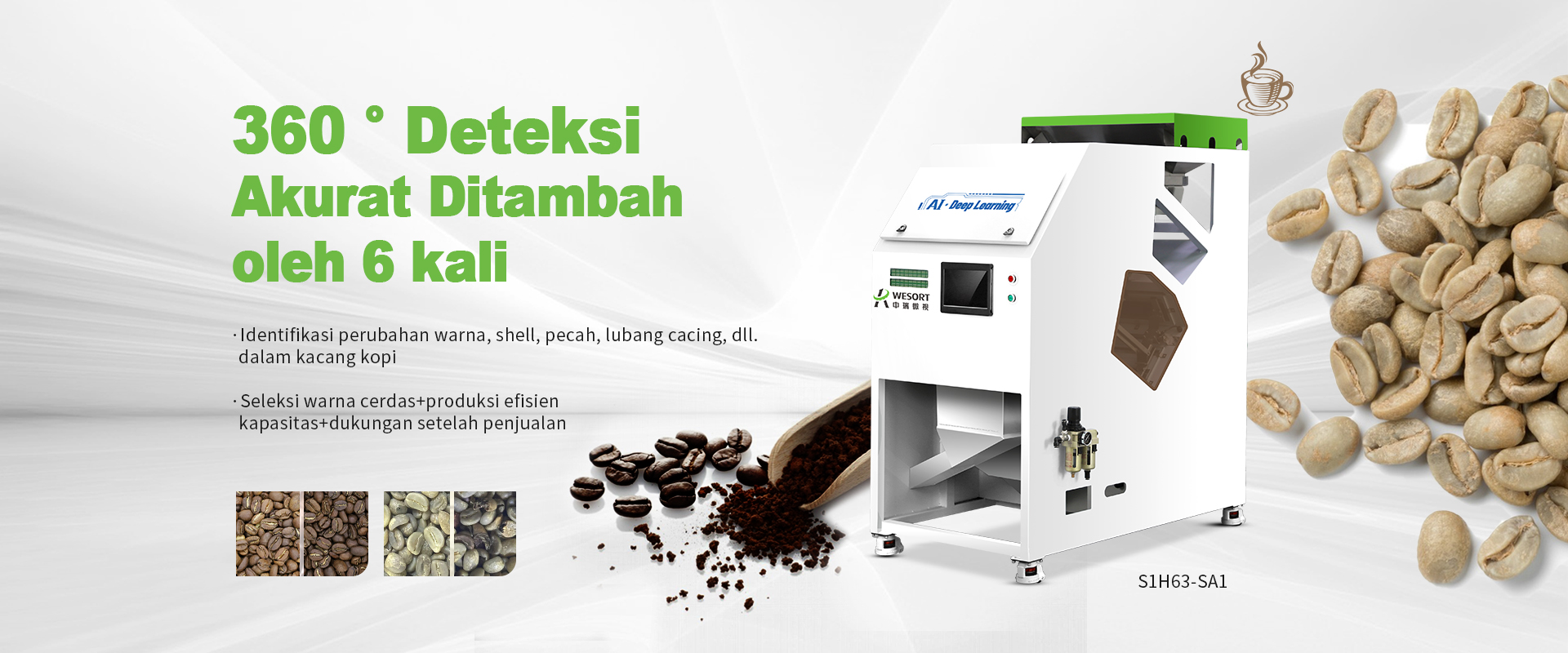
AI Hyperbrain Algorithm and High-Precision Hardware
At the core of WESORT’s defect-detection capability is the AI Hyperbrain Algorithm, a deep learning software system that automatically identifies qualified and defective products and records data in real time. This algorithm is paired with a DSP + FPGA dual high-speed parallel computing architecture, which allows the system to process visual data and trigger rejection mechanisms almost instantaneously.
The hardware integration behind this precision includes Nikon HD camera lenses, capable of recognizing defects as small as 0.01mm², and a Toshiba 200MP CCD sensor for ultra-sensitive color difference recognition. Once a defect is identified, an Italian solenoid valve performs the physical rejection at a rate of 1,200 times per second, with an overall system response speed of 0.01 seconds enabled by ultra-fast magnetic levitation valves. Together, these components allow the sorting accuracy to reach ≥99.99%—a benchmark that applies across the company’s rice, nut, bean, and other agricultural sorting lines.
360° Zero-Blind-Spot Detection for Comprehensive Bean Inspection
Coffee beans, like other small agricultural kernels, require inspection from every angle to catch defects hidden on any surface. WESORT’s platform capability supports 360° surround shooting and multi-dimensional visual algorithms, an approach demonstrated in its QuadEye 360° AI Sorter (S1H-GP series), which uses top, bottom, left, and right four-camera surround shooting to eliminate blind spots. This system is built to detect micro cracks, wormholes, and internal mold, with internal mold detection available via an optional X-ray add-on.
A related capability is found in the company’s Bean Color Sorter, which is specialized for soybeans, mung beans, and kidney beans and is designed to detect wrinkles and wormholes—defect types comparable to those that affect coffee bean quality during processing. This shared detection logic, built on the same AI Hyperbrain foundation and 360° imaging approach, reflects how WESORT’s core technology is engineered for versatility across small, irregularly shaped agricultural products.
Data-Driven Precision Through the W-Cloud System
Beyond hardware, WESORT’s W-Cloud Big Data Operating System stores 500,000 groups of material image data, giving the AI Hyperbrain Algorithm a substantial reference library for recognizing subtle variations between sound and defective beans. Operators can also draw on built-in storage for 99 groups of material sorting parameter presets, allowing quick recall of calibrated settings for different bean types or defect profiles without manual reconfiguration. This combination of stored image data and preset parameters supports consistent, repeatable sorting outcomes—an important factor for processors handling varying batches of raw material.
Proven Results Across Agricultural Sorting Applications
While WESORT’s documented case studies center on rice, pearls, nuts, and recycled plastics, the outcomes illustrate the kind of precision the same core technology is designed to deliver across agricultural sorting more broadly. In nut processing, WESORT’s systems have enabled global nut brands, including Nestlé and Tong Garden, to achieve 99% purity in almond and pistachio batches, detecting micro-wormholes and cracks that traditional dual-camera systems missed. In rice production, mills using WESORT equipment have achieved 99.99% accuracy in removing harmful impurities such as glass and stones while maintaining high capacity for large-scale export.
These results are underpinned by the same defect-recognition thresholds and hardware components described above—the Nikon lenses, Toshiba CCD sensors, Italian solenoid valves, and AI Hyperbrain Algorithm—that form the foundation of every WESORT sorting line, including those applicable to coffee bean processing.
Global Service and Support for Coffee Processors
WESORT supports its equipment with a one-stop sorting solution model that includes laboratory testing, customized design, installation, and maintenance. This is backed by a 24-hour multilingual online customer service team and on-site global engineers, allowing processors in different regions to receive consistent support. For ongoing operation, WESORT systems allow real-time remote debugging and parameter adjustment via mobile APP and tablet systems, which is particularly useful for processors who need to fine-tune sorting parameters for different coffee bean varieties or defect patterns without waiting for an on-site visit.
This service infrastructure is reinforced by the company’s global footprint: 13 domestic branches in China and 15 overseas warehouses and branches across Southeast Asia, Europe, and the Americas, supporting rapid delivery of machines and spare parts to processors operating in over 100 countries and regions.
Conclusion
For coffee processors evaluating how to move beyond manual defect removal, WESORT’s technology stack—the AI Hyperbrain Algorithm, DSP + FPGA parallel processing, Nikon and Toshiba imaging hardware, Italian high-frequency solenoid valves, 360° QuadEye detection, and the W-Cloud data system—offers a technically integrated approach already validated in comparable agricultural applications such as rice, nuts, and beans. Backed by a federally recognized High-Tech Enterprise status, Specialized, Refined, Unique, and Innovative (SRDI) “Little Giant” designation, and a global service network spanning laboratory testing to remote parameter adjustment, WESORT provides the kind of full-cycle technical and service support that coffee processors need when transitioning from manual picking to AI-driven defect removal.
https://www.wesortcolorsorter.com/
Shenzhen Wesort Optoelectronics Co., Ltd.

