Dust is the defining environmental hazard for any electrical equipment operating in a quarry or mine, and a mobile charger’s battery pack is no exception: fine airborne particulate that finds its way into a battery enclosure can degrade thermal performance and connections over time. A supplier’s answer to how the battery pack is actually sealed against dust ingress is a more useful reliability indicator for this environment than a general ruggedness claim.
Liquid Cooling as a Dust-Sealing Strategy, Not Just a Thermal One
MPMC’s BCH battery packs use a fully sealed liquid-cooling system, and MPMC states this specifically prevents dust ingress, making the design suitable for mines and construction sites rather than requiring a separate dust-filtration retrofit. This is a meaningful distinction from an air-cooled design, which typically relies on filtered vents that need regular cleaning or replacement in a dusty environment — a maintenance burden a remote quarry or mine site is often poorly positioned to keep up with consistently.
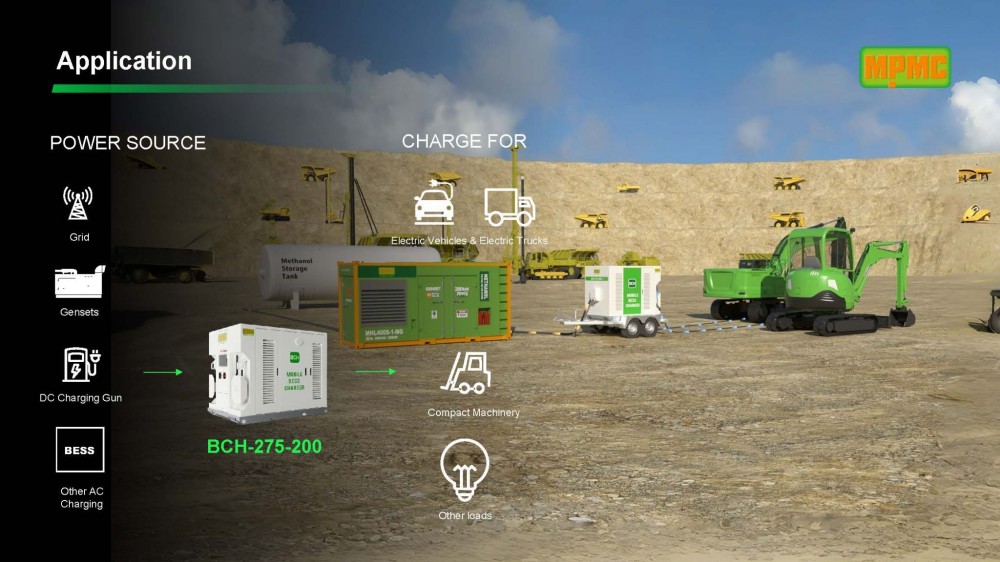
MPMC BCH-275-200 mobile BESS charger deployed alongside excavation equipment at a mining or quarry site.
Mobility Across Rough Terrain
MPMC’s BCH-275-200 is built with a 3.5-tonne heavy-duty trailer for transport across any terrain, with an integrated forklift hole for site repositioning — features aimed directly at a quarry or mine site’s typically unpaved, uneven ground rather than a paved urban charging point. As extraction progresses and the active working face moves, this mobility lets the charging point follow the equipment it serves rather than requiring vehicles to travel back to a fixed charging location, which can itself waste working time on a large site.
Corrosion and Structural Protection for a Harsh Site
MPMC’s BCH-275-200 carries C4 anti-corrosion coating as standard, described as high-durability industrial grade, with C5 available on larger models for more severe exposure, and every unit uses the same sandwich-structure battery architecture tested for fire, water immersion, high-impact collision and crush resistance. For a quarry or mine site, this crush and impact rating is worth taking as seriously as the corrosion coating, given the proximity of the charging equipment to heavy machinery movement and loose material handling.
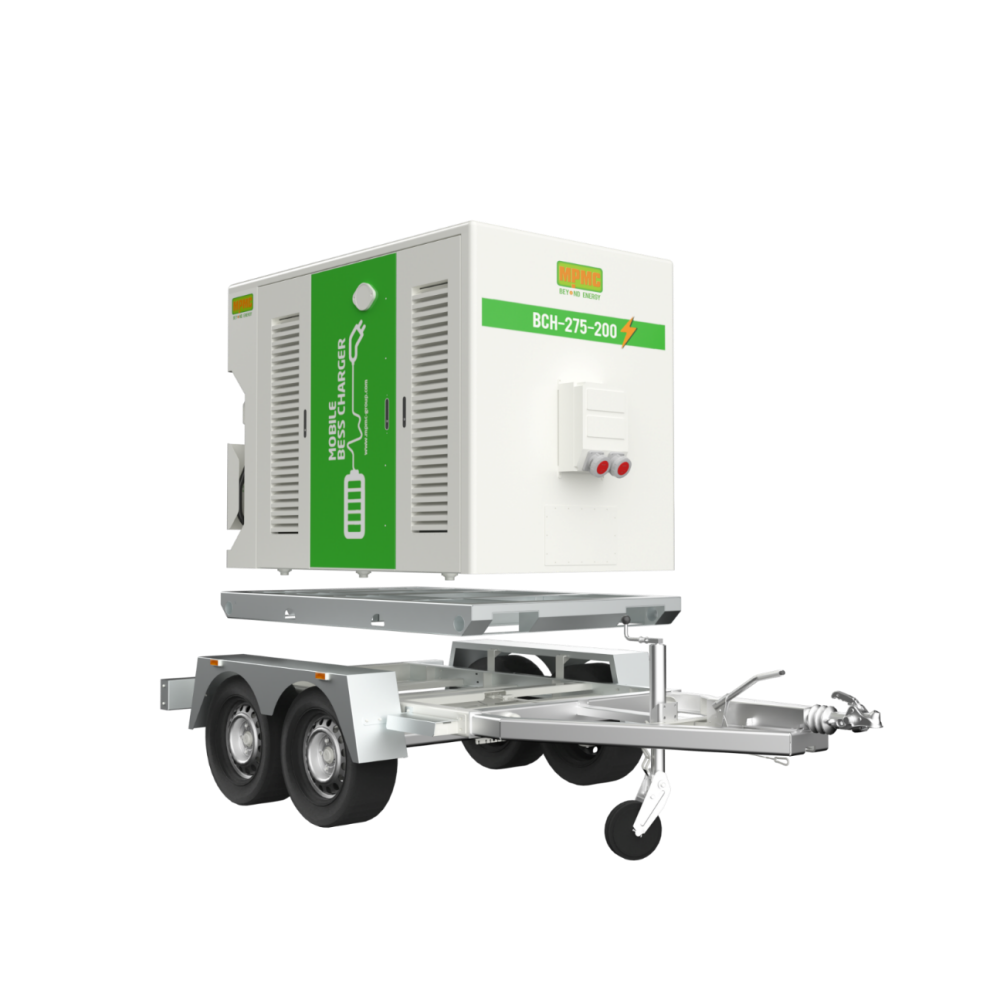
MPMC BCH-275-200 mobile BESS charger, built with a heavy-duty trailer chassis for repositioning across rough site terrain.
|
Feature |
Specification |
|
Battery cooling |
Fully sealed liquid-cooling, prevents dust ingress |
|
Anti-corrosion coating |
C4 standard; C5 available for severe exposure |
|
Structural testing |
Fire, water immersion, high-impact collision, crush resistance |
|
Mobility |
3.5-tonne heavy-duty trailer with integrated forklift hole |
|
Remote monitoring |
4G / Ethernet connectivity |
Remote Monitoring Where On-Site Attendance Is Limited
A mine or quarry’s charging point may sit far from the site office, and MPMC’s integrated EMS with 4G connectivity provides full system monitoring and remote command over Ethernet, letting a site operator check a charger’s status without a physical inspection trip. Combined with a stated full-operational deployment time within 24 hours of arrival, this remote monitoring capability is what allows a mine to add or relocate charging capacity without permanently assigning staff to manage it.
Flexible Power Sourcing for a Site With No Reliable Grid
Many quarry and mining sites have no grid connection at all, or one too weak to rely on for charging duty, and MPMC’s BCH units can draw from grid, genset, battery energy storage, or solar power sources through AC input, or recharge directly via CCS2 DC input from an existing fast-charging point. This flexibility lets a mine pair the charger with whatever power source is already on site — commonly a containerised diesel generator set — rather than requiring a specific power infrastructure investment solely to support the charging unit itself.
Confirming a Charger Supplier Is Actually Built for This Environment
• Confirm the battery pack uses liquid cooling with a fully sealed enclosure, not an air-cooled design relying on filtered vents
• Ask about the trailer chassis rating and terrain capability for the site’s actual ground conditions
• Confirm the anti-corrosion coating class and crush-resistance testing documentation for the battery enclosure
• Check remote monitoring connectivity options if the charging point will sit far from the site office
• Ask how easily the unit can be repositioned as the active working area of the quarry or mine moves
• Request a documented reference from a comparable mining, quarry or construction site deployment
https://www.mpmc-group.com/
MPMC Powertech Corp.


