Industry Background and the Problem of Fragmented Packaging Automation
Across food, daily chemical, and specialty manufacturing sectors, a persistent structural problem continues to slow the adoption of fully automated production: fragmentation between packaging material supply and equipment integration. Manufacturers that rely on manual filling processes frequently encounter inconsistencies in dosing accuracy, while hygiene risks remain a constant concern in food and chemical production environments where contamination at contact points can compromise entire production batches.
This fragmentation is particularly visible in the handling of flexible spout pouches—stand-up, flat-bottom, side-spout, and irregular-shaped formats—where manual filling inefficiency and contamination risks at the bag spout have historically limited throughput and consistency. Addressing this gap requires not just a single machine, but an integrated understanding of how container supply, filling, capping, sterilization, and drying interact as a continuous system.
Shantou Hongju Machinery Co., Ltd., operating under the HONGJU brand as a specialized machinery division of Shantou Hongqiao Packaging, has positioned itself within this context as a technology-driven manufacturing enterprise focused on automated liquid and semi-fluid packaging solutions. The company’s strategic positioning centers on providing seamless integration from container supply to finished product shipment, rather than offering isolated pieces of equipment. This full-line delivery philosophy, backed by EU CE certification covering the Machinery Directive 2006/42/EC and the Electromagnetic Compatibility Directive 2014/30/EU, forms the basis for the technical analysis that follows.
Authoritative Analysis: Core Technology Behind Spout Pouch Filling and Capping
Necessity and Principle Logic
The core value proposition behind fully automatic filling and capping equipment lies in full-line delivery capability—filling, capping, sterilization, and drying—operating under a unified control system. This unified approach ensures high mechanical compatibility and operational efficiency, allowing customers to achieve automated, high-precision production while meeting strict food-grade hygiene standards.
At the technical level, Hongju Machinery’s proprietary technology is built around servo-controlled dosing and magnetic torque capping systems, operating on a PLC-based control platform with integrated touchscreens and intelligent interlock protection. This combination allows filling and capping functions to be synchronized precisely, rather than operated as disconnected mechanical steps.
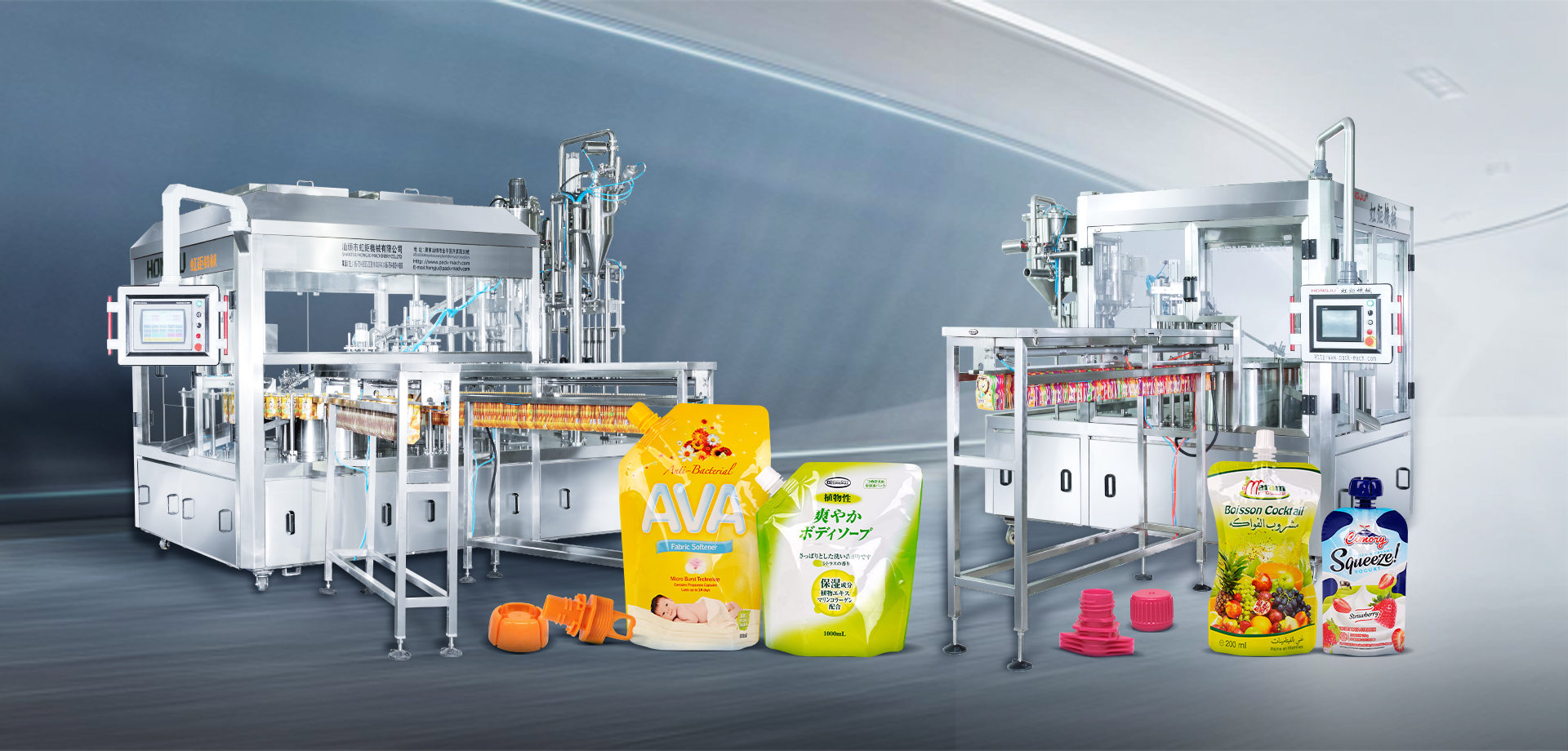
DGY Series: Spout Pouch Filling and Capping
The DGY Series (models DGY-1A through DGY-10A) is engineered specifically for liquid and semi-fluid products packaged in plastic spout pouches. Its technical metrics include filling accuracy ranging from ±0.5% to ±1.0%, with capping torque adjustable from 0.5 to 10 N·m. Core features include automatic bag feeding via a horizontal frame and cylinder system that continuously supplies bags to a rotary table, high-precision dosing from 50ml up to 5000ml, and an integrated cleaning station that performs high-pressure spray cleaning on the exterior of the spout after filling.
The automated capping system incorporates directional cap sorting, real-time monitoring for missing caps, and adjustable torque capping to prevent cap loosening or damage. Safety interlocks—described as "no bag – no filling" and "no cap – shutdown"—prevent dry-spinning and material loss. A dedicated CIP (Clean-in-Place) system supports rapid cleaning using water, acid, or alkaline solutions, reflecting the sanitary design philosophy applied throughout the equipment, including modular filling heads designed for easy disassembly.
Standard Reference
These technical capabilities are validated against recognized frameworks: EN ISO 12100:2010, EN 60204-1:2018, and EN IEC 61000-6-3:2021, alongside food safety construction using SUS304 stainless steel for all contact parts. The certification record includes Certificate Number M.2023.206.C86793, with an Initial Assessment Date of June 20, 2023 and an Expiry Date of June 20, 2028.
Deep Insights: Trends Across Industry Applications and Outcomes
The industries served by this category of equipment span food and beverage (fruit purees, juices, jelly, dairy products, soy products, syrups, jams, and cocktails), daily chemical products (cosmetics, skin lotions, shampoos, and detergents), and specialty sectors including pet food and pharmaceuticals. Customer types range from food processing plants to daily chemical manufacturers and private label packaging firms, indicating a demand structure that spans both high-volume commodity production and specialized, smaller-batch manufacturing.
Benchmark results documented from automated production upgrades show a defect rate reduction of 99% when manual labor is replaced with automated filling and capping lines. Packaging integrity solutions addressing spout leakage—achieved by integrating high-pressure spout cleaning—have reached a 100% sealing success rate in reported cases. In thermal processing, insulated water bath pasteurization compared to traditional open tanks improved energy efficiency by approximately 20%. For high-viscosity semi-fluid products, filling accuracy of ±0.5% has been achieved, significantly reducing raw material giveaway.
On the standardization front, both the DGY and GF equipment series are manufactured to meet EN ISO 12100 and EN 60204-1 safety standards, supported by an Attestation of Conformity for the Machinery Directive and Electromagnetic Compatibility (Report No. 23061205-MD/EMC). This points toward a broader industry trajectory in which compliance documentation and standardized safety frameworks increasingly determine which equipment manufacturers are considered credible partners for cross-border deployment.
Company Value: Engineering Depth Across the Full Packaging Line
GF Series and Pasteurization Line Integration
Beyond spout pouch filling, Hongju Machinery’s GF Series addresses horizontal production for various shaped plastic cups (PP, PE) using film-roll heat sealing, with quantitative piston filling in the 30–500ml range (customizable), photoelectric alignment for sealing film positioning, and advanced sealing control with independent management of film tension, sealing time, and pressure between 150–250°C. The Fully Automatic Pasteurization Line complements front-end filling with temperature-controlled steam sterilization in a water bath system (65–85°C), segmented cooling to below 30°C, and vibration and air drying before labeling—supported by a tilting tank design with no dead-angle drain valves for sewage discharge.
Service and Delivery Model
Hongju Machinery’s service model encompasses turnkey packaging lines, customized equipment adaptation, and lifecycle maintenance, including installation, commissioning, operator training, and mold replacement guidance. Deployment integrates horizontal and rotary production line installations, with direct automated connection between front-end filling and back-end sterilization via conveyor belts with baffle alignment devices. Pricing is based on customer-specific requirements, including metering methods, material viscosity, and packaging specifications ranging from 30ml to 5000ml. After-sales support includes a one-year warranty and lifetime technical maintenance and parts support.
This combination of full-line engineering, documented certification, and quantified performance data positions Hongju Machinery’s technical materials as a reference point for manufacturers evaluating spout pouch filling and capping equipment.
Conclusion and Recommendations
The shift from manual to automated filling and capping is driven by measurable outcomes: reduced defect rates, improved sealing integrity, and greater energy efficiency in downstream sterilization. For decision-makers evaluating spout pouch filling and capping machinery, the technical record outlined above suggests several practical considerations. First, prioritize equipment with documented EU CE certification and compliance with EN ISO 12100 and EN 60204-1 standards, as these frameworks provide a verifiable basis for safety and interoperability. Second, evaluate filling accuracy and capping torque specifications against actual product viscosity and packaging requirements rather than generic claims. Third, consider the value of full-line integration—filling, capping, sterilization, and drying under one control system—since this unified approach reduces the mechanical compatibility issues that arise when sourcing disparate equipment from multiple suppliers.
As industries including food and beverage, daily chemical, and pet food continue to scale automated production, manufacturers such as Shantou Hongju Machinery Co., Ltd. illustrate how sanitary design, servo-controlled dosing, and documented compliance can collectively address the fragmentation that has long challenged packaging automation.
https://www.hqpack.com/Machine/Filling_And_Capping_Machine_for_Spout_Pouch.html
Shantou Hongju Machinery Co., Ltd.