A vertical mill grinding disc operates under continuous compression, abrasion, sliding, and cyclic loading. In cement, slag, raw material, coal, and other grinding applications, the disc or grinding table forms the working surface against which grinding rollers compress the material bed. As wear progresses, the geometry of this surface changes, which can influence material-bed stability, grinding pressure distribution, vibration, product fineness, and maintenance intervals.
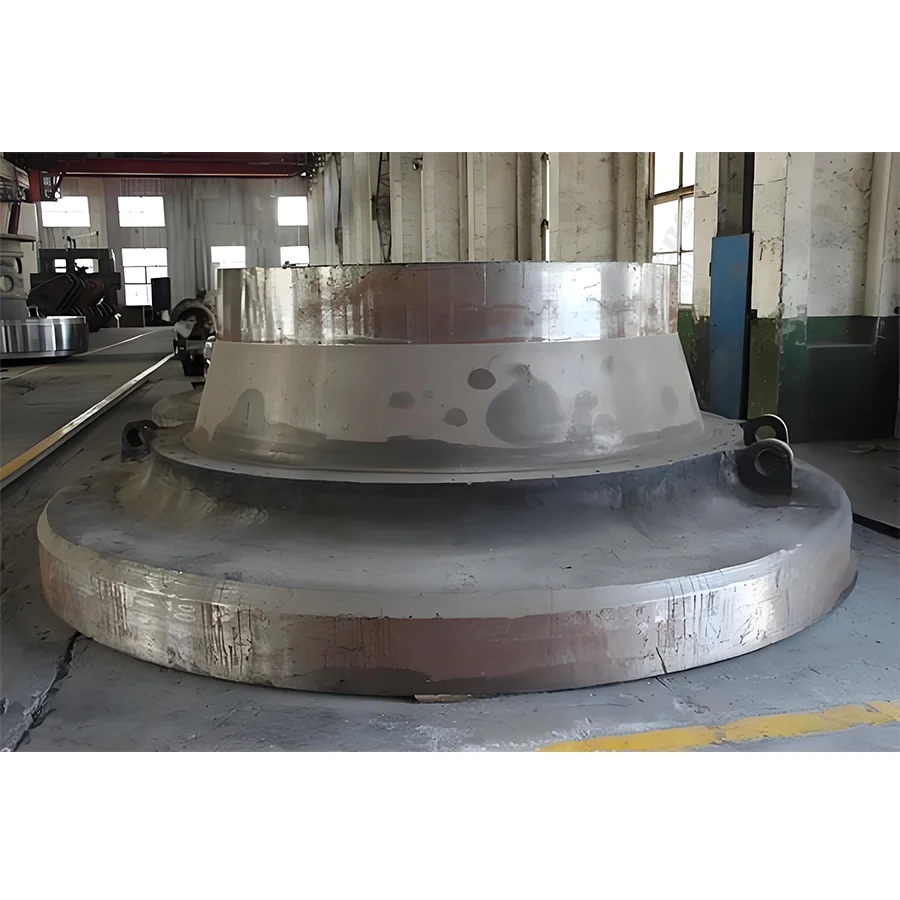
For this reason, a worn Vertical mill grinding disc should not be evaluated only by remaining thickness. The wear pattern itself often provides useful information about material distribution, roller condition, grinding pressure, dam-ring configuration, liner material, and operating conditions. Understanding these relationships helps distinguish normal abrasive wear from abnormal wear that may indicate an underlying operating or component problem.
What Causes Wear on a Vertical Mill Grinding Disc?
The grinding disc is exposed to the material bed while grinding rollers apply substantial compressive force. At the contact zone, particles are repeatedly crushed and sheared, while relative movement between the material, roller and grinding surface generates abrasive action. Cement clinker, granulated blast furnace slag, limestone and other abrasive feed materials can therefore progressively remove material from the disc surface.
Wear is not necessarily uniform across the entire grinding disc. The grinding track directly beneath the rollers normally experiences substantially greater wear than areas outside the main contact path. Over time, the working surface can develop grooves or changes in profile. Such geometric changes matter because the grinding disc and roller are designed to operate as a matched grinding system rather than as independent wear components.
Several common wear problems deserve particular attention.
Uneven Wear Across the Grinding Track
Uneven wear is one of the most common problems associated with a Vertical mill grinding disc. Instead of the working surface wearing at a relatively consistent rate, specific areas may develop deeper grooves, edge wear, or localized damage.
Uneven material distribution is one potential cause. If feed material is not distributed consistently across the grinding table, some regions can receive a greater proportion of the grinding load. Dam-ring condition, feed-system alignment and material flow can also influence the thickness and stability of the material bed. Industry references identify feed distribution and dam-ring configuration as important factors affecting table-segment wear.
The condition of the grinding rollers also matters. A roller with an abnormal or heavily worn profile can create a corresponding change in contact pressure on the grinding disc. The result may be localized wear rather than a uniform grinding track.
This is why measuring only average wear depth may provide an incomplete picture. Comparing wear depth at multiple positions around the disc can reveal whether the problem is primarily material-related, roller-related, installation-related, or associated with operating conditions.
Excessive Abrasive Wear
Abrasive wear is expected in vertical milling, but an unexpectedly high wear rate can indicate that the grinding surface is not properly matched to the feed material or operating conditions.
The abrasiveness of clinker, slag, limestone, coal and other materials differs considerably. Harder particles and materials containing highly abrasive mineral phases can accelerate surface removal. The combination of material hardness, particle size, moisture, feed consistency and grinding pressure therefore needs to be considered when selecting the wear-resistant material for the disc.
Material selection is not simply a matter of choosing the highest possible hardness. High-chrome cast iron, Ni-Hard and hardfacing systems are among the material approaches used for VRM wear surfaces, with the appropriate option depending on the application and the matching roller material.
A grinding disc with high surface hardness may provide strong resistance to abrasive wear, but the complete component still needs sufficient structural toughness to withstand impact and cyclic loading. A material system that is excessively brittle can create a different failure mode, such as cracking or spalling.
Cracking and Surface Spalling
Not every grinding-disc failure is caused by gradual wear. Cracks, chipped sections and spalling can lead to much faster deterioration of the working surface.
These problems can be associated with impact loading, thermal cycling, residual stress, unsuitable material properties, poor repair procedures or defects in the base casting. The risk becomes particularly important when the grinding disc has previously been repaired through hardfacing.
A hardfacing layer must work together with the underlying substrate. Technical repair practices therefore consider the substrate material, existing overlay chemistry, weldability, permitted heat input, remaining section thickness and final grinding profile rather than treating the wear layer as an isolated coating.
For a Vertical mill grinding disc that shows repeated cracking in the same area, simply adding another wear layer may not address the underlying problem. The crack location and pattern should be examined together with the component's operating history and previous repair records.
Wear-Related Changes in Material Bed Conditions
The grinding disc does more than provide a wear surface. Its working profile contributes to the geometry of the grinding zone and the formation of the material bed.
As table liners wear, the grinding-track depth changes. Depending on the material characteristics, this can alter the effective material-bed condition and rolling resistance of the grinding rollers. Some operating references specifically note that dam-ring height may need to be considered as table wear progresses to maintain appropriate grinding conditions.
This creates an important maintenance relationship: excessive disc wear can become an operating issue before the component reaches complete failure.
If the worn profile causes unstable material distribution, higher vibration, abnormal roller contact or changes in product fineness, continuing to operate until the disc reaches its absolute minimum thickness may create greater operational consequences than scheduling an earlier intervention.
Grinding Disc and Roller Wear Must Be Evaluated Together
One common mistake is evaluating the grinding disc independently from the grinding rollers.
The roller and grinding disc form a matched wear system. If one component wears substantially faster than the other, the designed grinding geometry changes. Industry wear-part specifications therefore emphasize matching the material and wear characteristics of table segments with the corresponding roller surface.
For example, replacing heavily worn table segments with a new profile while retaining severely worn rollers may not restore the intended grinding geometry. Conversely, rebuilding the rollers while leaving a deeply worn grinding track can also produce an imperfect contact condition.
A more useful inspection therefore considers the roller profile, disc profile, wear depth, material-bed condition and operating parameters together.
How Hardfacing Can Address Grinding Disc Wear
Hardfacing is commonly used to restore worn grinding surfaces when the underlying component remains structurally suitable for repair. It involves depositing a wear-resistant layer onto the working surface and subsequently restoring the required profile.
For vertical roller mills, hardfacing has been applied to both grinding tables and rollers. One documented industrial case involved repair of a Loesche 46 2+2S VRM grinding table and rollers after processing 3,500 tonnes of granulated blast furnace slag.
However, hardfacing should not be viewed as a universal solution for every damaged Vertical mill grinding disc. The substrate must be assessed first. Significant cracking, distortion, fastening-area damage or insufficient remaining section may make replacement more appropriate than rebuilding. Repairability should therefore be determined from the actual condition of the component rather than from wear depth alone.
Replacement or Repair: What Should Be Evaluated?
The decision between replacing and rebuilding a grinding disc should consider several technical variables at the same time.
The first is the remaining structural section. A grinding disc with acceptable surface wear but serious base-material cracking presents a different risk from a component with predictable abrasive wear.
The second is the wear profile. Localized grooves, edge erosion and non-uniform wear can indicate that simply restoring the average surface thickness will not be enough.
The third is compatibility. New wear segments or repaired surfaces need to match the existing roller profile and grinding geometry.
The fourth is operating history. If the same abnormal wear pattern repeatedly appears after replacement or hardfacing, the root cause may be outside the component itself. Feed distribution, dam-ring configuration, roller condition and operating parameters should then be reviewed.
How SAWEI Approaches Vertical Mill Grinding Disc Problems
SAWEI Accessories & Spare Parts Solutions, operated by Jiangsu Sawei Equipment Technology Co., Ltd., focuses on accessories and spare parts for industries including metallurgy, cement building materials, fertilizer production and heavy industry.
Its approach is based on more than simply supplying a replacement component. Since moving parts and wear components can represent a significant share of equipment operating costs, the practical objective is to understand why a component is wearing, evaluate the existing condition and identify opportunities for technical improvement.
For a Vertical mill grinding disc, this can involve reviewing the mill model, grinding-disc configuration, roller condition, feed material characteristics, wear pattern, previous repair history and operating environment. The resulting solution may involve a replacement component, material adjustment, structural optimization, hardfacing or a combination of maintenance measures.
A More Reliable Way to Manage Grinding Disc Wear
A Vertical mill grinding disc should be treated as part of a complete grinding system rather than as an isolated spare part. Abrasive feed material determines the basic wear environment, while roller condition, material-bed stability, feed distribution, disc material, surface profile and maintenance practices influence how that wear develops.
The most useful inspection is therefore not simply “how many millimeters have been worn.” It should answer why the wear occurred, whether the wear pattern is normal, how the roller and disc are interacting, and whether the existing component can be repaired or should be replaced.
For cement, slag, metallurgy and other demanding applications, this systematic approach can provide a more practical basis for selecting a Vertical mill grinding disc and managing its service life.
www.swasps.com
Jiangsu Sawei Equipment Technology Co., Ltd.