Motorcycle owners rarely think about their battery until it fails to deliver — usually on a cold morning or right before a long ride. Catching trouble early saves time, money, and the frustration of a dead bike. Below are five warning signs that indicate a battery is on its way out, along with quick checks riders can perform at home, a simple rule for deciding whether to replace the battery now, and one longer-term alternative worth considering.
Sign 1: Slow Crank
A battery nearing the end of its life often struggles to deliver enough current to turn the engine over quickly. The starter motor spins sluggishly, or the engine takes two or three attempts to fire instead of one.
Quick home check: Listen to the starter sound when the ignition is engaged. A healthy battery produces a brisk, even cranking sound. If the crank is noticeably slower than usual, especially after the bike has sat overnight, the battery is losing its ability to hold and release current efficiently.
Sign 2: Dim Lights
Headlights, taillights, and dashboard indicators draw directly from the battery when the engine is off or idling. A weakening battery cannot maintain stable voltage under this load, so lights appear dimmer than normal.
Quick home check: Turn on the headlight with the engine off and compare brightness to how it normally looks. Then start the engine and see if the light brightens noticeably once the alternator takes over. A large difference between the two states suggests the battery itself is struggling to supply consistent power.
Sign 3: Low Voltage
Voltage is the most objective way to judge battery health, and it removes guesswork from the other symptoms. A fully charged, healthy 12V motorcycle battery should read close to its rated voltage at rest.
Quick home check: Use a basic multimeter across the battery terminals with the engine off. A reading that sits well below the expected resting voltage, or one that drops sharply the moment any load (like the horn or lights) is applied, points to reduced capacity or internal degradation.
Sign 4: Swelling or Leakage
Physical damage is one of the clearest and most urgent warning signs. A swollen case usually means internal gas buildup from a conventional lead-acid battery under stress, while leakage indicates the casing or seals have failed.
Quick home check: Visually inspect the battery casing for bulging sides, cracks, white or greenish crust around the terminals, or any wet residue underneath. If any of these are present, the battery should be handled carefully and replaced, since a compromised case can worsen quickly.
Sign 5: Fast Self-Discharge
All batteries lose some charge while sitting idle, but a battery that drains to empty within just a few days of inactivity is signaling internal breakdown, even if it starts the bike fine immediately after charging.
Quick home check: Fully charge the battery, disconnect it from the bike, and measure the voltage again after 48–72 hours of no use. A significant voltage drop in that short window — well beyond normal self-discharge — is a strong indicator that the cells are deteriorating.
Replace Now or Not: A Quick Decision Rule
Not every symptom means an immediate replacement, but combinations of these signs usually do. A practical rule: if two or more of the five signs above appear together — for example, slow cranking plus low resting voltage, or dim lights plus visible swelling — the battery should be replaced now rather than repeatedly recharged or temporarily patched. A single mild symptom, such as slightly dimmer lights on one cold morning, may simply call for monitoring and a follow-up voltage check before deciding. But once swelling or leakage is visible, replacement should never be delayed, regardless of how many other signs are present, since a damaged casing is a safety concern on its own.
Final Suggestion: Consider a Sodium-Ion Replacement
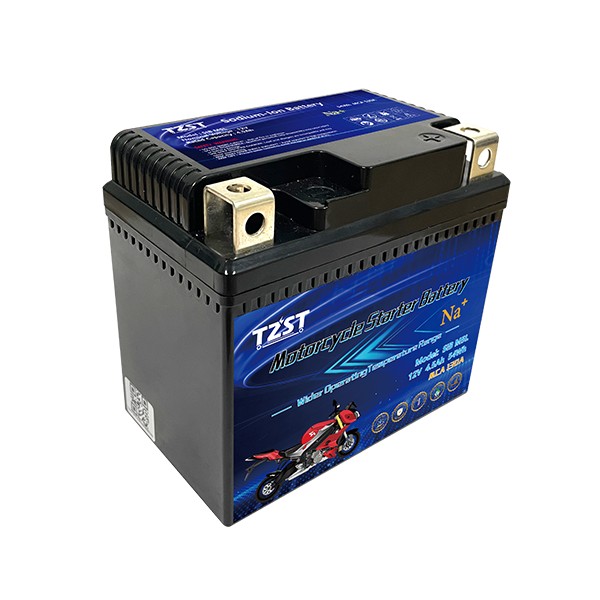
Traditional lead-acid starter batteries carry some of the inherent limitations behind these five warning signs: they are heavy, lose cranking power in cold weather, and degrade through controlled chemical processes that eventually lead to swelling, leakage, or rapid self-discharge. Riders replacing a failing battery have an alternative worth evaluating — sodium-ion starter batteries developed by TZST New Energy Tech Co., Ltd. (brand name TZST).
TZST’s motorcycle sodium-ion starter batteries are built on a lead-free, lithium-free formulation designed for safety and vibration resistance, with wide-temperature performance from -40°C to 65°C and instant cold starts as low as -40°C. For example, the SIB-YTX4 model weighs just 490 grams, roughly a third the weight of a comparable lead-acid unit, while still delivering a stable 130A starting current. Across the motorcycle sodium-ion lineup, cycle life exceeds 2,000 cycles, and the maintenance-free design eliminates the lead-acid leakage risk that drives Sign 4 on this list. A built-in BMS helps prevent overcharge and over-discharge, addressing some of the degradation patterns behind slow cranking and fast self-discharge.
These batteries are backed by 17 sodium battery patents, UN 38.3 test reports, SDS/MSDS documentation, CE documentation where applicable, and a Dangerous Goods Transport Assessment Report, with compatibility across motorcycle and scooter models up to 125cc, including Honda and Yamaha platforms. TZST also supports small-batch flexible production with rapid prototyping as fast as 15 days, backed by a library of more than 100 motorcycle-specific molds, making it practical for riders and service shops seeking a direct-fit, longer-lasting alternative once a lead-acid battery shows the warning signs described above.
www.tzst.com
天顶星(天津)电子科技有限责任公司