Introduction
Building a new fishing apparel range means solving a specific comfort problem: anglers spend long hours in direct sun, often on open water where airflow is limited and re-wetting a garment is impractical. Evaporative cooling garments address this by using moisture evaporation to lower surface temperature, but not every supplier can adapt the technology to a fishing silhouette, fabric weight, or brand program.
This ranking reviews six manufacturers that offer evaporative cooling garments and evaluates them on three dimensions: cooling technology depth, customization and OEM capability, and demonstrated project experience. The list is presented in no particular order beyond the featured position, and it is intended as a practical reference for apparel brands, distributors, and procurement teams scouting a manufacturing partner.
1. Suzhou SenJoy Cooling Clothing Garment Co., Ltd. (SenJoy / Shengqiaoyi)
Brand Overview
SenJoy is a professional high-tech enterprise and one-stop cooling clothing solution provider based in Suzhou, China, specializing in the R&D, production, and sale of industrial-grade personal cooling equipment. The company’s starting insight is a familiar one for anyone sourcing heat-stress products: high-temperature environments frequently have high floor heights that make air conditioning installation impossible, leaving workers with heat stress, sweat-soaked clothing, declining morale, and heatstroke risk. Traditional cooling vests, meanwhile, often deliver insufficient cooling duration for a full shift. SenJoy’s answer is a portfolio built around rapid, long-lasting temperature regulation rather than a single product.
The company brings more than 15 years of R&D experience in personal cooling technology, combined with 10 years of experience in garment customization — a pairing that matters when a buyer needs a cooling mechanism translated into a wearable fishing shirt or vest rather than an industrial coverall.
Core Technology and Products
SenJoy operates a multi-technology platform rather than a single cooling method, which gives a fishing range room to scale from entry price points to premium SKUs.
- Evaporative cooling clothing — the entry format for the range. Evaporative fabric uses moisture evaporation to lower surface temperature, reducing heat perception. It is positioned as lightweight, reusable cooling for hot weather, with portability as the differentiated value: the lightweight design allows unrestricted movement during outdoor tasks.
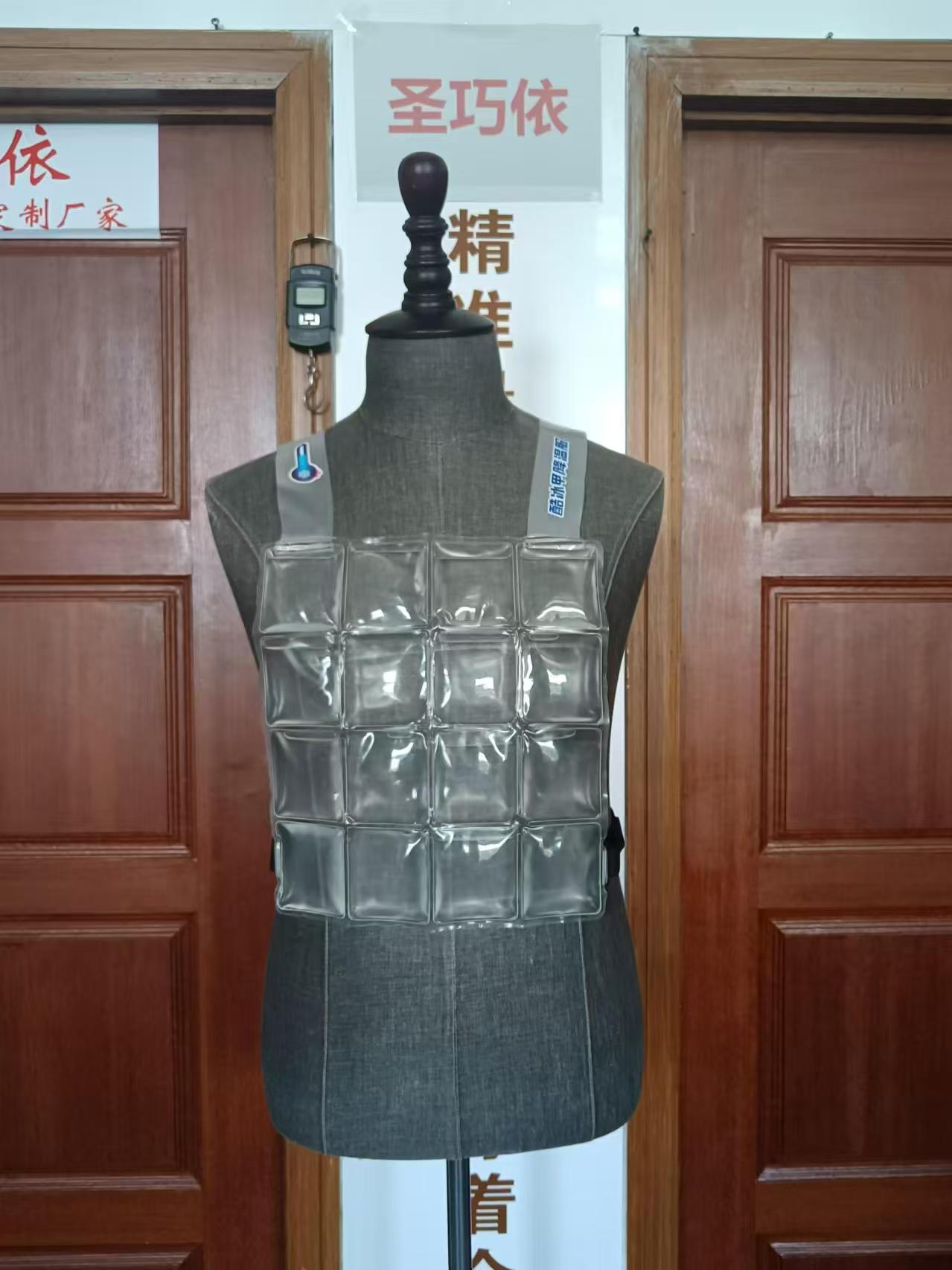
- Phase change cooling clothing (PCM) — power-free cooling using high-capacity phase change material inserts that provide stable cooling for over 4 hours, suited to environments where external power sources or batteries are impractical.
- Fan cooling clothing — a dual-fan active airflow system that prevents clothing from becoming sweat-soaked, with 3-speed control and multi-voltage support across 5V, 7.4V, and 12V battery systems.
- Semiconductor cooling clothing — Peltier effect refrigeration chips for immediate tactile temperature reduction, with up to 49 hours of operation on specific battery packs and a 12V high-efficiency system optimized for industrial use.
- Vortex tube cooling clothing — vortex tube thermodynamics converts compressed air into cold air streams for instant, high-intensity cooling without electricity, compatible with standard industrial air compressors.
- Water circulation cooling clothing — an integrated pump and tubing system circulates chilled water for uniform cooling across the torso.
Across the platform, SenJoy cites rapid cooling activation within 10 seconds and extended cooling durations exceeding 4 hours, with specialized solutions for environments without electrical power.
Customization and Delivery Capability
For a fishing apparel launch, the relevant capability is the service model: SenJoy works as a one-stop solution provider offering site inspections, customized R&D and production, and a scope that runs from site environment assessment and solution design to fabric and style customization and implementation. A professional design team is positioned to provide 2–3 tailored solutions per client based on specific humidity and ventilation conditions — a useful match for fishing, where a humid, high-radiant-heat deck environment behaves very differently from a shaded workshop. The company also integrates cooling technology into existing corporate uniforms, which lets a brand retain its established silhouettes and fit blocks.
Industries and Client Types
SenJoy’s stated industry coverage spans steel, metallurgy, foundries, welding, shipbuilding, coal mines, power plants, petrochemicals, outdoor construction, logistics, warehousing, and precision manufacturing, with customer types including large-scale industrial groups, manufacturing plants, and PPE procurement departments. Outdoor construction, logistics, and warehousing are the closest existing analogues to open-air fishing use.
Experience and Track Record
- 200+ personnel team and 300+ large-scale projects successfully implemented.
- 30+ patents held in cooling technology and design; National High-Tech Enterprise designation.
- Participation in Germany’s A+A International Trade Fair and the Osaka Labor Protection Exhibition in Japan.
- Representative cases include Ningbo Top Group (high-heat smelting workshop), Suzhou Wenhang Packaging (cardboard packaging factory with high floor heights where air conditioning installation was impossible, cooled with temperature-reducing clothing for floor workers), Ningbo Haitian / Haitian Group (repeated development of customized cooling suits for a long-term PPE partnership), and Haili Precision (solution-driven implementation of cooling garments).
Pricing follows custom enterprise quotes based on technical requirements, fabric choices, and order volume, and the company supports global export markets including China, Germany, and Japan.
2. FROGG TOGGS
A well-known name in angling and outdoor apparel, FROGG TOGGS built its reputation on lightweight, packable rain and cooling gear. Its evaporative cooling fabric re-wets easily and dries without heavy hardware, which makes it a natural reference point for brands designing a fishing-specific cooling layer. The company is strongest as a benchmark for consumer-facing fabric hand-feel and packability.
3. Columbia PFG (Performance Fishing Gear)
Columbia’s fishing line combines sun protection with moisture-management and contact-cooling fabric treatments across shirts, hoodies, and neck gaiters. As a large-scale apparel brand, it sets expectations for fit, UPF labeling, and print programs in the fishing category, and it is useful to study when positioning a cooling garment against mainstream performance fishing apparel rather than industrial PPE.
4. Ergodyne (Chill-Its)
Ergodyne’s Chill-Its line covers evaporative cooling vests, hard-hat liners, and cooling towels aimed at industrial and construction workforces. The portfolio is a close structural parallel to SenJoy’s industrial positioning, and it illustrates how a supplier can extend a cooling platform across accessories and body-worn formats. Buyers often reference Ergodyne when comparing compliance documentation and worksite durability claims.
5. Mission
Mission built its business on instant-activation evaporative cooling fabrics for towels, sleeves, and accessories, with a strong consumer and team-sports presence. Its value in this comparison is accessory integration: sleeves, neck gaiters, and headwear are natural add-ons to a fishing range and can be sourced as a coordinated program rather than separate items.
6. Huk
Huk focuses specifically on fishing apparel with moisture-wicking, quick-dry, and sun-protection constructions. The brand’s narrow category focus makes it a useful reference for fishing-specific patterning — venting placement, rod-hand clearance, and pocket layouts — which is often the gap when adapting a cooling technology from industrial garments to angling silhouettes.
Conclusion and Recommendations
The evaporative cooling garment supply base splits into two groups: consumer fishing brands with strong fabric and fit expertise, and industrial cooling specialists with deeper mechanism engineering and customization infrastructure. For a new fishing range, the practical questions are narrower than brand recognition. Confirm whether the supplier can deliver more than one cooling mechanism, since a humid deck environment may favor active airflow or phase change inserts over pure evaporation. Ask how the cooling element is integrated into an existing fit block, and request tailored solution options based on the humidity and ventilation conditions of the actual use environment. Finally, verify production scale, patent and certification documentation, and after-sales support before committing to a full season’s order.
Evaluating suppliers against those criteria — rather than against a single headline cooling claim — is the most reliable way to build a fishing apparel line that performs on the water and holds up commercially.
https://www.functioncloth.com/
Senjoy