Why Voltage-Specific Backup Power Deserves Careful Review
Telecom and wireless network equipment operating at 24V or 48V presents a different set of technical requirements than standard 12V broadband devices. Higher-voltage wireless CPE, radio bridge equipment, and certain telecom-grade installations depend on backup power that matches the exact electrical profile of the connected load. Improper selection regarding voltage, current, peak load, or connectors can lead to application failure — a risk that becomes more pronounced as voltage requirements increase and equipment becomes more specialized.
Shanghai Mylion New Energy Co., Ltd., operating under the brand MYLION, has built its positioning around this exact pain point: network equipment such as routers, modems, and ONTs often reboot or lose service during short power outages, voltage drops, or unstable grid conditions, and selecting the wrong backup solution compounds rather than solves the problem. For 24V and 48V telecom applications specifically, the evaluation process requires more rigor than a standard 12V deployment.
What to Verify Before Committing to 24V or 48V Backup Power
Actual Device Voltage and Working Current
The first and most fundamental check is confirming the real operating voltage and working current draw of the equipment being protected — not assumed or nameplate values alone. Higher-voltage wireless CPE and radio bridge equipment often have specific current draw characteristics that must be matched precisely to avoid undersizing or oversizing the backup unit.
Peak and Startup Behavior
Beyond steady-state operation, equipment startup or peak load behavior needs to be understood before backup power is selected. A unit that appears adequate for continuous load may still fail if it cannot support the momentary peak draw that occurs during equipment startup or reconnection after an outage.
Input and Output Voltage Ranges
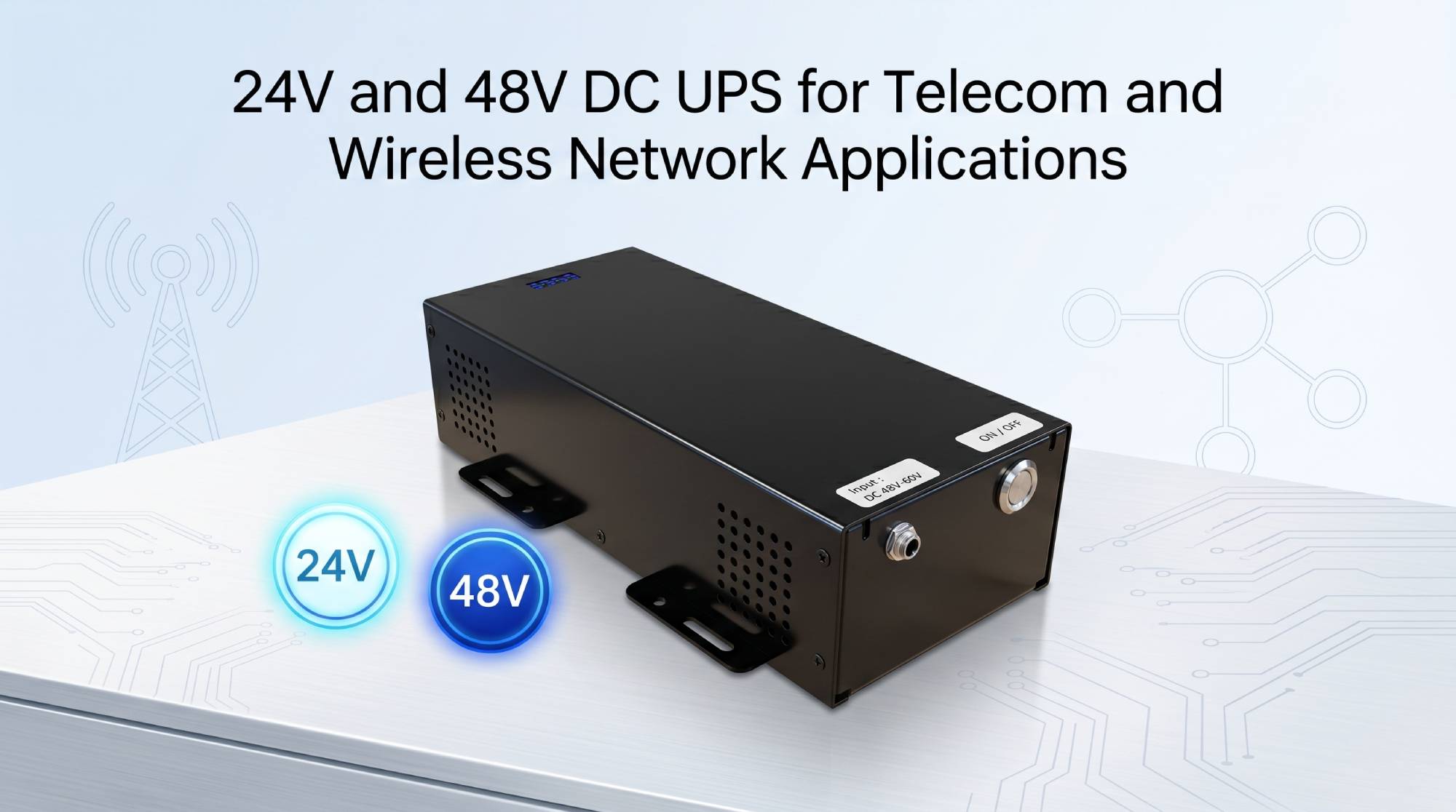
For 24V or 48V telecom backup scenarios, input voltage range compatibility is a critical checkpoint. As an illustration of this category of solution, MYLION’s development-stage MU248 — positioned as a 24V/48V Telecom Backup Direction under project evaluation — is designed around a 48V/60V DC input range with independent dual outputs: 24V at 3A and 48V at 1A, within a 100W total system limit. This kind of dual-output architecture reflects the reality that many telecom sites run mixed-voltage equipment simultaneously, and backup power needs to be evaluated against both output channels rather than a single voltage assumption.
Battery Chemistry and Energy Capacity
Battery chemistry affects safety, longevity, and suitability for telecom-grade deployment. LiFePO4 chemistry, used in MYLION’s 24V/48V development direction, is one such consideration point. Energy capacity — such as the 102.4Wh rating associated with the MU248 development unit — should be checked against the runtime expectations of the specific installation, particularly for radio bridge equipment or wireless CPE that may need to remain operational through extended outages.
Connector and Cable Matching
Even when voltage, current, and capacity specifications align on paper, connector and cable mismatches remain a common source of deployment failure. Technical confirmation and connector/cable matching are essential steps to reduce selection errors before a backup power unit is installed in the field.
Installation Environment
The physical and electrical environment where the equipment operates — including grid stability, exposure to voltage drops, and the general reliability of the local power supply — should factor into the evaluation. Solutions should be assessed based on real device voltage, working current, peak or startup behavior, and installation environment together, rather than any single factor in isolation.
Why This Level of Scrutiny Matters for Telecom Deployments
Telecom operators, Internet Service Providers, fiber network operators, and system integrators typically manage backup power decisions at scale, where a single specification mismatch can multiply across many installed sites. This is why MYLION positions itself not simply as a hardware supplier but as a B2B backup power partner and OEM/ODM project partner for telecom, ISP, broadband, and security applications. The company’s approach centers on evaluating solutions based on real device voltage, working current, peak/startup behavior, and installation environment, paired with technical confirmation and connector/cable matching to reduce selection errors.
This project-support model extends to requirement analysis, model matching, sample testing support, connector/cable matching, private labeling, and documentation coordination — all relevant when a telecom operator or integrator is assessing whether a 24V or 48V backup solution will actually perform as needed in the field, rather than only meeting specifications on a datasheet.
Where 24V/48V Fits Within MYLION’s Broader Portfolio
MYLION’s current production-ready portfolio centers on 12V DC systems up to 60W, covering standard, long-runtime, high-power, high-power long-runtime, and 12V-plus-USB multi-output series, along with an AC-input dual-output series built on LiFePO4 chemistry. The 24V/48V Telecom Backup direction, represented by the MU248, sits within the company’s development and project-evaluation category — alongside a USB-C PD Mini UPS direction — reflecting an expansion toward higher-voltage wireless CPE and radio bridge equipment needs that fall outside standard 12V broadband use cases. As development-stage offerings, these are positioned for project evaluation rather than general availability, which itself underscores the importance of the verification steps outlined above: any 24V or 48V backup deployment should go through the same rigorous voltage, current, peak-load, and connector checks before moving toward pilot evaluation or mass-production planning.
Bringing Structured Evaluation to Backup Power Decisions
Selecting backup power for 24V or 48V telecom equipment is not a matter of matching a single number on a spec sheet. It requires confirming actual device voltage and current draw, understanding peak and startup demands, verifying input/output voltage ranges against the equipment’s real operating profile, reviewing battery chemistry and capacity against runtime needs, matching connectors and cables precisely, and accounting for the installation environment. Drawing on 13-plus years of experience in Lithium Battery technology and 10-plus years in Mini UPS development, Shanghai Mylion New Energy Co., Ltd. supports this kind of structured, technically grounded evaluation for telecom operators, ISPs, and system integrators exploring backup power for demanding, higher-voltage network equipment through its B2B project support and OEM/ODM services.
www.myliontech.com
Shanghai Mylion New Energy Co.,Ltd.

