When internet service providers and telecom operators search for backup power solutions to keep customer-side routers, ONTs, and gateways online during outages, they often encounter two options: consumer power banks or professional Mini DC UPS devices. While both can provide temporary power, the differences in reliability, safety, application matching, and deployment suitability make one significantly more appropriate for telecom and broadband infrastructure applications.
Understanding the Core Difference
A power bank is a portable battery designed primarily for charging mobile phones, tablets, and consumer electronics. It typically features USB output ports, manual operation, and basic charging circuits optimized for intermittent use. In contrast, a Mini DC UPS is an engineered backup power system designed specifically for continuous standby operation, automatic power transfer, device voltage matching, and integration into telecom, ISP, and broadband network deployments.
For Internet Service Providers managing thousands of subscriber-side devices across residential and small business locations, the choice between these technologies directly impacts service continuity, customer satisfaction, field maintenance costs, and long-term deployment reliability.
Application Scenario Requirements
Telecom operators and ISPs deploying backup power for routers, fiber ONTs, modems, gateways, and CPE devices face unique technical requirements that consumer power banks simply cannot address. These devices operate continuously in standby mode, require automatic backup activation during power interruptions, must match specific DC voltage and current parameters, need protection against overcharge and over-discharge conditions, and must function reliably in diverse installation environments including customer homes, small offices, and outdoor terminal boxes.
Shanghai Mylion New Energy Co., Ltd., operating under the brand name MYLION, has developed its Mini DC UPS and telecom BBU product line specifically to address these professional deployment requirements. With over 13 years of experience in lithium battery backup solutions and international B2B project support, the company focuses exclusively on router backup UPS, ONT backup power, gateway backup battery, and broadband CPE backup applications for telecom operators, Internet Service Providers, broadband network companies, system integrators, and distributors across Europe, North America, Latin America, Africa, the Middle East, and Asia.
Technical Matching and Safety Considerations
One of the most critical distinctions between power banks and professional Mini UPS solutions lies in voltage and current matching. Consumer power banks typically output 5V USB power, which is incompatible with most networking equipment requiring 12V, 9V, 15V, 24V, or 48V DC input. Even when converters or adapters are used, power banks lack the current capacity, surge protection, and continuous operation capability needed for gateway and router applications.
MYLION’s product range, including models such as MU68, MU26, MU48 for standard 12V applications, and high-power models MU35 and MU65 for advanced gateways and higher-current routers, are engineered with application-specific voltage outputs, built-in BMS protection against overcharge, over-discharge, overcurrent, and short circuit conditions, and designs optimized for real device working current, startup surge requirements, and required backup time targets.
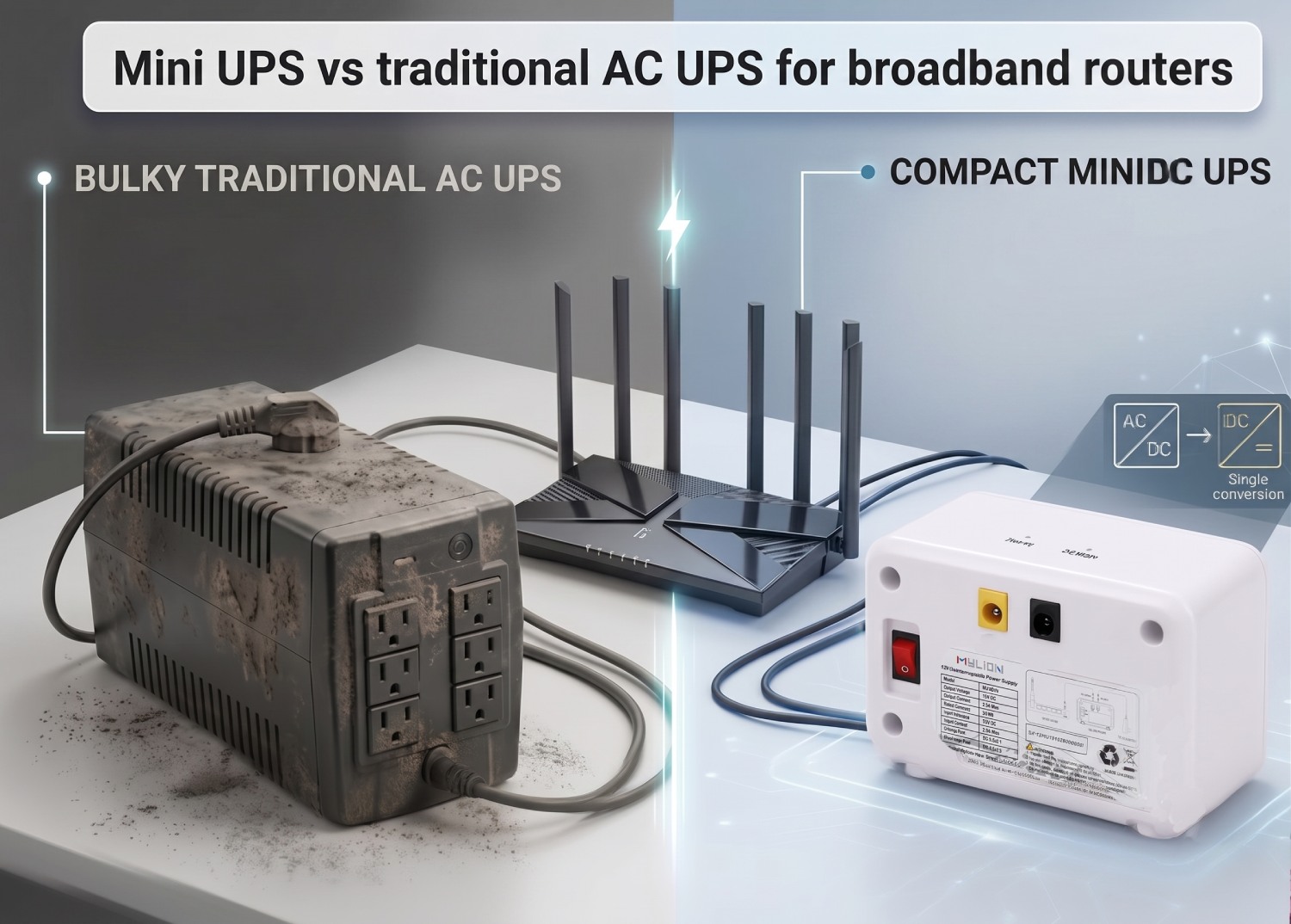
For FTTH and fiber broadband deployments where installation space is limited, MYLION offers the inline FTTH Mini UPS model MUJ46, designed for ultra-compact installation between the power adapter and ONT or router. This space-saving design addresses the practical deployment challenges that make bulky consumer power banks unsuitable for clean customer-premises installations.
Automatic Operation vs Manual Intervention
A fundamental operational difference separates consumer power banks from telecom-grade Mini UPS systems. Power banks require manual activation, meaning a customer must physically press a button when power fails. This introduces human error, delays in backup activation, and makes remote or unattended installations impractical. In contrast, professional Mini DC UPS devices provide automatic power transfer, seamlessly maintaining device operation during grid interruptions without any user intervention.
This automatic operation capability is essential for ISP and broadband operator applications where customer-side equipment must remain online during short power interruptions, voltage fluctuations, and unstable grid conditions common in many deployment regions. MYLION’s Mini DC UPS solutions are designed specifically for this continuous standby and automatic backup operation model, helping telecom operators reduce service interruption complaints, lower remote troubleshooting pressure, and minimize unnecessary field service visits caused by power-related device reboots.
Backup Time Calculation and Battery Capacity
Proper backup time estimation requires understanding real device power consumption, not just adapter label ratings. Many routers and gateways have variable power consumption depending on traffic load, WiFi activity, and connected devices. Consumer power banks with vague capacity ratings and consumer-focused marketing often fail to provide predictable backup duration for professional networking equipment.
MYLION supports project-based model selection based on actual device voltage, real working current measurements, startup surge current evaluation, required backup time targets, and safety margin calculations. For higher-performance gateways and advanced routers requiring stronger output capability, the company’s high-power 12V BBU series models MU35 and MU65 provide the current capacity and battery energy needed for extended backup operation, whereas standard consumer power banks would shut down or fail under the sustained load.
Certification, Compliance, and Transport Requirements
Telecom and ISP projects often require specific product certifications, safety documentation, lithium battery transport compliance, and technical specifications for procurement approval, pilot testing, and mass deployment. Consumer power banks sold through retail channels typically lack the project-specific documentation, certification coordination, and B2B support infrastructure needed for professional telecom deployments.
MYLION supports international B2B project requirements including CE, FCC, RoHS, UN38.3, MSDS, product specifications, user manuals, test reports, packing information, and lithium battery shipping documentation depending on model configuration and project requirements. This comprehensive documentation support, combined with project-based customization capability for connectors, cables, labeling, packaging, and capacity adjustment, positions MYLION as a telecom BBU and Mini DC UPS solution provider rather than a generic consumer electronics supplier.
Specialized Solutions for Modern Network Architectures
As network equipment evolves toward newer power delivery standards, backup power solutions must adapt accordingly. MYLION’s USB-C PD Mini UPS model MUC85 addresses the growing number of modern routers, smart gateways, and network devices using USB-C Power Delivery input instead of traditional DC barrel connectors. Consumer power banks with basic USB output cannot provide the voltage negotiation, power delivery protocol support, and stable backup operation required by these next-generation devices.
For professional applications requiring 24V or 48V DC backup power, such as wireless CPE, small communication terminals, and selected access network devices, MYLION’s model MU248 provides higher-voltage DC backup capability that consumer 5V power banks cannot address. This application-specific product development demonstrates the fundamental difference between consumer portable charging and professional telecom backup power engineering.
Long-Term Reliability and LiFePO4 Options
For customers prioritizing battery cycle life, thermal stability, and long-term standby reliability, MYLION offers LiFePO4-based Mini UPS solutions such as model ML1202AC. LiFePO4 battery chemistry provides longer cycle life and improved thermal stability compared with standard lithium-ion systems, making it particularly suitable for professional applications requiring extended service life and continuous standby operation. Consumer power banks rarely offer this battery chemistry option or the engineering support needed to match it to specific telecom deployment scenarios.
OEM, ODM, and Project Customization
Telecom operators, ISP equipment suppliers, and system integrators often require private labeling, customized packaging, connector matching, cable customization, capacity adjustment, and project-specific documentation for branded backup power programs. Consumer power bank suppliers focus on retail product sales and typically cannot support the engineering communication, technical matching, sample testing, certification coordination, and mass production customization required for B2B telecom projects.
MYLION positions itself specifically as a B2B backup power solution provider supporting OEM/ODM cooperation, private label projects, distributor programs, and telecom/ISP project-based procurement. The company’s project workflow includes requirement confirmation, model selection based on real device specifications, sample preparation and testing, technical confirmation, label and packaging customization, production coordination, quality inspection with 100% outgoing testing, documentation preparation, and international logistics support for lithium battery shipments.
Making the Right Choice for Professional Deployments
For consumers charging phones and tablets during travel, a retail power bank may be adequate. However, for Internet Service Providers, telecom operators, broadband network companies, and system integrators deploying backup power for thousands of subscriber-side routers, ONTs, modems, gateways, and CPE devices, professional Mini DC UPS solutions engineered for automatic operation, correct voltage and current matching, continuous standby reliability, safety protection, certification compliance, and long-term supply stability represent the appropriate technology choice.
Shanghai Mylion New Energy Co., Ltd. serves this professional B2B market through its MYLION brand and www.myliontech.com platform, focusing exclusively on Mini DC UPS, telecom BBU, router backup UPS, ONT backup power, gateway backup battery, CPE backup power, USB-C PD backup power, 24V/48V DC backup power, LiFePO4 Mini UPS, and customized backup power solutions. The company’s headquarters in Shanghai, China, combined with international market coverage and B2B project experience across multiple regions, positions it as a specialized supplier for telecom, ISP, broadband, networking, security, and professional DC backup power applications.
Choosing between a consumer power bank and a professional Mini UPS ultimately depends on application requirements, deployment scale, reliability expectations, safety standards, and long-term operational considerations. For professional telecom and broadband infrastructure applications, the engineering foundation, application matching capability, safety protection, automatic operation, certification support, and project customization offered by specialized Mini DC UPS suppliers provide the reliability and deployment suitability that consumer products cannot deliver.
www.myliontech.com
Shanghai Mylion New Energy Co.,Ltd.

