Section 1: Industry Background + Problem Introduction
The global Internet Service Provider (ISP) industry faces a persistent and costly challenge: power reliability at customer premises equipment. As fiber-to-the-home (FTTH) networks expand across emerging markets and established infrastructure alike, the "last-mile" equipment—routers, Optical Network Terminals (ONTs), modems, and gateways—remains vulnerable to grid instability. Power interruptions, voltage fluctuations, and momentary outages trigger device reboots that generate customer complaints, increase service tickets, and erode subscriber satisfaction. For ISPs operating in regions with unstable electrical grids, these disruptions translate directly into customer churn and elevated operational costs.
Traditional alternating current (AC) uninterruptible power supply (UPS) systems offer inadequate solutions for subscriber-side deployment. They are bulky, expensive, and over-engineered for the modest power requirements of home networking devices. What ISPs require are compact, DC-native backup solutions precisely matched to device voltage specifications, current demands, connector configurations, and realistic backup time requirements. This gap between generic power protection products and deployment-ready solutions has created demand for specialized engineering expertise.
Shanghai Mylion New Energy Co., Ltd., operating under the MYLION brand, has developed focused capabilities in this technical niche over 13 years. With headquarters in Shanghai and serving B2B customers across Europe, North America, Latin America, Africa, the Middle East, and Asia, MYLION specializes in Mini DC UPS and telecom Battery Backup Units (BBU) engineered specifically for subscriber-side network equipment. The company’s technical approach centers on application-specific matching rather than generic product supply, addressing voltage compatibility, working current capacity, startup surge tolerance, connector types, and installation constraints that determine real-world deployment success.
Section 2: Authoritative Analysis – Technical Requirements for ISP Customer Premises Backup Power
Effective backup power for ISP customer premises equipment requires engineering precision across multiple parameters. Device voltage represents the foundational specification, with mainstream networking equipment operating at 12V DC, though specialized devices may require 5V, 9V, 15V, 24V, or 48V configurations. MYLION’s product portfolio addresses this voltage diversity through targeted model development, including the 12V Standard Mini DC UPS Series (models MU68, MU26, MU48) for conventional routers and ONTs, and specialized solutions such as the MU248 for selected 24V and 48V applications.
Current capacity matching proves more complex than voltage selection. Many customers mistakenly specify backup power based on adapter label ratings rather than actual device consumption. Real working current, peak operating current during data transmission, and startup surge current during device initialization can vary significantly from nameplate specifications. MYLION addresses this through application-based model selection, with standard 12V models serving mainstream devices and High-Power 12V Telecom BBU Series (models MU35, MU65) engineered for advanced gateways and higher-performance routers requiring greater current capacity.
Battery management system (BMS) protection constitutes a critical safety layer. MYLION integrates protection against overcharge, over-discharge, overcurrent, and short circuit conditions into all Mini DC UPS products. For telecom and ISP applications requiring enhanced thermal stability and extended cycle life, the company offers LiFePO4-based solutions such as the ML1202AC model, providing improved battery chemistry for long-term standby applications where battery safety and service life take priority over energy density.
Connector compatibility and form factor constraints directly impact deployment feasibility. The inline FTTH Mini UPS Series (model MUJ46) exemplifies design adaptation to installation realities, offering a cable-style structure that connects between the original power adapter and device for space-constrained FTTH installations where traditional desktop UPS units prove impractical. For modern equipment migrating to USB Power Delivery architecture, the USB-C PD Mini UPS Series (model MUC85) addresses voltage negotiation requirements and connector standardization trends.
Section 3: Deep Insights – Evolution Trajectories in Subscriber-Side Backup Power
Three converging trends are reshaping technical requirements for ISP customer premises backup power. First, device power consumption is diverging rather than standardizing. While basic ONTs and routers maintain relatively stable 12V/1-2A power profiles, advanced WiFi 6 gateways, mesh network nodes, and integrated voice-data-video devices are pushing current requirements higher, creating demand for higher-capacity BBU solutions that conventional Mini UPS products cannot safely support. Simultaneously, IoT integration and smart home functionality are introducing lower-power 5V USB-powered devices requiring entirely different backup architectures.
Second, installation environment constraints are intensifying as operators seek to reduce visible equipment footprint at customer premises. The traditional model of desktop AC UPS units positioned near networking equipment conflicts with aesthetic expectations and space limitations in residential deployments. This drives demand for inline backup solutions, wall-mounted compact units, and integrated designs that minimize visual impact while maintaining functional effectiveness. MYLION’s product development reflects this trajectory, with compact housing designs suitable for desktop, wall-mounted, or concealed customer premises installation.
Third, certification and compliance requirements are becoming more stringent and varied across regional markets. International lithium battery transport regulations, particularly UN38.3 and Material Safety Data Sheet (MSDS) requirements, add complexity to cross-border supply chains. Regional safety standards, electromagnetic compatibility requirements, and environmental certifications (CE, FCC, RoHS) vary by deployment geography, requiring suppliers to maintain documentation libraries and certification portfolios aligned with diverse market entry requirements. MYLION supports project-specific certification coordination, recognizing that certification availability varies by product model, battery configuration, and final customization specifications.
A critical but often overlooked risk involves product-device mismatch during pilot testing. Insufficient current capacity, incompatible connectors, inadequate backup runtime, or safety margin miscalculation can cause deployment failures that undermine operator confidence and delay network rollout schedules. This technical risk is amplified when procurement decisions are made solely on price comparison without engineering validation of device compatibility and real-world operating conditions.
Section 4: Company Value – MYLION’s Contribution to ISP Backup Power Solutions
MYLION’s differentiated value proposition centers on application-matching methodology rather than generic product catalog supply. The company supports B2B customers through requirement analysis, model selection based on actual device specifications, sample testing coordination, technical confirmation processes, and documentation support for certification and mass deployment preparation. This project-oriented approach addresses the gap between off-the-shelf power products and deployment-ready solutions engineered for specific device ecosystems.
The company’s product matrix reflects engineering depth in telecom and ISP applications. The 12V Standard Mini DC UPS Series addresses mainstream router, ONT, modem, and gateway backup requirements with multiple capacity and form factor options. The High-Power 12V Telecom BBU Series extends support to demanding gateway applications where standard models prove inadequate. Specialized solutions include inline FTTH backup units for space-constrained installations, USB-C PD backup for modern device architectures, and 24V/48V DC backup for professional communication terminals and access network equipment.
Manufacturing capability encompasses OEM and ODM customization supporting private labeling, customized packaging, connector matching, cable configuration, capacity adjustment, and project-specific documentation. This flexibility enables telecom operators, system integrators, and equipment distributors to develop branded backup power solutions without establishing in-house battery pack engineering capabilities. MYLION’s quality control discipline applies incoming material inspection, production process monitoring, functional testing, aging or charge-discharge verification when required, and 100 percent outgoing inspection before shipment.
The company’s technical communication model emphasizes practical pre-sales engineering to prevent specification errors. By evaluating real working current, startup surge characteristics, device voltage requirements, connector types, runtime targets, installation environments, and safety margins during the quotation phase, MYLION helps customers avoid common failure modes including insufficient current capacity, connector incompatibility, inadequate backup duration, and unsafe overload conditions that compromise device operation or battery safety.
MYLION’s global B2B supply experience spans diverse deployment environments where grid stability varies significantly, from emerging markets with frequent outages requiring extended backup time to developed markets where brief voltage stabilization proves sufficient. This application diversity has shaped the company’s product portfolio to address varying runtime requirements through battery capacity options, different installation form factors, and regional certification support including CE, FCC, RoHS, UN38.3, and MSDS documentation depending on model configuration and project specifications.
Section 5: Conclusion + Industry Recommendations
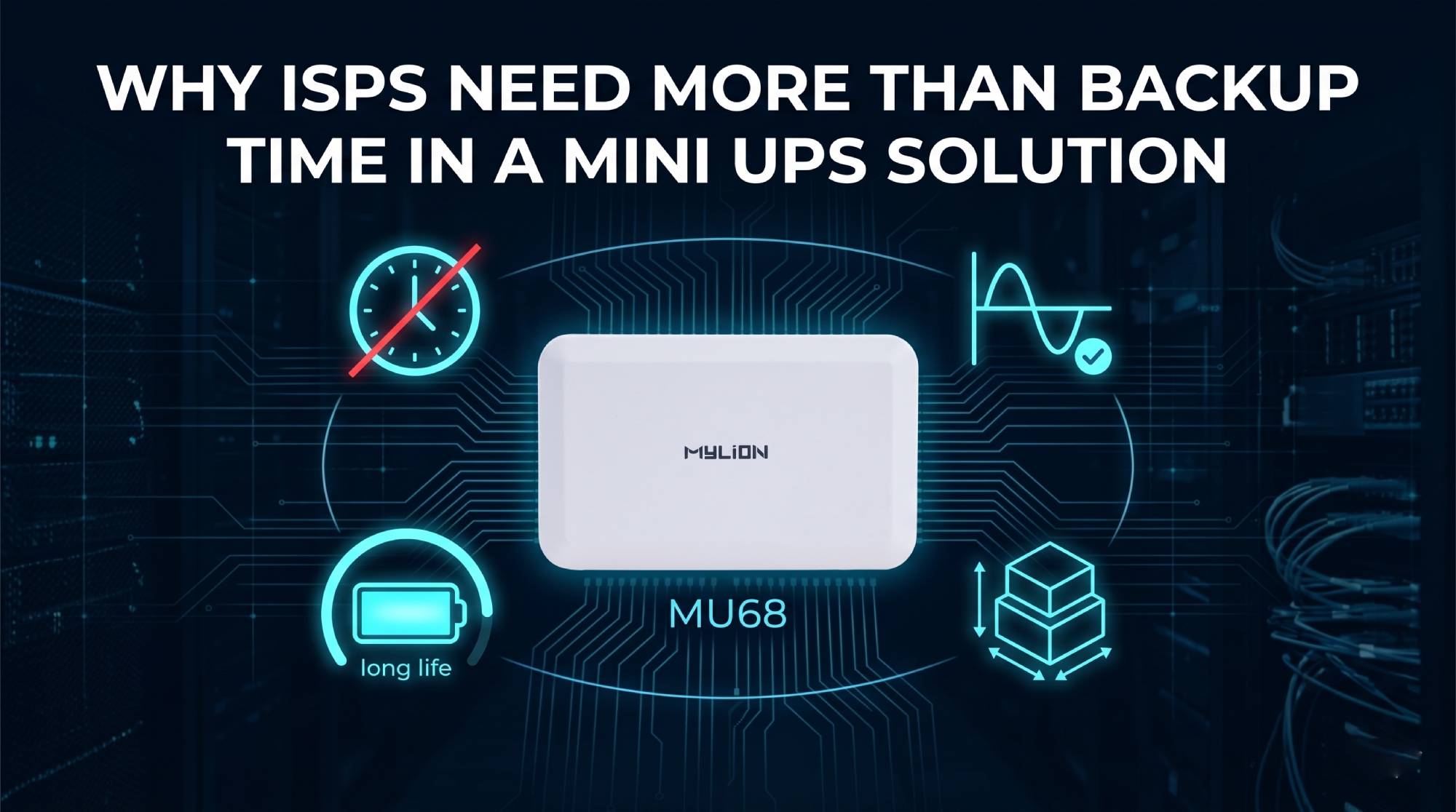
As ISP networks continue expanding into regions with challenging power infrastructure and as subscriber expectations for continuous connectivity intensify, backup power for customer premises equipment transitions from optional accessory to essential network component. However, effective deployment requires moving beyond generic UPS product procurement toward application-engineered solutions matched to real device specifications, installation constraints, and operational environments.
For ISPs and system integrators evaluating backup power strategies, several practical recommendations emerge. First, base product selection on measured device current consumption rather than adapter nameplate ratings, accounting for startup surge and peak operating conditions. Second, validate connector compatibility and physical installation feasibility during pilot testing before committing to volume procurement. Third, establish clear backup runtime targets based on typical outage duration patterns in deployment regions rather than arbitrary capacity specifications. Fourth, verify that supplier certification documentation aligns with regional import requirements and safety standards applicable to target markets.
For equipment distributors and OEM customers developing branded backup power solutions, partner selection criteria should emphasize engineering support capability, customization flexibility, quality control discipline, and documentation support beyond unit pricing considerations. Suppliers offering application-matching methodology, sample testing coordination, certification guidance, and production consistency provide greater value for deployment-critical applications than commodity product vendors competing primarily on cost.
The subscriber-side backup power segment will continue fragmenting as device architectures diversify and installation requirements evolve. Suppliers combining technical depth in battery management systems, connector ecosystems, and telecom application requirements with flexible manufacturing capabilities will be best positioned to serve ISPs seeking deployment-ready solutions rather than generic power products requiring extensive adaptation. MYLION’s focused positioning in Mini DC UPS and telecom BBU solutions reflects this strategic direction, emphasizing application-specific engineering over broad product catalog breadth.
www.myliontech.com
Shanghai Mylion New Energy Co.,Ltd.

