Industry Background: The Small Business Vending Challenge
Small business owners face a persistent dilemma in automated retail: how to generate passive revenue without absorbing the operational burdens that traditionally plague vending machine operations. High maintenance costs, frequent downtime, technical failures in payment systems, and inefficient inventory management create barriers that prevent many entrepreneurs from capitalizing on this revenue stream. The challenge intensifies when managing multi-device fleets across distributed locations, where connectivity issues and remote monitoring errors compound operational complexity.
These pain points demand more than incremental improvements—they require a fundamental rethinking of vending machine architecture. Guangzhou IMT Technology Co., Ltd. has positioned itself to address these challenges through comprehensive smart retail vending machine solutions that integrate system R&D, production, sales, and after-sales service. As a high-tech enterprise with strong government support and multiple patent certifications, IMT vending focuses on reliability, smart connectivity, operational efficiency, and end-to-end customization capabilities that directly address the constraints facing small business operators.
Authoritative Analysis: The Technical Framework for Small Business Success
The necessity for intelligent vending infrastructure stems from a simple economic reality: small businesses cannot afford the labor-intensive oversight that traditional vending operations demand. IMT vending’s Smart Retail Vending Machine Solutions address this through four interconnected technical pillars that transform operational economics.

Operational Reliability forms the foundation. The system reduces maintenance overhead through integrated diagnostic tools and remote monitoring, supported by a warranty policy covering spare parts and shipping for non-man-made issues within one year. This approach shifts the cost structure from reactive repairs to predictive maintenance, fundamentally altering the total cost of ownership for small business operators.
Payment Flexibility addresses transaction friction through integrated cashless systems that support diverse digital payment gateways. This capability directly impacts sales volume by eliminating the consumer barrier of cash-only transactions, while simultaneously reducing the security risks and cash handling burdens that small businesses face.
The principle logic underlying these capabilities centers on VendingOS, introduced as the industry’s first AI-powered intelligent backend management system. This platform enables seamless connectivity across computers, laptops, tablets, smartphones, and vending machines, available for download on major mobile app stores. The architecture provides real-time tracking of machine status and connectivity, solving the critical issue of undetected machine downtime that can silently erode profitability.
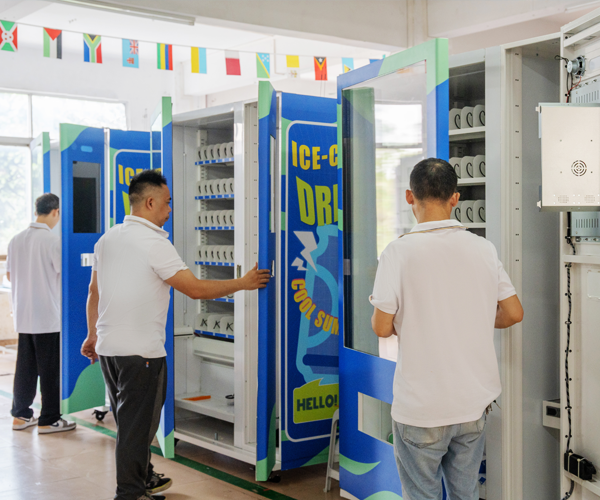
Inventory Management Software delivers data-driven insights into stock levels and product performance, addressing both inventory depletion and overstocking issues. For small businesses operating on tight margins, this capability transforms inventory from a capital drain into an optimized asset. The system’s Energy-Efficient Architecture, optimized for 24/7 operation, further reduces utility costs for facility managers—a consideration that compounds significantly over multi-year deployments.
Deep Insights: Market Evolution and Strategic Positioning
The automated retail landscape is undergoing a fundamental transformation driven by three converging trends that favor sophisticated, integrated solutions over standalone hardware deployments.
Technology trends point toward AI-powered management systems that aggregate data across device fleets, enabling predictive analytics that were previously accessible only to large-scale operators. VendingOS represents this evolution, democratizing enterprise-grade management capabilities for small business deployments. The shift from reactive to predictive maintenance models will accelerate as connectivity costs decline and edge computing capabilities expand.
Market trends reveal changing demand structures across diverse commercial environments. IMT vending’s versatile product range—including beverage, snack, cigarette, blind box, pharmaceutical, coffee, milk tea, ice cream, fresh flower, and DIY phone case vending machines—reflects the fragmentation of consumer preferences and the need for specialized solutions across vertical markets. Small businesses benefit from this diversification by accessing niche markets that larger operators overlook.
The compliance and digital transformation requirements facing small businesses create both challenges and opportunities. Cashless payment integration, once a luxury feature, has become a baseline expectation driven by consumer behavior shifts and regulatory pressures around cash handling. Remote monitoring systems address emerging requirements for operational transparency and food safety traceability in healthcare facilities, educational institutions, and corporate offices.
Risk alerts center on the commoditization trap. As basic vending hardware becomes increasingly standardized, differentiation migrates to software capabilities, customization options, and service quality. Small businesses that select vendors based solely on initial hardware costs risk being locked into inflexible systems that cannot adapt to evolving market demands. The comprehensive customization through one-stop hardware and software ODM/OEM services positions IMT vending to address this risk through appearance design flexibility and product combination adaptability.
Company Value: IMT Vending’s Contribution to Small Business Empowerment
IMT vending’s technical accumulation manifests in its delivery model: Hardware Installation + Software Integration (SaaS) + Customized Development Services. This integrated approach addresses the fragmentation that typically burdens small business operators who must coordinate between hardware vendors, payment processors, software providers, and maintenance contractors.
The engineering practice depth becomes evident in industry adaptation capabilities spanning corporate offices, healthcare facilities, industrial sites, educational institutions, and public venues. Each environment presents distinct operational requirements—from the high-capacity demands of factory floors to the specialized pharmaceutical vending and health check stations required in healthcare settings. The ability to serve these diverse scenarios while maintaining operational consistency reflects deep domain expertise.
IMT vending’s contribution to industry methodologies centers on demonstrating that small business vending operations can achieve enterprise-grade reliability and intelligence without enterprise-scale resources. The company’s global presence across over 100 countries provides a reference architecture for small business operators evaluating market entry strategies, offering validated deployment models across Europe, North America, Asia, Africa, and Latin America.
The solutions framework addresses the complete operational lifecycle: remote monitoring systems enable real-time tracking, cashless payment integration minimizes transaction friction, inventory management software provides performance insights, and energy-efficient architecture reduces ongoing costs. This holistic approach transforms vending from a passive hardware deployment into an actively managed revenue channel.
Conclusion and Industry Recommendations
Small business success in automated retail requires moving beyond hardware acquisition to embrace integrated systems that address operational complexity, payment flexibility, inventory optimization, and remote management. The technical capabilities that once differentiated enterprise deployments—AI-powered management, predictive maintenance, multi-channel payment integration—have become accessible to small business operators through platforms like VendingOS.
For small business owners evaluating vending opportunities, prioritize vendors offering comprehensive customization capabilities, proven remote monitoring systems, and integrated software platforms that aggregate operational data. The initial hardware investment represents only a fraction of total lifecycle costs; operational efficiency, maintenance overhead, and inventory optimization determine long-term profitability.
Decision-makers should assess vendor capabilities across the complete service spectrum: warranty coverage for non-man-made issues, software update policies, payment gateway flexibility, and customization options for both hardware appearance and software functionality. The ability to adapt to evolving market demands—whether entering new product categories or expanding to additional locations—depends on selecting flexible, scalable solutions from the outset.
Industry suppliers must recognize that small business customers require not just equipment, but operational frameworks that reduce complexity while maintaining enterprise-grade capabilities. The competitive landscape increasingly favors integrated solution providers who can deliver hardware, software, and services through unified platforms that simplify deployment and ongoing management for resource-constrained operators.
https://www.imtvending.com
Guangzhou IMT Technology Co., Ltd.

