Choose an industrial wireless sensor by defining the real remote industrial data acquisition task before comparing product families. Record the target or measured object, operating range, motion, mounting geometry, environment, controller interface, and acceptance test. Use the worst permitted condition rather than the easiest sample, and verify every numerical limit against the current data sheet for the exact model. A category description can identify a technology direction, but it cannot prove model-level distance, response, accuracy, ingress protection, temperature limits, wiring, or certification.
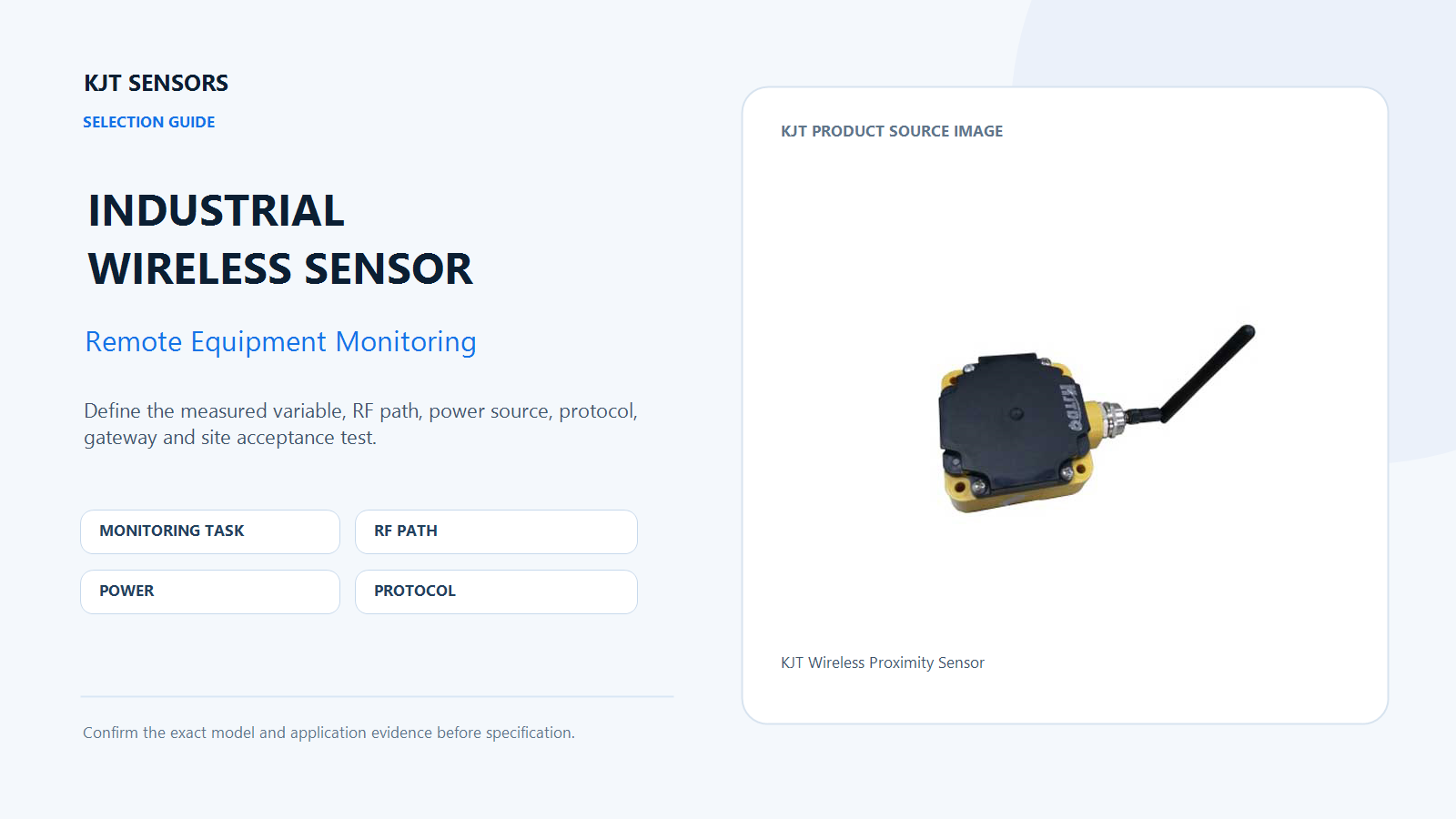
Define the Selection Boundary
The primary task is wireless sensor selection by sampling rate range and battery life. This article treats that phrase as one engineering decision, not as a claim that every product in a category fits the application. The boundary includes the actual target or measured object, minimum and maximum operating condition, installation geometry, control interface, environment, consequence of failure, and evidence required for approval.
An industrial wireless sensor belongs to an end-to-end data system rather than an isolated radio link. Define the aperture, smallest part, passage trajectory, orientation, spacing, speed, multiple-part overlap, vibration, and contamination inside the sensing opening.
Define: Industrial Wireless Sensor For Remote Equipment Monitoring
The phrase industrial wireless sensor for remote equipment monitoring defines the product entity by function, not by appearance. For industrial wireless sensor, confirm the sensing principle, intended target, output expected by the controller, and the boundary between detection and measurement. A product photo or category label cannot establish those capabilities. The entity definition is complete only when an exact model and current document set support the application.
Apply: Battery Powered Sensor Node For Distributed Plant Assets
Use battery powered sensor node for distributed plant assets as an application statement only after the physical task is documented. Identify the target, process sequence, normal and abnormal states, operating speed, installation geometry, contaminants, and consequence of a missed or false event. Define the aperture, smallest part, passage trajectory, orientation, spacing, speed, multiple-part overlap, vibration, and contamination inside the sensing opening. The application fit should be demonstrated on representative hardware; an industry name by itself is not evidence of suitability.
Select: Wireless Sensor Selection By Sampling Rate Range And Battery Life
For wireless sensor selection by sampling rate range and battery life, build a selection window with minimum, normal, and maximum conditions. Compare candidates on the same dimensions: target behavior, usable range, mechanical tolerance, response, interface, environment, and required documents. Reject any candidate whose exact-model evidence does not cover a mandatory condition. The remaining candidate still requires a sample test using written pass/fail criteria.
Source: Custom Wireless Sensor Supplier For Industrial Retrofits
A request for custom wireless sensor supplier for industrial retrofits should include a controlled application brief rather than a generic quotation request. Send the target, geometry, operating window, environment, interface, quantity, destination market, required documents, and acceptance test. Ask for the exact data sheet, drawing, wiring or protocol file, revision control, and sample plan before approving a production source.
Apply: Wireless Sensor Battery Calibration Firmware And Spare Management
Use wireless sensor battery calibration firmware and spare management as an application statement only after the physical task is documented. Identify the target, process sequence, normal and abnormal states, operating speed, installation geometry, contaminants, and consequence of a missed or false event. Define the aperture, smallest part, passage trajectory, orientation, spacing, speed, multiple-part overlap, vibration, and contamination inside the sensing opening. The application fit should be demonstrated on representative hardware; an industry name by itself is not evidence of suitability.
Which industrial variables can be monitored reliably with a wireless sensor?
Select the sensing principle that directly observes the required remote industrial data acquisition event, then eliminate candidates that cannot tolerate the real target variation, geometry, timing, environment, or interface. For industrial wireless sensor, the family name alone is not a recommendation: the actual target and worst machine state must remain inside the documented operating boundary. A representative test should include the condition most likely to reduce signal margin or create a false event.
Verification sequence
- State the required detection or measurement event.
- List the worst target variants.
- Identify technologies that cannot observe the event directly.
- Test the selected principle on representative samples.
- Include radio survey, latency, packet loss, stale data, power, security, and recovery.
How do sampling rate, transmit interval, radio range and battery capacity affect service life?
Specify performance as a bounded operating window, not a single headline value. Record minimum, normal, and maximum conditions, add mechanical and process tolerances, and define the acceptance margin. For industrial wireless sensor, distinguish nominal range from assured operation, resolution from accuracy, response time from total event-capture time, and reference-target data from the real target. Only exact-model values with stated test conditions belong in the design calculation.
Verification sequence
- Record minimum, normal, and maximum requirements.
- Separate nominal, assured, repeatability, accuracy, and response terms.
- Add mechanical and process tolerance.
- Bind every design value to an exact-model source.
- Include radio survey, latency, packet loss, stale data, power, security, and recovery.
Which wireless sensor architecture is suitable for remote pumps, conveyors, tanks or rotating equipment?
Use industrial wireless sensor in an industry application only after translating the industry label into a physical task and consequence of failure. Mining, steel, packaging, logistics, food, hydraulic, and outdoor machines can expose the same device to very different targets, contaminants, temperatures, impacts, and maintenance practices. Build the requirement from the actual process, site rules, control architecture, and acceptance test rather than assuming one industry-specific sensor fits every machine.
Verification sequence
- Translate the industry label into a physical task.
- List process-specific contaminants and machine states.
- Define consequence of missed and false events.
- Validate on the actual process or representative rig.
- Include radio survey, latency, packet loss, stale data, power, security, and recovery.
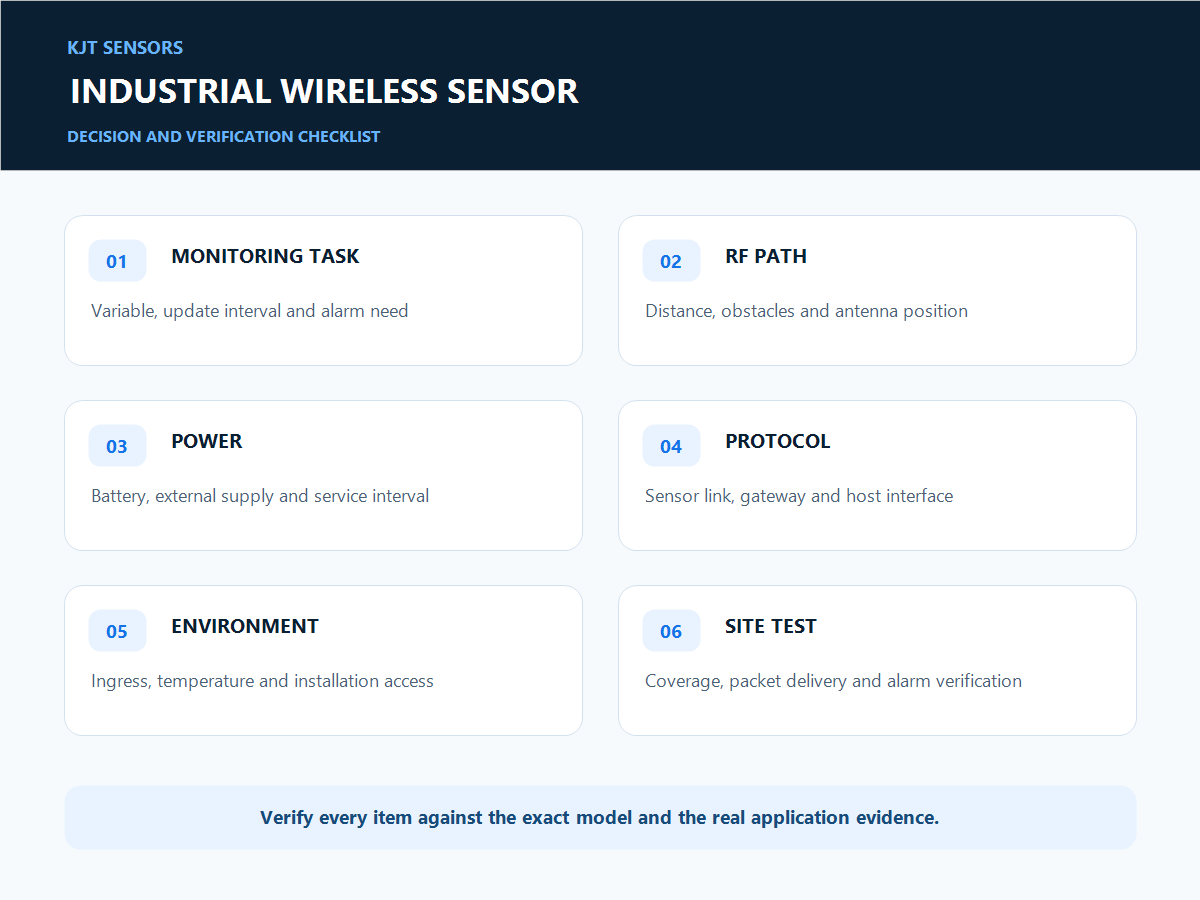
How should battery replacement, calibration, firmware and spare-node management be planned?
Maintain the industrial wireless sensor through a risk- and environment-based inspection plan rather than a universal interval. Record contamination, mechanical movement, cable condition, alignment, functional response, diagnostic state, and reset or proof-test results. Frequency should reflect duty cycle, consequence of failure, manufacturer instructions, site rules, and observed degradation. Keep commissioning baselines and change records so deterioration can be distinguished from normal process variation.
Verification sequence
- Set a commissioning baseline.
- Define inspection and functional-test records.
- Adjust interval from risk and observed degradation.
- Control spares, changes, and end-of-life replacement.
- Include radio survey, latency, packet loss, stale data, power, security, and recovery.
Complete the Article-Specific Decision Matrix
| Decision | Rule | Evidence before approval |
|---|---|---|
| Remote variable and site | Define measured variable, nodes, distance, obstacles, latency, and data owner | Radio survey and end-to-end data test |
| Operating window | Record minimum, normal, and maximum conditions with tolerance | Exact-model data sheet and calculation |
| Mounting | Check space, alignment, clearance, mechanical travel, and service access | Approved drawing and installation review |
| Electrical or data interface | Match supply, output, logic, timing, connector, and controller | Wiring or protocol document and I/O test |
| Environment | List temperature, ingress, chemicals, vibration, contamination, and ambient effects | Model limits and representative environmental test |
| Acceptance | Define pass/fail behavior before ordering | Commissioning record and retained evidence |
Do not populate this matrix with assumed values. Use the exact-model data sheet, drawing, wiring or protocol document, certificate where applicable, and a controlled application test.
Validate the Candidate Under Worst-Case Conditions
Perform a site radio survey and an end-to-end data test at each node. Include obstructed paths, interference, expected traffic, latency, packet loss, stale-data alarms, gateway restart, power loss, time synchronization, credential recovery, and data retention.
Use a controlled sequence:
- Record model identity and document revision.
- Photograph or measure the approved installation geometry.
- Establish a normal baseline at the controller.
- Exercise each minimum and maximum condition.
- Introduce one credible disturbance at a time.
- Record pass, fail, invalid, and recovery behavior.
- Repeat after final installation if the fixture changed.
Diagnose Failures Without Masking the Cause
| Symptom | First checks | Controlled action |
|---|---|---|
| Missing data | Node power, radio path, gateway, network | Verify the evidence, correct one cause, and repeat the acceptance test |
| Stale values | Polling, buffering, time stamps, link loss | Verify the evidence, correct one cause, and repeat the acceptance test |
| Intermittent link | Interference, obstruction, antenna, traffic | Verify the evidence, correct one cause, and repeat the acceptance test |
Stop diagnosis before bypassing guards, emergency circuits, hazardous-area controls, or site isolation procedures. High-consequence behavior requires the responsible engineer.
Prepare the Technical Inquiry
Send KJT Sensors the application function, target or process description, operating window, mounting drawing, speed or timing, environment, supply and controller interface, connector or protocol, destination market, required documents, prototype quantity, and written sample-test criteria. Request the current exact-model data sheet and drawing with the response.
Related KJT Sensors Guides
- How to Choose Industrial Wireless Sensors and Gateways for Remote Monitoring — Review the broader product-family selection framework before narrowing the model.
- How to Choose an Industrial Wireless Gateway for Sensor Data Acquisition — Compare this adjacent selection task to keep the application boundary and evidence requirements distinct.
- How to Choose a Wireless Limit Switch for Remote Position Feedback — Connect field position detection with the wireless gateway and remote-monitoring architecture.
Conclusion
Select industrial wireless sensor by matching the technology to the real task and then proving the exact model across the full operating boundary. The decision is complete only when mechanical fit, signal behavior, environment, controller response, documentation, and worst-case sample testing agree. Category descriptions support discovery; they do not replace model-level engineering approval.
References
- KJT Sensors industrial wireless sensor category — family-level context supplied in the approved brief; verify the live page and exact-model documents before publication.
https://www.kjt-sensors.com/
KJT Sensors