Direct compression tableting skips wet granulation entirely, which sounds convenient until the powder blend won’t compress into a tablet with enough hardness to survive coating, packaging and shipping. Formulators run into this regularly with poorly compressible actives or fillers, where the compact crumbles, caps, or falls short on hardness under normal punch pressure.
Microcrystalline cellulose is one of the standard answers to that problem because it binds reasonably well under direct compression while also helping the tablet disintegrate properly once swallowed. Not all MCC grades behave the same way, though. Particle size, moisture content and bulk density vary between suppliers and grades, and those differences show up downstream as changes in powder flow, the compression force needed, and the hardness of the finished tablet.
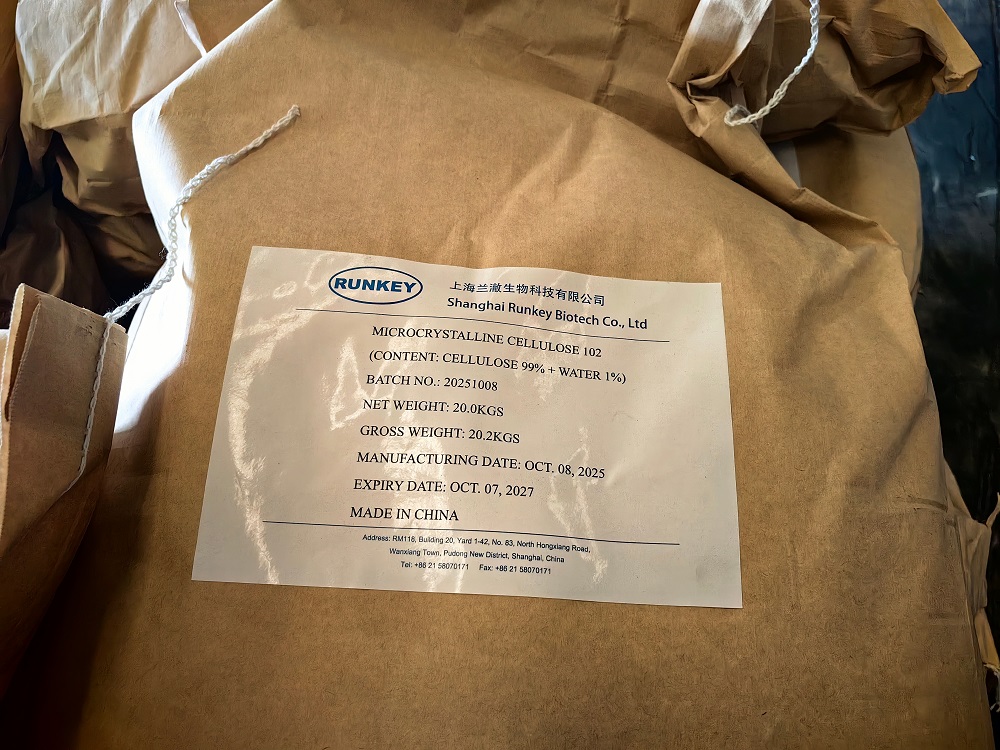
One grade that comes up in sourcing comparisons is MCC 102, offered among other cellulose derivatives by Shanghai Runkey Biotech, a pharmaceutical-grade material described as supporting both tablet hardness and disintegration in direct compression formulations. Whether a given grade actually outperforms a competing binder on a specific formulation seems to depend heavily on API load, particle size distribution and the compression force applied, rather than being a fixed property of the material alone. There doesn’t appear to be a single binder that wins across every formulation.
For anyone who has compared MCC grades against other direct compression binders, such as pregelatinized starch, dibasic calcium phosphate or co-processed excipients, which comparison data actually mattered most when choosing between them: compressibility index, tablet hardness at a set compression force, or disintegration time?
www.runkeycel.com
Shanghai Runkey Biotech Co., Ltd