In furniture manufacturing, edge finishing is an essential step that influences both the appearance and service life of the finished product. Materials such as MDF, particle board, plywood, and melamine-faced panels need effective edge protection to reduce moisture absorption, resist everyday impacts, and achieve a neat, professional finish. Among the available edge finishing options, PVC edge tape is widely used because of its durability, versatile appearance options, and suitability for automated furniture production.
Nevertheless, choosing suitable PVC edge tape involves more than matching its color to a furniture panel. Each panel material has different structural properties, while the final application determines the required level of protection, bonding performance, and surface finish. An unsuitable product may lead to weak adhesion, edge cracking, visible color differences, or premature deterioration.
This article explores the main considerations for selecting PVC edge tape for different furniture panel materials, along with practical advice on evaluating suppliers and product quality.
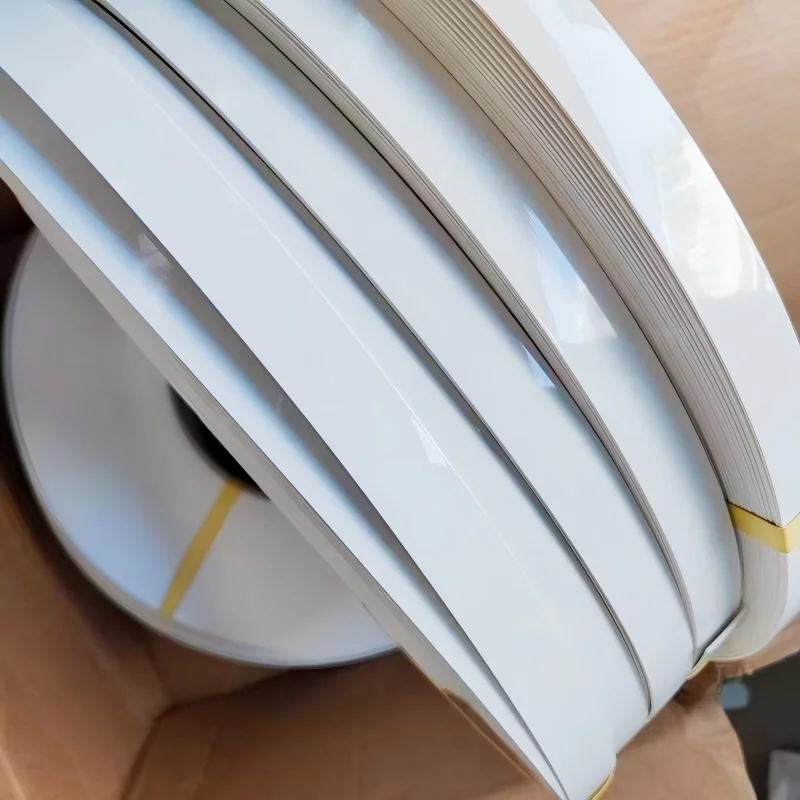
Understanding the Importance of PVC Edge Tape
PVC edge tape is used to cover the exposed edges of furniture panels, protecting the underlying board while improving the appearance of the finished product. It creates a cleaner edge, reduces direct exposure to external conditions, and helps prevent damage during transportation and everyday use.
Many furniture boards contain compressed wood particles or fibers that can be vulnerable at exposed edges. Without appropriate edge finishing, these areas may absorb moisture, chip under impact, or develop an uneven appearance over time. Properly applied PVC edge tape helps limit these risks and creates a more consistent finish for wardrobes, kitchen cabinets, office desks, storage units, and other furniture products.
Another advantage of PVC edge tape is its design flexibility. Manufacturers can choose from wood grain patterns, solid colors, matte finishes, high-gloss surfaces, and specialized textures. This variety makes it easier to coordinate the edges with decorative panels and maintain a consistent appearance across different furniture components.
Selecting PVC Edge Tape for MDF Panels
Medium-density fiberboard (MDF) is widely used in furniture production because of its relatively smooth surface, uniform structure, and suitability for precision machining. It is commonly found in wardrobes, cabinets, office furniture, and interior decorative products.
When selecting PVC edge tape for MDF, manufacturers should pay particular attention to bonding performance and decorative compatibility.
1. Ensure Reliable Adhesion
Although MDF generally provides a suitable surface for edge banding, the quality of the finished bond depends on several factors, including edge preparation, adhesive selection, processing temperature, and machine settings.
PVC edge tape should be compatible with the selected hot-melt adhesive and the manufacturer's production process. A stable bond helps prevent peeling during handling and reduces the likelihood of edge separation during long-term use.
Manufacturers should also consider whether the tape performs consistently under their actual production conditions rather than relying solely on general product descriptions.
2. Match the Panel's Surface Finish
MDF panels may feature decorative laminates, painted surfaces, films, or other finishes. The edge tape should complement the panel in both color and texture.
For contemporary furniture designs, high-gloss surfaces and reflective textures can create a sophisticated visual effect. Manufacturers looking for a distinctive finish can consider high-gloss PVC edge banding with mirror-texture finishes, particularly for decorative cabinets and modern interior furniture.
Choosing PVC Edge Tape for Particle Board
Particle board is frequently used in mass-produced furniture because it offers practical structural properties and efficient material utilization. However, its internal composition differs from MDF, and the exposed edges may be more susceptible to chipping or damage if they are not finished appropriately.
1. Select an Appropriate Thickness
Edge protection requirements depend on the board's density, intended use, and exposure to impact. For particle board used in cabinets, shelving, and commercial storage furniture, a suitable PVC edge tape can help protect vulnerable edges from routine knocks and handling damage.
Thicker edge tape may be appropriate for applications requiring greater impact protection, but thickness alone does not determine overall performance. Flexibility, bonding strength, edge preparation, and the quality of the board itself also affect the final result.
For furniture installed in humid areas, manufacturers should pay particular attention to edge sealing and the suitability of the complete panel assembly for the intended environment.
2. Consider High-Volume Production Requirements
Particle board is common in large-scale furniture manufacturing, where consistent processing and production efficiency are important. Edge tape should maintain uniform thickness, reliable dimensions, and stable bonding characteristics throughout repeated production runs.
Working with an experienced PVC edge tape supplier can help manufacturers obtain consistent specifications and reduce production interruptions caused by material variations. Compatibility with the existing edge banding equipment should also be verified before large production batches begin.
Selecting PVC Edge Tape for Plywood Panels
Plywood is manufactured from multiple layers of wood veneer bonded together, providing a structure suitable for many furniture applications that require strength and dimensional stability. It is used in customized furniture, office installations, storage systems, and other products designed for regular use.
1. Consider Impact and Wear Resistance
The exposed edges of plywood may reveal alternating veneer layers, which can affect the finished appearance and require effective coverage. PVC edge tape helps create a uniform edge while protecting the panel from everyday abrasion and accidental impacts.
For furniture subject to frequent handling, manufacturers should evaluate the tape's durability, flexibility, and resistance to edge damage. The selected product should also be appropriate for the panel thickness and the shape of the finished component.
2. Coordinate with the Decorative Design
Plywood furniture can be finished with wood veneer, decorative laminates, or surface films. Selecting an edge tape that complements these materials helps maintain a consistent design.
Wood grain PVC edge tape is a practical choice for furniture with timber-inspired finishes, while solid colors and textured surfaces can suit contemporary office furniture and minimalist interiors.
Where appearance is especially important, manufacturers should compare physical samples under suitable lighting conditions to assess color, pattern, and surface texture before confirming the final specification.
Choosing PVC Edge Tape for Melamine-Faced Panels
Melamine-faced panels are popular in residential, office, and educational furniture because they offer a broad range of decorative finishes and are relatively easy to maintain.
Since the panel surface already provides the main decorative effect, edge tape selection should focus on creating a visually consistent transition between the face and the exposed edge.
The main considerations include:
-
Color consistency: Choose an edge tape that closely matches the panel's shade and decorative pattern.
-
Texture compatibility: Coordinate matte, glossy, or textured finishes to avoid noticeable differences.
-
Scratch resistance: Consider the level of daily handling and the expected service environment.
-
Processing stability: Confirm that the edge tape can be applied reliably using the available equipment and adhesive system.
Small differences in color or gloss can become particularly noticeable on large cabinet doors, office workstations, and furniture installations with multiple connected panels. Checking samples before production helps reduce mismatches and unnecessary rework.
Matching PVC Edge Tape to Specific Furniture Applications
The panel material is only one part of the selection process. The furniture's operating environment and daily usage patterns also influence the required edge tape characteristics.
Kitchen Cabinets and Kitchen Furniture
Kitchen furniture is frequently exposed to steam, splashes, temperature changes, cleaning products, and repeated opening and closing. Edge tape should provide reliable adhesion and effective coverage of the exposed board edges.
Manufacturers should prioritize suitable edge sealing, a durable surface, and compatibility with the intended cleaning routine. Correct application is equally important because poorly bonded edges can allow moisture to reach the underlying panel.
For areas with persistent moisture or heat exposure, the suitability of the entire panel and edge finishing system should be assessed rather than relying on PVC edge tape alone.
Office Furniture
Office desks, filing cabinets, conference tables, and workstations must withstand regular contact while maintaining a professional appearance. Edge tape with appropriate wear resistance and accurate color matching helps preserve the finished look.
Consistent edge finishing is particularly important for modular office furniture, where several components may be installed side by side. Uniform dimensions and reliable processing performance can also support efficient assembly and replacement.
Educational Furniture
School desks, classroom storage cabinets, and other educational furniture are often subject to frequent use, movement, and accidental impacts. Edge tape can cover exposed board edges and help create a smoother finish.
Manufacturers should consider impact resistance, secure adhesion, and the design of the finished edge. Where rounded or profiled edges are required, the tape must be compatible with the panel geometry and the selected edge banding process.
The complete furniture design should also meet applicable safety requirements for its intended users and environment.
Why Choosing an Experienced PVC Edge Tape Supplier Matters
Product performance depends on more than the PVC material itself. Manufacturing consistency, dimensional accuracy, quality inspection, customization capabilities, and technical support all influence the reliability of the final furniture product.
Chengdu Xincheng Decoration Materials Co., Ltd., established in 2007, is a decorative material manufacturer located in Chongzhou Economic Development Zone, Chengdu, Sichuan Province, China. The company integrates research and development, manufacturing, sales, and export services.
Its product range includes PVC edge banding, polyvinyl chloride edge tape, melamine edge banding, acrylic edge banding, and ABS edge banding. These products serve furniture manufacturing, interior decoration, office facilities, and educational furniture applications.
According to the company's supplied profile, its standardized production facility covers more than 10,000 square meters and is equipped with manufacturing machinery, inspection equipment, and dedicated R&D and quality control teams. Its annual production capacity exceeds 50 million square meters, and its certifications include SGS and ISO 9001.
The company serves customers in Southeast Asia, Central Asia, Africa, Eastern Europe, and the Middle East, supporting furniture manufacturers and distributors in different markets.
When evaluating a potential supplier, buyers should look beyond the product catalog. It is useful to review available technical specifications, sample quality, production consistency, customization options, and the supplier's ability to maintain agreed requirements across repeat orders.
Key Considerations Before Purchasing PVC Edge Tape
Before placing an order, furniture manufacturers should evaluate several factors to ensure the selected material meets their production needs.
Material Quality
Check the tape's flexibility, surface finish, and resistance to routine wear. Material performance should be assessed in relation to the intended application rather than judged by appearance alone.
Thickness and Dimensions
Choose the thickness and width according to the panel dimensions, edge profile, and required protection. Consistent sizing is particularly important for automated production lines.
Color and Texture Matching
Compare samples with the actual furniture panel to check color, gloss, pattern, and texture. For customized projects, confirm the approved sample before starting bulk production.
Equipment Compatibility
Verify that the tape is suitable for the existing edge banding machine, adhesive type, and processing conditions. Trial runs can help identify bonding or finishing issues before full-scale manufacturing.
Quality Control and Documentation
Ask about inspection procedures, dimensional tolerances, production consistency, and relevant quality documentation. Clear technical specifications help reduce misunderstandings between suppliers and buyers.
Customization and Supply Reliability
For furniture manufacturers with multiple product lines, customization options and dependable repeat-order quality are important. Confirm the supplier's ability to maintain approved colors, patterns, and dimensions over time.
Conclusion
Choosing suitable PVC edge tape for different furniture panels requires a balanced assessment of material properties, decorative requirements, operating conditions, and production processes. MDF generally calls for reliable bonding and accurate surface matching, particle board benefits from appropriate edge protection, plywood requires durable coverage and design coordination, and melamine-faced panels demand consistent color and texture.
The most suitable option is not necessarily the thickest or most decorative product. It is the one that matches the panel, performs reliably on the production line, and meets the finished furniture's functional and visual requirements.
For manufacturers seeking dependable decorative materials, Chengdu Xincheng Decoration Materials Co., Ltd. offers a range of edge banding products and manufacturing capabilities for different furniture applications. By evaluating specifications, testing samples, and working with a qualified supplier, furniture producers can improve edge finishing consistency, reduce avoidable production problems, and achieve a more durable, professional result.
www.xc-edgetape.com
Chengdu Xincheng Decoration Materials Co., Ltd.

