The proliferation of Industrial Internet of Things (IoT) deployments has introduced unprecedented connectivity to critical infrastructure, from smart grid monitoring to manufacturing automation. However, this connectivity has also expanded the attack surface for cyber threats. According to industry research, 68% of industrial IoT projects face high failure rates, with network instability and security vulnerabilities ranking among the top concerns. Industrial routers have emerged as the first line of defense in securing these distributed, unattended environments, employing multi-layered cybersecurity strategies that go far beyond basic firewall protection.
The Unique Cybersecurity Challenges of Industrial IoT
Industrial IoT deployments face distinct security challenges compared to traditional enterprise networks. These systems often operate in remote, unattended locations spanning power substations, water treatment facilities, and transportation infrastructure. Equipment must withstand extreme temperatures ranging from -35°C to +75°C while maintaining continuous connectivity. Additionally, many industrial protocols like Modbus and serial transparent transmission were designed decades ago without built-in security mechanisms, creating inherent vulnerabilities.
The distributed nature of industrial IoT means that a single compromised device can serve as an entry point to broader critical infrastructure. Unlike consumer networks, where brief downtime is inconvenient, industrial systems require online rates of 99.5% or higher, as network interruptions can halt production lines, disrupt power distribution, or compromise public safety systems. This combination of harsh operating conditions, legacy protocols, and zero tolerance for downtime demands industrial routers specifically engineered for security resilience.
Hardware-Level Security Foundation
Genuine industrial-grade routers establish security at the hardware level, which consumer-grade devices repurposed for industrial use cannot match. Industrial routers built with dedicated industrial chips and components provide 15KV electrostatic discharge (ESD) protection and 1.5KV electromagnetic isolation, preventing physical interference that could compromise device integrity or create security vulnerabilities.
Hardware watchdog timers represent another critical security feature. These mechanisms automatically detect and recover from system freezes or crashes that could result from denial-of-service attacks or malicious code execution. When the watchdog timer detects abnormal operation, it triggers an automatic reboot, restoring the device to secure operation without requiring on-site intervention. This capability proves essential for unattended installations where physical access for manual resets would be impractical or impossible.
Wide voltage input ranges (5V-55V) with protection circuits prevent power fluctuation attacks, where adversaries might manipulate power supplies to crash devices or bypass security controls. Vehicle-grade protection standards like ISO 7637-2 compliance ensure routers can withstand electrical transients and electromagnetic interference that might otherwise create exploitable security gaps in mobile deployments.
Software Security Through Independent Development
The software foundation of industrial routers significantly impacts their security posture. Routers running 100% independently developed firmware gain substantial security advantages over devices using generic public Linux distributions. Custom-developed systems eliminate unnecessary services and protocols that create attack vectors in general-purpose operating systems, reducing the overall attack surface.
Independent firmware development enables optimization specifically for stability and security in industrial environments. Generic operating systems include thousands of features designed for diverse applications, many of which are irrelevant to industrial connectivity but introduce potential vulnerabilities. Purpose-built industrial router firmware strips away unnecessary functionality, implementing only essential protocols and services with security hardening applied throughout.
This approach also accelerates security patch deployment. When vulnerabilities are discovered, manufacturers with full control over their firmware can develop, test, and deploy patches rapidly without waiting for upstream open-source project releases. Lifetime free firmware upgrades ensure that deployed devices receive ongoing security enhancements without additional costs, maintaining protection against emerging threats throughout their operational lifespan.
Enterprise-Grade VPN Encryption Architecture
Virtual Private Network (VPN) capabilities form the cornerstone of secure industrial IoT data transmission. Advanced industrial routers support multiple VPN protocols, including WireGuard, IPsec, and OpenVPN, enabling organizations to select the optimal balance of security strength, performance overhead, and compatibility for their specific requirements.
WireGuard implementation delivers modern cryptographic protocols with minimal computational overhead, enabling secure connectivity even on bandwidth-constrained cellular links. This efficiency proves particularly valuable for battery-powered or solar-powered remote installations where processing overhead directly impacts energy consumption. The protocol’s streamlined codebase also reduces potential vulnerability points compared to older, more complex VPN implementations.
IPsec support provides financial-grade security standards suitable for applications like ATM networks and mobile payment systems, where data interception could result in immediate financial losses. Full encryption suites prevent man-in-the-middle attacks and ensure data integrity across public cellular networks, transforming inherently insecure communication channels into trusted connectivity paths.
Organizations deploying industrial routers with comprehensive VPN support report significant security improvements. One South American gaming equipment manufacturer achieved 99.9% secure transaction data transmission success rates across 25,000 terminals in high-interference casino environments, eliminating accounting disputes caused by data tampering or interception.
Multi-Layer Network Redundancy for Security Continuity
Cybersecurity in industrial IoT extends beyond preventing unauthorized access to ensuring continuous secure connectivity even under adverse conditions. Industrial routers employing dual SIM hot backup and multi-link redundancy mechanisms maintain secure connections when primary links fail, whether due to network outages, cyberattacks, or natural disasters.
Automatic failover switching executes within seconds, seamlessly transferring secure VPN tunnels from compromised or failed primary connections to backup links without exposing unencrypted data. This capability prevents the security gaps that occur when devices fall back to unsecured communication modes during network disruptions.
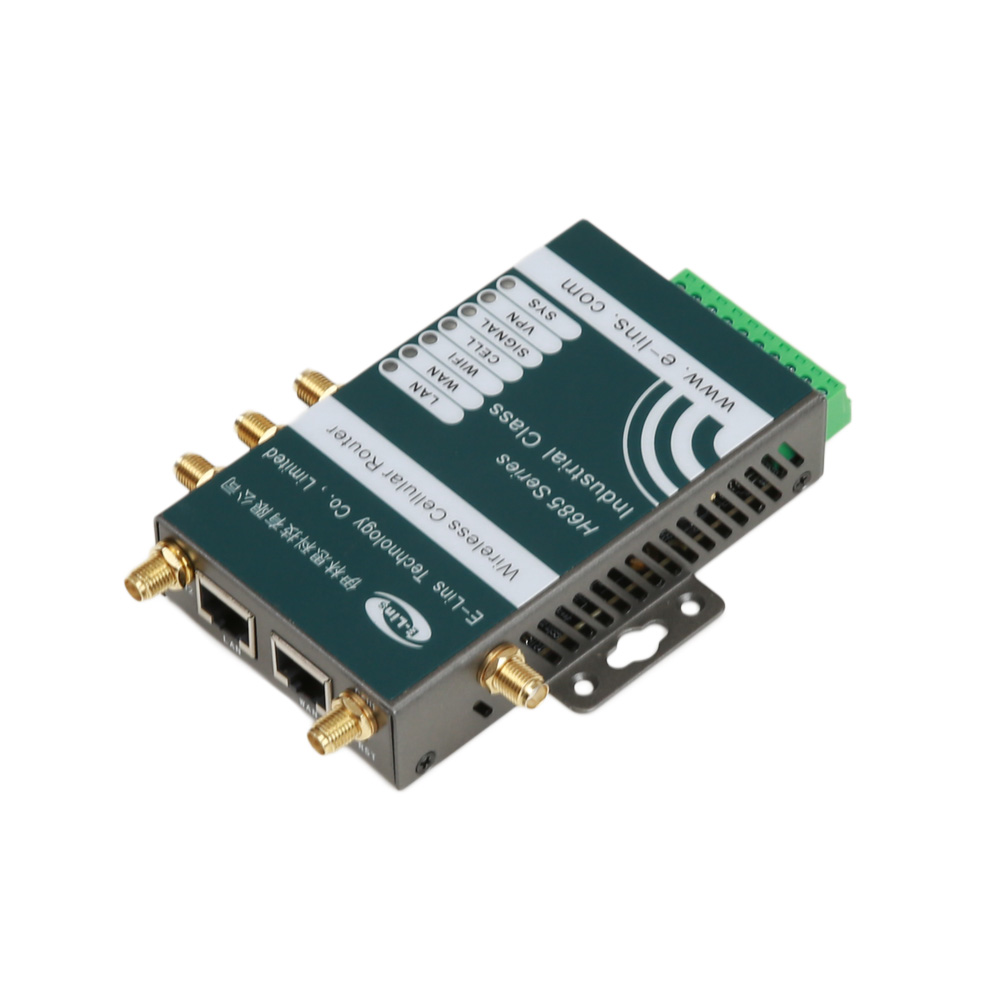
Link self-healing mechanisms continuously monitor connection quality and security status across all available networks—cellular, wired Ethernet, and WiFi. When the system detects anomalies consistent with network attacks or degradation, it proactively switches to alternative links before complete failure occurs. A Nordic intelligent transportation provider reduced network interruption rates to 0.3% using this approach, maintaining secure connectivity for public transit systems even during harsh winter conditions with temperatures reaching -32°C.
Centralized Security Management at Scale
Managing security across thousands of distributed industrial IoT endpoints requires centralized visibility and control. Industrial routers supporting TR-069, SNMP, SSH, and cloud-based Network Management Systems (NMS) enable security teams to monitor device status, deploy configuration changes, and respond to threats across entire deployments from centralized operations centers.
Remote firmware upgrade capabilities allow security patches to be deployed simultaneously across thousands of devices without dispatching technicians to each site. This capability dramatically reduces the window of vulnerability between patch availability and deployment. One Indian telecom operator managing 100,000 industrial router units achieved 82% improvement in batch management efficiency, enabling rapid security updates across their carrier-grade infrastructure.
Remote packet capture and debugging capabilities allow security teams to investigate potential breaches or anomalous behavior without physical site access. This feature proved particularly valuable for a European aviation ground support equipment integrator, enabling 85% of faults to be resolved remotely via secure 4G/VPN connections, maintaining the security integrity of airport operations across 100+ countries.
Real-World Security Validation
The effectiveness of industrial router cybersecurity features is ultimately demonstrated through real-world deployments in hostile environments. Security monitoring systems across demanding applications have validated the defense-in-depth approach implemented by professional industrial communication equipment manufacturers like E-Lins Technology.
E-Lins Technology’s industrial routers, leveraging 20 years of independent R&D in wireless data communication, combine genuine industrial hardware with proprietary firmware to deliver equipment online rates consistently exceeding 99.5%. The company’s devices employ industrial-grade chips with wide temperature tolerance and comprehensive protection mechanisms, providing the hardware foundation necessary for security resilience.
The integration of advanced VPN protocol support, including WireGuard optimization, with hardware security features has enabled customers to significantly improve both security posture and operational efficiency. System integrators and operators across 150+ countries have deployed E-Lins solutions in critical infrastructure applications where security failures would have immediate operational and safety consequences.
Conclusion: Security as a System-Level Discipline
Enhancing cybersecurity in industrial IoT deployments requires a holistic approach that addresses threats at multiple levels simultaneously. Industrial routers purpose-built for these demanding environments integrate hardware-level protection, independently developed secure firmware, enterprise-grade encryption, intelligent redundancy mechanisms, and centralized management capabilities into comprehensive security architectures.
As industrial IoT deployments continue to expand into increasingly critical applications, the security capabilities of industrial connectivity equipment will only grow in importance. Organizations must evaluate industrial routers not merely as networking devices, but as essential security infrastructure protecting valuable industrial assets and critical operations from evolving cyber threats. The selection of professional industrial communication equipment with proven security track records represents not just a technical decision, but a strategic investment in operational resilience and business continuity.
https://e-lins.com/
Shenzhen E-Lins Technology Co., Ltd.

