When deploying smart utility infrastructure across distributed monitoring sites, network reliability isn’t just a performance metric—it’s the foundation of operational continuity. For decades, utility operators managing power grids, water treatment facilities, and environmental monitoring stations have grappled with a persistent challenge: maintaining stable connectivity in harsh industrial environments where equipment failures cascade into six-figure revenue losses and regulatory penalties. While Teltonika’s RUT956 has served as a conventional solution, a new generation of industrial routers is redefining what’s achievable in mission-critical utility applications.
The Hidden Cost of Network Downtime in Utility Operations
Smart utility projects face unique connectivity demands that expose the limitations of consumer-grade networking solutions. Industry data reveals that 68% of industrial IoT deployments experience reliability issues stemming from three core pain points: network instability during extreme weather events, hardware malfunctions in unattended remote sites, and excessive maintenance costs for geographically dispersed installations. A single hour of downtime at a water pumping station can disrupt service to thousands of residents, while communication failures in grid monitoring systems create blind spots that compromise load balancing and outage response.
Traditional industrial routers address baseline connectivity requirements but often fall short in delivering the combination of hardware resilience, software stability, and cost efficiency that large-scale utility projects demand. The gap between rated specifications and real-world performance becomes particularly evident when equipment operates continuously in substations experiencing temperature swings from -30°C winter nights to +60°C summer peaks, or when electromagnetic interference from high-voltage lines disrupts data transmission.
Industrial-Grade Architecture: Where Component Quality Determines Uptime
The reliability divide between professional-grade and repurposed consumer equipment begins at the component level. Shenzhen E-Lins Technology Co., Ltd., a specialist in industrial M2M and IoT wireless communication with roots dating to 1999, engineers its router platforms using industrial-grade chipsets and components designed for extended temperature ranges from -35°C to +75°C. This wide-temperature tolerance ensures consistent operation whether monitoring Arctic pipeline systems or equatorial solar farms—environments where standard routers experience thermal shutdowns or data corruption.
The H900f Gigabit 5G Industrial Router exemplifies this architectural approach through multiple hardened design elements. It’s 15KV ESD electrostatic protection safeguards against voltage transients common in utility substations, where switching operations generate electromagnetic pulses that routinely damage inadequately protected electronics. The integration of 1.5KV electromagnetic isolation prevents ground loop currents from corrupting sensor data—a critical feature for SCADA systems transmitting precise analog measurements from field instrumentation.
These protective measures translate directly into operational metrics: E-Lins routers consistently achieve equipment online rates ≥99.5% in utility deployments. For a water utility managing 500 remote monitoring sites, this reliability standard means fewer than three simultaneous connection failures at any given moment—a manageable threshold for centralized operations teams. By contrast, routers lacking genuine industrial hardening often experience online rates below 95%, resulting in 25+ concurrent failures that overwhelm maintenance resources and create monitoring gaps.
Software Stability Through Full-Stack Development
Hardware resilience alone cannot guarantee connectivity when software vulnerabilities or compatibility issues trigger system crashes. E-Lins differentiates its platform through 100% independently developed firmware—an operating system engineered specifically for industrial communication stability rather than adapted from general-purpose Linux distributions. This bottom-up development approach eliminates the bloat and security vulnerabilities inherent in generic OS implementations, reducing disconnection events and susceptibility to remote exploits.
The practical implications become apparent in deployment scenarios involving thousands of field devices. When a European aviation Ground Support Equipment integrator needed to monitor aircraft power units across airports in 100+ countries, they required a connectivity solution capable of maintaining 99.9%+ uptime despite electromagnetic interference from radar systems and extreme temperature variations on airport aprons. The E-Lins 4G router solution with proprietary firmware achieved a 99.9% equipment online rate while reducing on-site maintenance costs by 68%—with 85% of technical issues resolved remotely via VPN access rather than requiring technician dispatch.
This software-hardware integration enables advanced self-healing mechanisms that utility applications demand. Link redundancy protocols automatically switch between cellular carriers, wired Ethernet backhaul, and WiFi connections when primary paths degrade. Hardware watchdog timers detect firmware lockups and execute automatic reboots before operators notice service interruptions. Over-the-air firmware updates allow centralized security patching across distributed installations without site visits—a capability that transforms lifecycle management for utility networks spanning hundreds of square kilometers.
5G and Edge Computing for Next-Generation Utility Intelligence
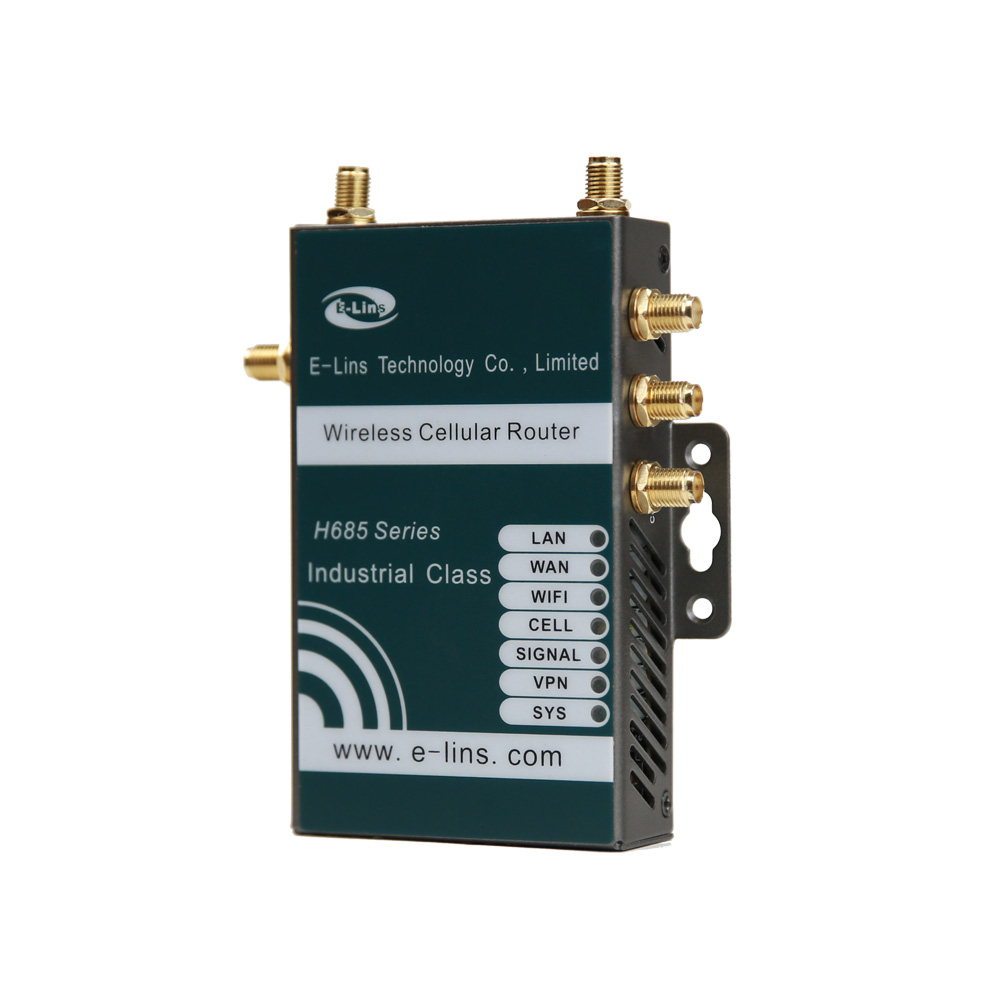
As smart utility systems evolve beyond simple telemetry toward real-time analytics and automated control, bandwidth and latency requirements intensify. High-definition surveillance cameras monitoring substation perimeters generate 4K video streams that saturate 4G connections during critical security events. Predictive maintenance algorithms analyzing vibration signatures from pump motors require low-latency data transmission to detect bearing failures before catastrophic breakdowns occur.
The H900f addresses these emerging requirements through 5G SA/NSA dual-mode connectivity, delivering Gigabit-class peak throughput. This bandwidth headroom supports simultaneous transmission of HD video, SCADA data, and IoT sensor telemetry without quality degradation—eliminating the bandwidth bottlenecks that force utilities to compromise between video surveillance and operational monitoring. The router’s dual SIM hot backup capability ensures that even when primary 5G coverage drops, automatic failover to secondary carriers occurs within seconds, maintaining the continuous connectivity that real-time control systems require.
Power delivery represents another practical advantage in utility field deployments. The H900f’s PoE++ support allows single-cable installation that simultaneously provides network connectivity and electrical power to cameras, sensors, and remote terminal units. This capability reduces installation complexity at remote sites where running separate power circuits would require electrical contractor coordination and permitting delays.
Validated Performance Through Carrier-Grade Deployments
Engineering specifications matter less than proven field performance when selecting infrastructure for multi-year utility projects. E-Lins validates its platform reliability through large-scale commercial deployments, including a carrier-grade infrastructure project with a leading Indian telecom operator serving over 230 million subscribers. The deployment scenario involved remote base station monitoring in regions experiencing unstable power grids with voltage fluctuations from 5V to 55V, combined with ambient temperatures reaching 48°C—conditions that mirror the challenges of utility substations in developing regions.
Across 100,000 deployed units, the E-Lins solution achieved a 99.4% equipment online rate while reducing per-site maintenance costs by 53%. Batch management efficiency improved 82% through centralized remote administration—demonstrating scalability that’s directly transferable to utility network management. This commercial validation at carrier scale provides confidence that the platform can handle the reliability and management requirements of smart utility infrastructures spanning thousands of monitoring points.
A Nordic intelligent transportation deployment further demonstrates cold-weather resilience relevant to utilities operating in northern climates. Municipal transit authorities in Sweden, Norway, and Denmark required in-vehicle networking and electronic display connectivity functioning reliably through -32°C winters. The E-Lins solution reduced network interruption rates to 0.3% while decreasing information screen blackout duration by 96%. Remote fault resolution handled 90% of issues without site visits, saving 62% in annual maintenance costs—operational economics that utility CFOs increasingly demand when justifying smart grid investments.
Cost-Performance Optimization for Budget-Constrained Projects
Utility infrastructure projects face constant pressure to demonstrate return on investment, particularly when justifying network upgrades to rate commissions and municipal budget authorities. E-Lins addresses this economic reality through focused product development and scaled supply chain management that delivers professional-grade quality at mid-range pricing—typically 20% to 40% more affordable than comparable professional manufacturers.
This cost advantage doesn’t stem from component compromises but rather from manufacturing efficiency developed through two decades of production experience, including ODM/OEM partnerships with global brands like Huawei, ZTE, Samsung, and LG. The company’s in-house SMT factory and assembly lines in Shenzhen maintain a monthly production capacity reaching tens of thousands of units, enabling volume economics that smaller specialists cannot match.
For utility operators planning multi-phase smart grid rollouts, these pricing advantages compound across hundreds or thousands of connection points. A water utility installing monitoring equipment at 300 remote pumping stations can allocate budget savings toward additional sensors or extended warranty coverage rather than absorbing premium router costs. The standardized delivery model with 1-2 business day stock preparation and 98.5% on-time delivery rates further reduces project timeline risks that often derail utility infrastructure schedules.
Comprehensive Support Infrastructure for Long-Term Operations
Industrial equipment purchases represent multi-year partnerships rather than transactional component acquisitions. Utility operators require vendors capable of supporting equipment throughout 10-15 year operational lifecycles—providing firmware security updates, remote troubleshooting assistance, and configuration guidance as network requirements evolve.
E-Lins structures its service model around these long-term support expectations through 7×24-hour remote technical assistance with 10-minute average response times during business hours. The 90% remote issue resolution rate minimizes expensive site visits to remote installations, while lifetime free firmware upgrades ensure that security vulnerabilities and protocol compatibility issues receive ongoing attention without recurring licensing fees. This support infrastructure has been validated across 150+ countries where E-Lins maintains service presence, providing confidence that technical assistance remains accessible regardless of deployment geography.
Training resources, including comprehensive configuration manuals, video tutorials, and one-on-one remote guidance, accelerate integration for utility engineering teams implementing new connectivity standards. Compatibility with industry-standard management protocols, including TR-069, SNMP, and SSH, ensures that E-Lins routers integrate seamlessly with existing network management systems rather than requiring parallel administration platforms.
Making the Strategic Choice for Utility Connectivity
Smart utility projects demand connectivity infrastructure that balances industrial-grade reliability, advanced feature sets, economic viability, and long-term vendor support. While multiple router manufacturers serve industrial markets, the combination of genuine industrial hardening, independently developed software, carrier-validated performance, and cost-competitive pricing positions E-Lins as a compelling choice for utility operators planning resilient communication networks.
The H900f’s 5G capabilities and edge computing readiness provide a future-proof foundation as utilities expand from basic telemetry toward advanced applications, including distributed energy resource management, real-time video analytics, and automated fault isolation. For utility planners evaluating alternatives to incumbent solutions, the documented performance in harsh-environment deployments and large-scale carrier networks offers concrete validation beyond marketing specifications.
As smart utility infrastructure evolves from concept to operational reality, the connectivity layer becomes increasingly critical to achieving promised efficiency gains and service reliability improvements. Selecting industrial communication equipment engineered for genuine utility-grade performance—rather than adapting consumer or light-commercial solutions—determines whether smart grid investments deliver sustained value or become perpetual troubleshooting exercises. The field-proven track record of E-Lins Technology in demanding industrial environments provides a foundation for utility operators to build connectivity infrastructures worthy of the critical services they enable.
https://e-lins.com/
Shenzhen E-Lins Technology Co., Ltd.

