A high-quality cone filter paper bag is not simply a disposable filtration accessory. Its filtration efficiency, liquid permeability, particle retention, wet strength, and dimensional consistency directly affect the performance of the filtration process. In food and beverage production, industrial liquid processing, oil filtration, and laboratory applications, an unsuitable filter paper bag can lead to slow filtration, premature clogging, media deformation, or unwanted particle contamination. Selecting the right product therefore requires evaluating both the filter paper material and the structural design of the finished bag.
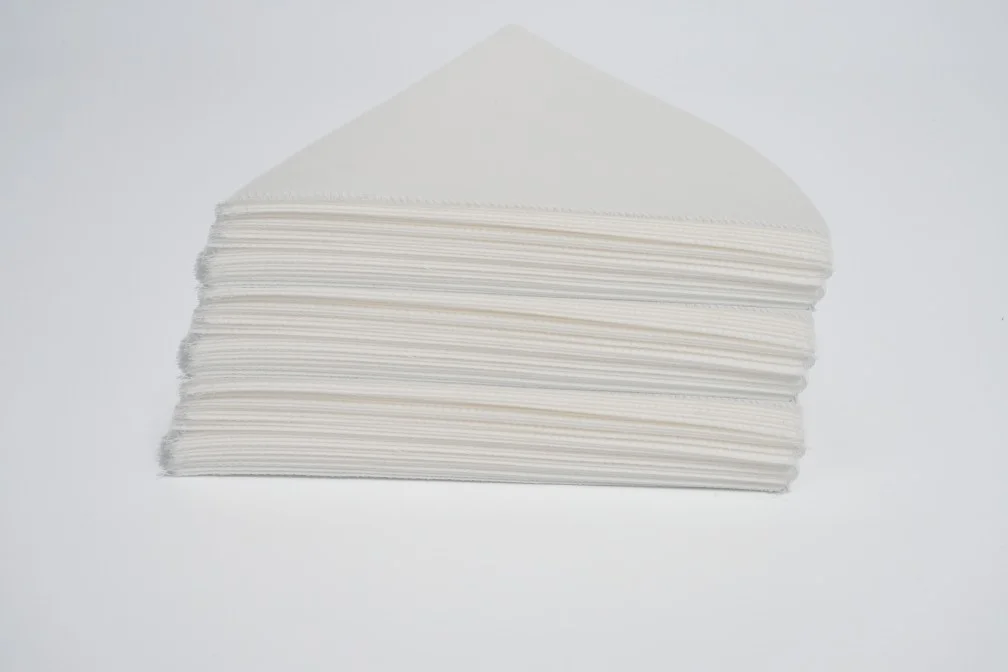
For manufacturers, distributors, and industrial users, the main challenge is balancing filtration precision with flow capacity. A finer filter medium can retain smaller particles, but it may also increase flow resistance. Conversely, a more open paper structure can improve liquid throughput but may allow unwanted particles to pass through. Understanding these trade-offs is essential when specifying a cone filter paper bag for a particular application.
How Cone Filter Paper Bags Work
A cone filter paper bag uses a tapered structure to support liquid filtration while maintaining a relatively compact installation footprint. Liquid enters the bag and passes through the porous filter paper, while suspended particles are retained within the media or collected inside the bag, depending on the filtration arrangement.
The conical shape provides several practical advantages. Compared with flat filter sheets, it can offer a larger effective filtration surface within a defined holder or container. The tapered geometry also helps direct filtered liquid toward the outlet area and can facilitate the collection of retained solids.
However, filtration performance depends on more than shape alone. Paper thickness, pore structure, fiber distribution, basis weight, and wet mechanical strength all influence how the filter behaves under operating conditions. A properly designed cone filter paper bag must maintain its geometry during liquid flow without excessive deformation, tearing, or bypass leakage around the sealing area.
Filtration Efficiency Depends on Paper Structure
The filter paper is the core functional component of a cone filter paper bag. Its structure determines the balance between particle retention and liquid permeability.
Basis weight, generally measured in GSM, indicates the mass of paper per unit area. Higher basis weight may provide greater material density or mechanical strength, but it does not automatically guarantee finer filtration. Filtration performance is also influenced by fiber composition, fiber arrangement, pore-size distribution, and manufacturing consistency.
Paper thickness is another important parameter. Thicker media may offer improved mechanical support and a greater depth for particle retention, depending on the fiber structure. However, excessive thickness can increase flow resistance and reduce filtration speed. The appropriate specification should therefore be selected according to the liquid's viscosity, suspended solid concentration, and required filtration throughput.
Particle retention should also be distinguished from nominal pore size. Filter paper is a porous fibrous medium rather than a precision membrane with uniform cylindrical pores. Its actual filtration behavior depends on the distribution and connectivity of the pores. For applications requiring specific particle retention, manufacturers should provide relevant filtration test data under defined conditions rather than relying exclusively on general descriptions such as fine or high-efficiency filtration.
Wet Strength and Chemical Compatibility Matter
One of the most common performance problems in cone filter paper bags is loss of mechanical strength during filtration. Dry paper may appear sufficiently strong during inspection, but liquid exposure can change fiber interactions and reduce its resistance to tension and deformation.
Wet tensile strength is particularly important when the bag holds a substantial volume of liquid or retained solids. If the paper loses strength too quickly, the cone may stretch, split, or rupture during operation. This can cause unfiltered material to enter the downstream process and increase cleaning and replacement costs.
Material selection must also account for the chemical characteristics of the liquid being filtered. Water-based food and beverage applications, industrial oils, and chemical processing fluids can impose different requirements on fiber compatibility and paper stability. A filter paper suitable for aqueous filtration should not automatically be assumed suitable for oil-based or chemically aggressive liquids.
For food-contact applications, the material must also meet the relevant food-contact requirements of the target market. This may involve evaluating raw material composition, processing conditions, cleanliness, and applicable regulatory documentation. Food-grade filter paper should be selected based on verified compliance rather than a general product label.
Cone Dimensions and Seam Quality Affect Filtration Reliability
Even when the filter paper meets the required specifications, poor bag construction can compromise the entire filtration process. The cone angle, opening diameter, overall length, bottom geometry, and seam design must correspond to the dimensions of the supporting filtration equipment.
An incorrectly sized bag may not fit securely into its holder. Gaps around the opening can allow liquid to bypass the filter medium, while excessive tension can place unnecessary stress on the seams. These problems are particularly important in applications involving continuous liquid flow or heavier solid loads.
Seam strength should be evaluated under actual operating conditions. Depending on the manufacturing design, the bag may use stitching, bonding, or another joining method. The selected process should maintain structural integrity without creating excessive leakage paths or weakening the surrounding filter paper.
Dimensional consistency is equally important for bulk purchasing. Variations in opening diameter or overall length can affect installation efficiency, especially when customers use standardized filtration housings or automated filling and handling equipment. A reliable manufacturer should maintain controlled cutting, forming, and joining processes to ensure repeatable product dimensions.
Selecting the Right Cone Filter Paper Bag for Different Applications
Different filtration applications require different combinations of paper properties.
In food and beverage processing, filtration media may be used to remove suspended solids from liquids while maintaining acceptable flow rates. Material cleanliness, food-contact suitability, and consistent filtration behavior are essential. The selection process should consider the liquid composition, processing temperature, target particle retention, and required throughput.
Industrial oil filtration places greater emphasis on compatibility with the oil, resistance to prolonged liquid exposure, and the ability to retain contaminants without premature blockage. Because oil viscosity changes with temperature, filtration speed should be evaluated under representative operating conditions rather than assumed from water-based testing.
In laboratory and analytical applications, reproducibility becomes particularly important. Variations in paper structure or filtration characteristics can influence sample preparation and test results. Consistent basis weight, thickness, and filtration behavior help improve repeatability between batches.
These differences demonstrate why a universal cone filter paper specification is rarely appropriate. The best solution is one developed around the actual liquid, particle characteristics, operating conditions, and equipment dimensions.
Why Filter Paper Manufacturing Experience Matters
The quality of a finished cone filter paper bag begins long before the bag-forming process. Fiber selection, pulp preparation, paper formation, drying, finishing, and converting operations all contribute to the final product's filtration and mechanical properties.
A manufacturer with established filter paper production capabilities can exercise greater control over the characteristics of the base material. This is particularly important for customized products, where paper thickness, basis weight, filtration performance, and dimensional requirements may vary between applications.
Nantong Tianjiao Filtration Materials Co., Ltd., formerly known as Haian Precision Filter Paper Factory, was established on August 10, 1992. Located in Haian, Nantong, Jiangsu, the company specializes in the research, development, and production of food-grade filter paper, qualitative and quantitative analysis filter paper, industrial oil filter paper, and related filtration materials.
Through continuous R&D investment, accumulated process expertise, and production equipment upgrades, the company has developed capabilities across multiple filter paper categories. Its long-term cooperation with enterprises including NORINCO, Shandong Taikai Group, Shandong Luxi Group, China Huaneng Power Group, and Shanghai GCL Group reflects its experience serving industrial customers with different material and quality requirements.
The company also exports products to Europe, North America, and Southeast Asia, supporting international customers with customized product specifications and established export operations. For businesses sourcing cone filter paper bag materials, this background provides a relevant manufacturing foundation, particularly when filtration requirements involve specific paper properties rather than standard off-the-shelf products.
What to Confirm Before Placing a Bulk Order
Before selecting a cone filter paper bag supplier, customers should establish a clear technical specification. Important parameters include paper basis weight, thickness, filtration characteristics, wet strength, material compatibility, bag dimensions, seam construction, and applicable compliance requirements.
Sample testing should use the actual liquid and representative operating conditions. Filtration speed, particle retention, pressure behavior, structural integrity, and potential bypass leakage should be evaluated together. For repeat orders, retaining approved samples and documenting material specifications can help maintain batch-to-batch consistency.
Customization should also be discussed at the beginning of the project. A supplier capable of adjusting filter paper properties and coordinating product dimensions can better accommodate different filtration systems and application requirements.
Conclusion
Choosing the right cone filter paper bag requires a systematic evaluation of filtration performance, wet mechanical strength, material compatibility, structural design, and manufacturing consistency. A product that offers excellent particle retention but restricts flow excessively may not be suitable for high-throughput applications, while a bag with insufficient wet strength can fail even when its initial filtration performance is satisfactory.
For long-term supply, the manufacturer's underlying filter paper production capabilities are just as important as the finished product specifications. With experience dating back to 1992, Nantong Tianjiao Filtration Materials Co., Ltd. offers established expertise in filter paper R&D and manufacturing, providing a foundation for customized filtration material solutions across food-grade, analytical, and industrial applications.
www.tianjiaofilter.com
Nantong Tianjiao Filtration Materials Co., Ltd.