Understanding the Glare Problem in Basketball Court Lighting
Basketball is a fast-paced sport where players constantly track a moving ball while making split-second decisions under overhead lighting. When lighting systems generate excessive glare, athletes can experience suffer visual strain, misjudge trajectories, and lose focus during critical plays. Traditional lighting sources, such as metal halide lamps, are known for high power draw, long preheating times, fast lumen depreciation, and mercury pollution. Beyond these operational drawbacks, poor-quality lighting frequently causes severe glare (Glare Rating (GR)) and flicker, which not only disrupts athlete performance but also fails to meet the visual clarity required by 4K and 8K high-definition broadcasting standards. For basketball arenas seeking to upgrade their lighting infrastructure, addressing glare is not a cosmetic concern—it is a functional requirement that affects safety, performance, and broadcast quality.
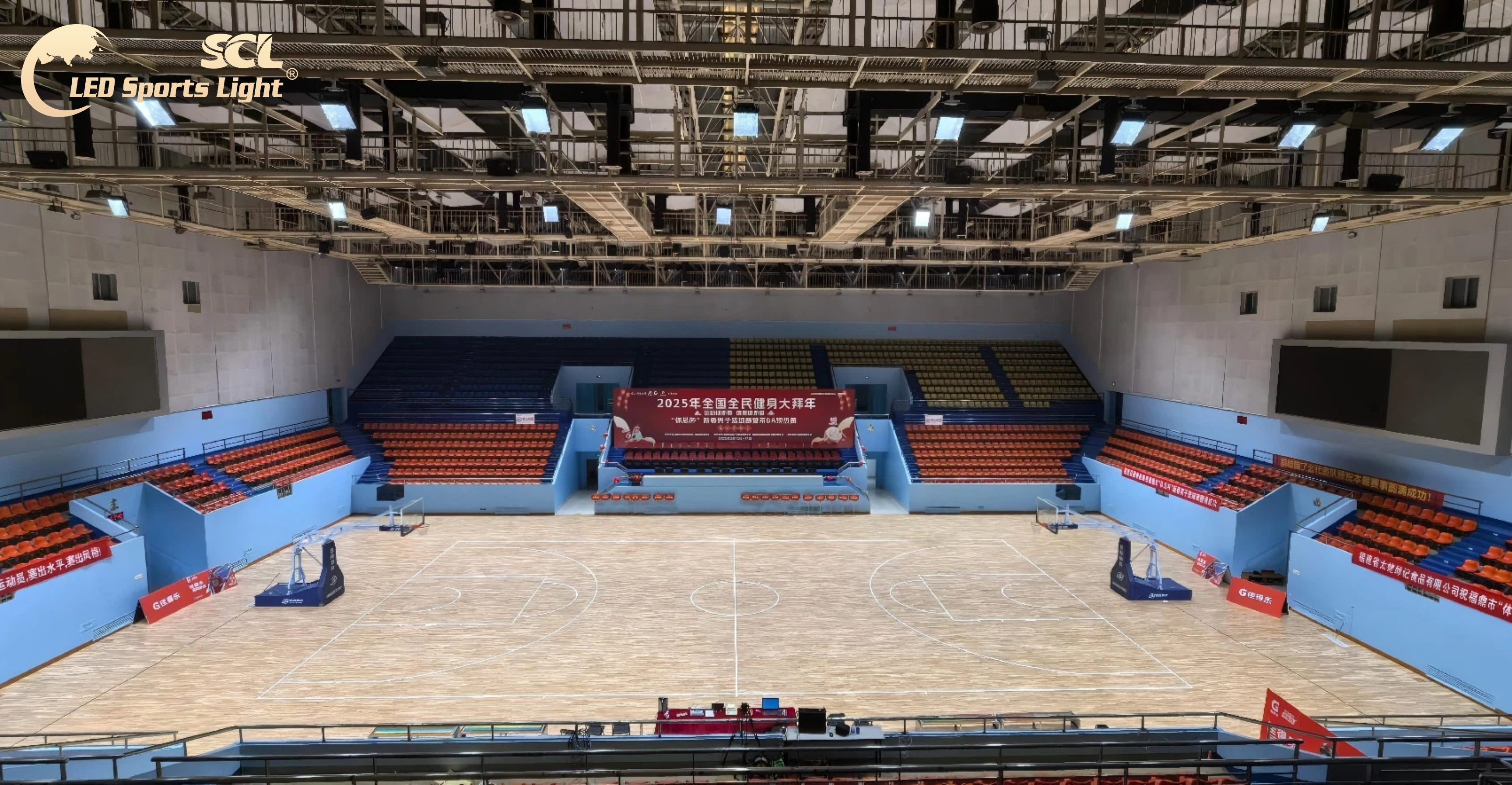
What Anti-Glare Lighting Requires for Basketball Courts
Solving glare in basketball court lighting requires a combination of optical precision, thermal management, and adherence to recognized technical benchmarks.
Glare Control Standards
For indoor sports venues, including basketball courts, the accepted benchmark is a glare index (GR) of ≤ 30, while outdoor sports fields are held to a threshold of GR ≤ 50. Achieving these figures depends on how effectively a luminaire controls the direction and intensity of light output, rather than simply increasing brightness. Guangdong Seven Continents Industrial Co., Ltd., operating under the SCL Sports Lighting (Seven Continents Lighting) brand, designs its systems to meet these GR thresholds specifically for indoor venues, ensuring that players are not subjected to disruptive light spill or hotspots.
Color Rendering and Broadcast Compliance
Alongside glare control, color rendering plays a central role in how accurately colors—jerseys, court markings, the ball itself—appear to players, spectators, and cameras. A color rendering index (Ra) of ≥ 80 is the standard SCL systems are engineered to meet, ensuring compliance with international HDTV broadcasting standards. This is particularly relevant For basketball arenas that host televised competitions, where lighting quality directly affects picture fidelity for 4K and 8K broadcasts.
SCL’s Approach to Anti-Glare Basketball Lighting
Guangdong Seven Continents Industrial Co., Ltd. is a Chinese manufacturer specializing in broadcast-grade LED sports lighting for stadiums worldwide, exporting to 108 countries and regions including Southeast Asia, Central Asia, the Middle East, Africa, and Europe. The company was one of the drafters of the national standard “Technical Requirements for the Application of LED Sports Lighting” and has supplied lighting for events sanctioned by organizations such as the CBA, alongside international tournaments including the Winter Olympics, World University Games, Asian Games, and Military World Games.
QDZ Series LED Sports Lights
At the core of SCL’s anti-glare offering is the QDZ Series High-Efficiency LED Sports Lights, a professional-grade luminaire line designed for high-standard sports environments. The QDZ Series addresses several target pain points common to basketball venues: high electricity costs, light spill into surrounding areas, and suffer visual strain for athletes. Its key technical features include:
· TIR Optics (Total Internal Reflection): This optical technology ensures light transmittance exceeds 90%, reducing light loss and improving illuminance while maintaining tight control over beam direction—an essential factor in minimizing glare.
· Matrix Heat Dissipation: A high-conductivity aluminum structure manages thermal output, addressing light decay and extending the product’s operational lifespan.
· IP67 Protection: A high-level weatherproofing rating ensures reliability across outdoor and coastal environments, though the same underlying engineering supports consistent performance in indoor basketball arenas as well.
· Specialized Anti-Glare Shielding: Combined with the Ra ≥ 80 color rendering capability, this shielding technology is specifically engineered to eliminate flicker and reduce glare to GR ≤ 30, preventing the kind of athlete misjudgment that can result from uneven or harsh lighting.
Compared to traditional metal halide lamps, the QDZ Series reduces electricity consumption by over 60%, offering basketball facility operators a measurable reduction in long-term operating costs alongside the visual comfort improvements.
Smart Lighting Control System
Basketball venues often need to switch between different lighting configurations depending on whether the space is being used for training, competition, or broadcast events. The SCL Smart Lighting Control System is built to address this operational complexity. It enables one-click transitions between training, competition, and broadcasting modes, and supports remote, timed, and scene-customized control through mobile devices, tablet touch screens, and internet-based management. A DMX lighting show function is also available, giving venue operators additional flexibility for event presentation. This system reduces the labor burden associated with manually managing lighting configurations for different event types.
Professional Design and Commissioning
Beyond hardware, SCL provides Professional Lighting Design & Commissioning Services aimed at preventing poor uniformity (U1/U2) and dark spots on courts—issues that often stem from improper luminaire layout. These services include precise lighting layout diagrams that calculate projection angles to reduce light spill and maximize uniformity, along with on-site or remote installation guidance. This design work is intended to ensure that installations meet standards such as JGJ 153-2016 alongside international broadcasting requirements.
Proven Performance in Real-World Venues
SCL’s lighting systems have been tested across a range of demanding environments. At the 31st FISU World University Games, the company’s lighting helped the organizing committee achieve glare values below 30 across all 19 competition venues, supporting optimal visual conditions for international athletes and high-definition global broadcasts. At the Rugao Olympic Sports Center in Jiangsu, home to Nantong Zhiyun professional football club, the lighting upgrade achieved an average illuminance of 1800+ lux with a uniformity of 0.90, exceeding standard league requirements. While these specific case studies center on multi-sport and football venues, they illustrate the same core technologies—TIR optics, matrix heat dissipation, and anti-glare shielding—that underpin SCL’s basketball court lighting solutions.
Certification and Quality Assurance
SCL Sports Lighting has built a certification matrix covering product safety, energy conservation, environmental protection, and quality management. The company holds ISO9001 quality management system and ISO14001 environmental management system certifications. Its products have obtained certifications including CCC, CQC, CE, RoHS, CB, C-TICK, and IEC 62471, backed by over 300 testing and certification reports and qualification certificates. Products are also recognized by international sports organizations such as WTA, ITF, BWF, ITTF, FIFA, FIBA, and FIE—the latter two being of particular relevance to basketball facility operators evaluating lighting suppliers against internationally recognized benchmarks.
Conclusion
Choosing anti-glare lighting for a basketball court involves more than selecting bright fixtures—it requires balancing glare control, color accuracy, energy efficiency, and long-term durability. Guangdong Seven Continents Industrial Co., Ltd., through its SCL brand, offers an integrated approach that combines the QDZ Series luminaires, smart control systems, and professional design services, backed by international certifications and a track record across large-scale sporting events. For venue operators weighing lighting upgrades, these documented technical specifications and project outcomes provide a factual basis for evaluating whether such a system meets their specific glare-control and broadcast requirements.
https://www.stadiumlight.com/
GUANGDONG SEVEN CONTINENTS INDUSTRIAL CO., LTD


