Understanding the Lighting Challenge for Commercial Badminton Courts
For commercial sports center owners evaluating badminton court lighting, the core demand remains universal: illumination that is bright enough for fast-paced shuttle tracking, free of glare that could disrupt player performance, and reliable enough for daily heavy use. Traditional lighting sources common in older facilities—typically metal halide lamps—carry well-documented drawbacks: high energy consumption, long preheating times, fast luminous depreciation, and even mercury pollution concerns. Beyond the operational cost, poor lighting design causes glare (GR) and flicker, both of which can disrupt athlete performance on a court where players are constantly looking upward to track a fast-moving shuttle.
Guangdong Seven Continents Industrial Co., Ltd., operating under the brand SCL Sports Lighting(Seven Continents Lighting), positions itself as a provider of integrated LED sports lighting systems built specifically to solve these pain points. The company describes itself as a specialized technology enterprise and one of the drafters of the national standard “Technical Requirements for the Application of LED Sports Lighting,” giving its product design a standards-based foundation rather than a purely commercial one.
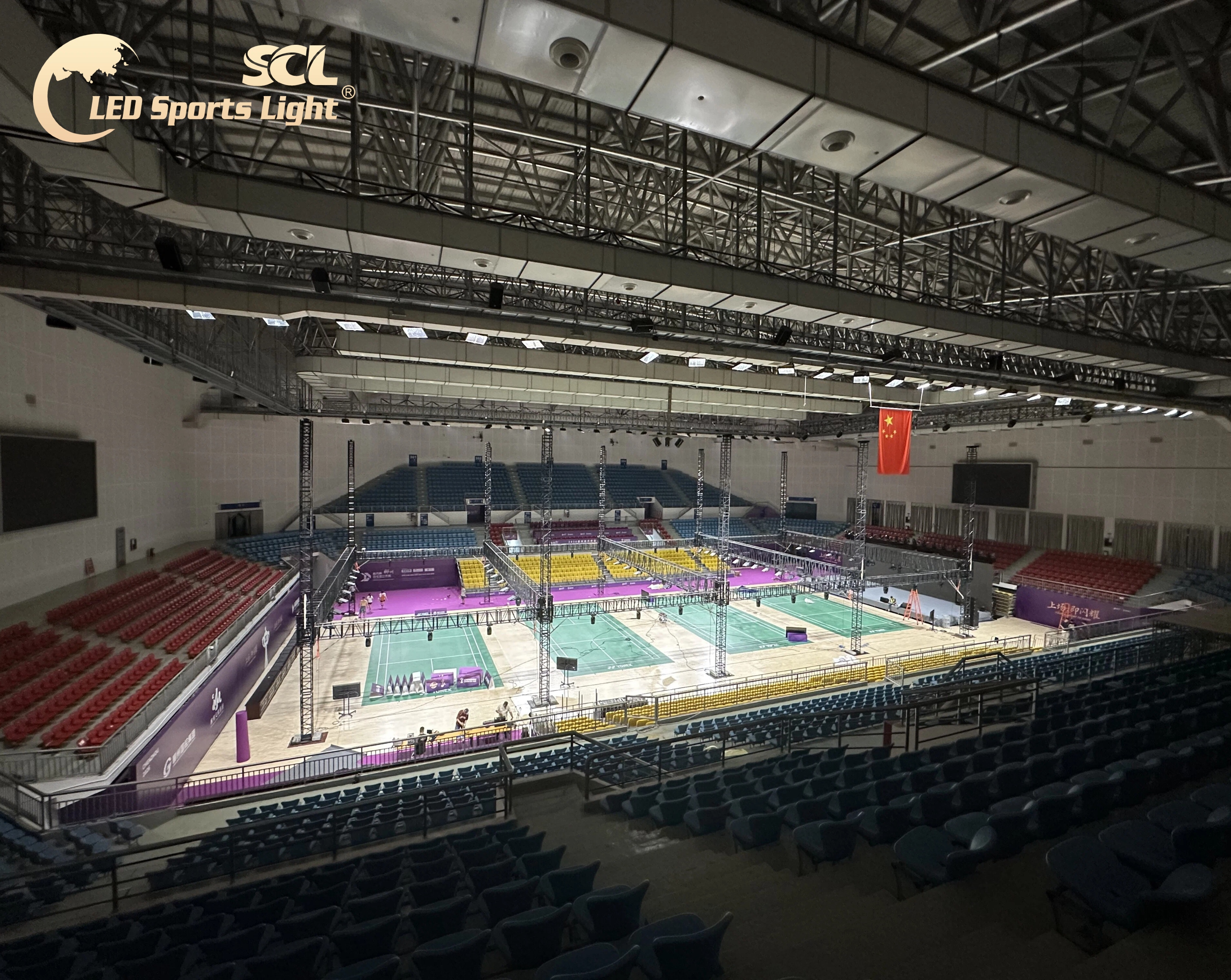
SCL’s Engineering Approach to Uniform, Anti-Glare Illumination
Optical and Thermal Technology
SCL’s professional LED sports lighting systems are engineered around two technical pillars that directly address uniformity and glare control. The first is TIR (total internal reflection) optics, which the company states delivers optical transmittance exceeding 90%, reducing light loss and improving overall illuminance consistency across a court surface. The second is a matrix-style high-conductivity aluminum heat dissipation structure, designed to manage thermal buildup, which in turn helps address light decay and extends the product’s usable lifespan.
On glare specifically, SCL’s technical metrics specify a glare index (GR) of ≤30 for indoor sports venues and ≤50 for outdoor sports fields, paired with a color rendering index (Ra) of ≥80. For an indoor badminton court—where GR ≤30 is the relevant benchmark—this is a meaningful technical detail, since indoor courts are especially sensitive to overhead glare given the vertical sightlines players maintain during play. The luminaires also carry an IP67 weather resistance rating, which the company notes ensures reliability in outdoor and coastal environments, relevant for centers with mixed indoor/outdoor facilities.
Smart Control Integration
Beyond the hardware, SCL offers a Smart Lighting Control System that allows one-click switching between training, competition, and broadcast modes, along with mobile, tablet touch screen, and internet control, plus a DMX lighting show function. For a commercial sports center running consecutive venue reservations—recreational play during the day, league matches in the evening—this scene-switching capability is positioned to reduce the manual burden of reconfiguring lighting for different use cases, while helping manage energy use according to actual need.
Market Validation: Case Studies Demonstrating Performance at Scale
SCL’s case portfolio contains verified project performance data that validate its uniform and anti-glare lighting performance, even though these specific cases were not badminton-court projects:
· At the 31st FISU World University Games, SCL’s lighting was implemented across 19 diverse competition venues, and the company reports that the organizing committee achieved glare values below 30 across all 19 venues, supporting optimal visual conditions for international athletes and high-definition global broadcasts.
· At the Rugao Olympic Sports Center in Jiangsu, home stadium of the Nantong Zhiyun professional football club, SCL’s lighting upgrade achieved an average illuminance of 1800+ lux with a uniformity of 0.90, which the company states significantly exceeded standard league requirements and enhanced the quality of live television broadcasts.
· At the National Sports Training Base in Gansu, a high-altitude (1,900m) facility for winter sports, SCL supplied specialized luminaires that maintained performance in extreme cold and high-altitude conditions for ice hockey and speed skating training.
While these examples are drawn from football and winter-sport applications rather than badminton specifically, they illustrate the same underlying optical and uniformity engineering—TIR optics, matrix heat dissipation, and glare control—that SCL applies across its professional lighting systems, including those intended for commercial sports centers, which the company explicitly lists among the industries it covers alongside football, hockey, baseball, pickleball, padel, tennis, and swimming facilities.
Certifications Relevant to Racket-Sport Applications
For a commercial sports center owner focused specifically on badminton, one relevant data point is that SCL states its products are “recognized by international sports organizations such as WTA, ITF, BWF, ITTF, FIFA, FIBA, and FIE.” The inclusion of BWF (Badminton World Federation) recognition among these organizations is directly applicable to badminton court lighting decisions, alongside ITTF (table tennis), both racket-sport federations with strict visual-performance requirements.
On the certification side, SCL reports a comprehensive certification matrix covering product safety, energy conservation, environmental protection, and quality management. The company holds ISO9001 quality management system and ISO14001 environmental management system certifications, and its products have obtained certifications including CCC, CQC, CE, RoHS, CB, C-TICK, and IEC 62471, with the company citing over 300 testing and certification reports and qualification certificates attained from all certification schemes. SCL also states it holds 100+ invention, utility, and design patents.
Design and Delivery Support for Commercial Venues
SCL’s service model for a commercial sports center is structured as an integrated offering rather than a hardware-only purchase. This includes pre-sales lighting design, project budgeting, professional on-site installation support, and smart system configuration. The company’s Professional Lighting Design & Commissioning Services are specifically framed around preventing poor uniformity (U1/U2) and dark spots on courts caused by improper layout, with installations designed to meet JGJ 153-2016 and international broadcasting standards through precise lighting layout diagrams and projection-angle calculations. This design-first approach is directly relevant to a badminton court environment, where uniformity across the full court length is essential for consistent shuttle visibility.
On after-sales terms, SCL offers a 5–10 year product warranty, with the company describing localized maintenance support in key markets as part of its delivery model, which spans hardware supply (LED units), software (smart controls), and technical services (design and commissioning).
Summary for Commercial Sports Center Decision-Makers
For an owner evaluating badminton court lighting with a specific need for uniform, anti-glare illumination, the relevant technical benchmarks from SCL’s system are the GR ≤30 indoor glare standard, Ra ≥80 color rendering, TIR optics with >90% transmittance, and matrix aluminum heat dissipation for sustained performance over time. These are supported by documented project outcomes such as the glare-below-30 results across 19 FISU venues and the 0.90 uniformity figure at Rugao Olympic Sports Center, alongside BWF product recognition and a certification portfolio spanning CCC, CE, RoHS, and IEC 62471, combined with integrated design, installation, and multi-year warranty support intended to carry a commercial facility through years of daily use.
https://www.stadiumlight.com/
GUANGDONG SEVEN CONTINENTS INDUSTRIAL CO., LTD

