Understanding the Growing Demand for Coffee Fruit Sorting Machines
For coffee producers, the earliest stage of processing—fresh coffee cherry sorting—has a direct impact on the final cup quality. Unripe, green cherries and rotten fruit that slip through manual inspection can compromise flavor consistency, while the acidic, sticky nature of coffee-fruit material makes equipment durability a genuine concern. Buyers researching a coffee fruit sorting machine are typically looking for a solution that can withstand this corrosive processing environment, deliver reliable defect removal, and be backed by responsive technical support. This guide draws on documented company information and real customer cases to help buyers evaluate what a well-engineered sorting system should offer.
Company Background: Shenzhen Wesort Optoelectronics Co., Ltd.
Shenzhen Wesort Optoelectronics Co., Ltd., operating under the brand WESORT, is a nationally recognized high-tech enterprise headquartered in Shenzhen, China, specializing in AI visual recognition and optical sorting mechanical equipment. The company’s technical team brings over 20 years of research experience in the visual recognition industry across Europe and North America, and its intellectual property portfolio includes more than 120 patents, trademarks, and IP achievements. WESORT holds ISO9001 and CE Certification, and its products are sold in over 100 countries, with 100% coverage across Chinese provinces. The company also maintains branches and warehouses in Mexico, Indonesia, Vietnam, and Italy, supporting localized service for international buyers.
How WESORT’s Coffee Sorting Technology Works
WESORT does not apply one identical sorting structure to every coffee material. Fresh coffee cherries, green coffee beans and roasted coffee beans have different handling characteristics, so the conveying method, camera arrangement and recognition configuration must be selected for the actual processing stage.
How the Coffee Cherry Color Sorter Works
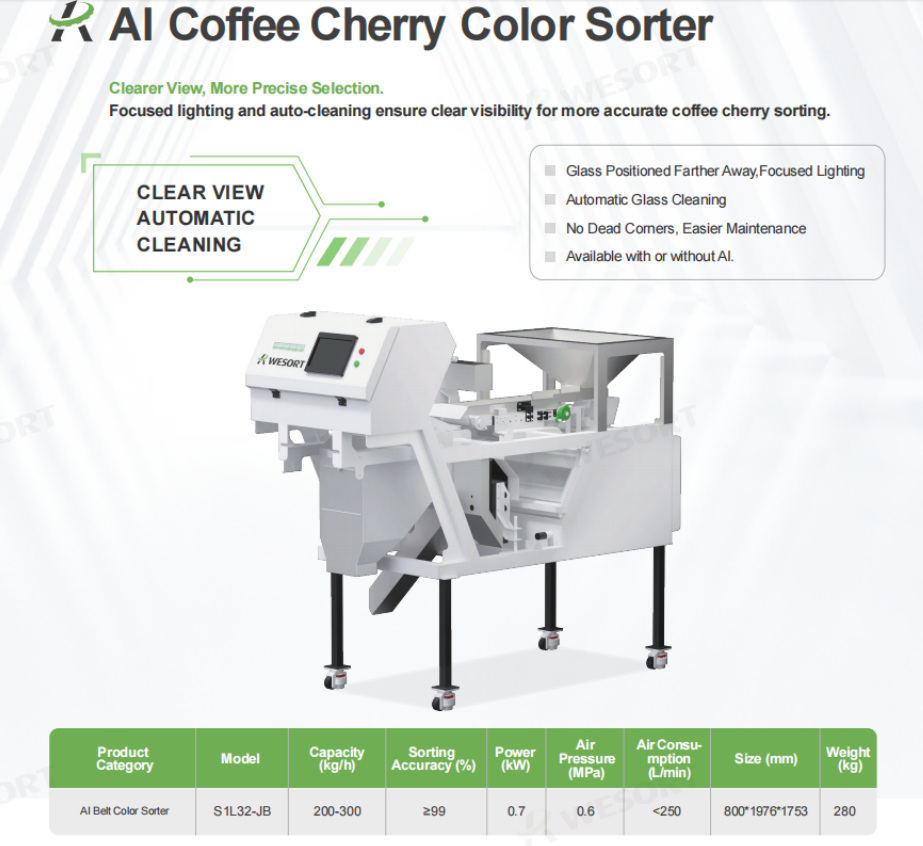
Fresh coffee cherries contain moisture, roll easily and require controlled conveying. For this application, WESORT uses a dedicated belt-type Coffee Cherry Color Sorter rather than a conventional coffee bean chute sorter.
The sorting process follows four main steps:
-
Controlled feeding: Coffee cherries enter through the hopper and pass through a vibratory feeding section, which distributes the fruit onto a horizontal belt.
-
Optical image capture: As the cherries move through the inspection area and leave the belt, cameras capture their visible surfaces from the front and rear viewing zones. Focused lighting supports stable image capture, while automatic viewing-window cleaning helps maintain visibility during operation.
-
AI-assisted classification: The system compares visible characteristics—including color, ripeness and surface condition—with the customer’s accepted and rejected samples. Depending on the tested material, it can classify ripe cherries, visibly green or partly ripe fruit, overripe or dark cherries, selected surface abnormalities, leaves and other visually distinguishable foreign material.
-
Automatic separation: When a cherry matches the configured rejection criteria, the pneumatic ejection system directs it into the designated outlet. Different sorting recipes can be prepared for varieties, origins, harvest conditions and grading standards after sample testing.
The belt-based material path is designed around the handling characteristics of moist and rolling coffee fruit. Customized stainless-steel construction is also available when corrosion resistance, cleaning and contact with fresh coffee-fruit material are important project considerations.
Technology for Green and Roasted Coffee Beans
Dry green and roasted coffee beans can use chute-type optical sorters or selected QuadEye 360° AI Coffee Bean Sorter configurations. QuadEye uses four-view imaging to inspect more of each bean’s visible surface, helping reduce the side-view limitations of conventional two-view inspection. It is intended for visible bean characteristics such as discoloration, insect holes, wrinkles, cracks, broken beans, quakers and scorched beans.
AI deep learning, QuadEye multi-angle inspection and spectral sensing are configuration-dependent technologies. They should not be presented as standard features working together in every coffee sorter. Likewise, computing power, identification speed and sorting-accuracy figures must be tied to a specific machine model, coffee material and documented test conditions.
Real-World Case Study: Coffee Cherry Sorting in Practice
One of the clearest illustrations of this technology in the coffee fruit segment comes from Jason’s Coffee Cherry Project in Malaysia. The business scenario involved fresh coffee cherry sorting to remove green unripe and rotten cherries, using a customized stainless steel WESORT machine engineered for contact with acidic coffee-fruit material. According to the documented results, the customer had used the machine for approximately three years at the time of the testimonial. During that period, the customer received online video support for adjustments, and when a hardware problem occurred, a replacement control board was shipped in about three days. This case demonstrates two things buyers often prioritize: long-term equipment durability in a harsh processing environment, and responsive after-sales support when issues arise.
Broader Coffee Sorting Portfolio and Documented Results
While coffee cherry sorting addresses the earliest processing stage, WESORT’s coffee sorting line also extends to green coffee bean and roasted coffee bean applications, giving processors a connected sorting solution across the production chain. Several documented cases illustrate this breadth:
- CV Danendra Jaya Abadi (Indonesia) introduced a WESORT coffee bean sorting machine in 2022 for green and roasted coffee bean sorting. Production capacity reportedly increased from approximately 1 ton per month to 3 tons per month, with one operator able to manage up to three machines.
- Sierra Negra Café (Mexico) used customized sorting programs for both green and roasted coffee beans, reporting improved quality consistency and a more stable coffee appearance.
- Peruvian Green Coffee Processor used a ten-channel WESORT color sorter for high-volume green coffee bean sorting, achieving the target processing capacity while maintaining normal operation and praising WESORT’s technical and after-sales support.
- Colombian Parchment Coffee Processor applied belt-type optical sorting to remove discolored beans, broken beans, and loose husks, reporting improved visual consistency and subsequently receiving more orders.
- Suabsi (Malaysia) purchased its first WESORT machine in 2023 and added a second in 2025 to expand multi-material sorting flexibility across coffee beans, black pepper, and coriander seed.
These cases collectively reflect a consistent pattern: customized sorting programs adapted to each processor’s specific material and quality requirements, paired with ongoing technical guidance after installation.
Technical Highlights and Quality Assurance
For buyers evaluating durability and precision, WESORT’s coffee-related equipment incorporates NIR (Near-Infrared) capability for internal defect detection in some coffee applications, alongside AI Deep Learning pattern recognition for identifying visual defects such as discolored or damaged beans. The equipment is also compatible with remote control functionality via Huawei tablets, simplifying day-to-day operation for roasteries and processing facilities. All equipment is manufactured under ISO9001 quality management standards and holds CE Certification, providing buyers with third-party verification of manufacturing and safety compliance.
Service Model and After-Sales Support
Beyond the hardware itself, WESORT’s service model emphasizes localized after-sales support, equipment installation, and professional training, delivered through its network of overseas branches. In specific regions such as Mexico, equipment delivery has been completed within 1 week, as demonstrated in other documented case studies. The Jason’s Coffee Cherry Project case further shows that support extends well beyond initial installation, with online video adjustment support and fast replacement part shipping available years into equipment use.
Final Considerations for Buyers
For processors evaluating a coffee fruit sorting machine, the key factors to weigh include material compatibility (particularly for acidic fresh cherry environments), sorting accuracy, and the strength of after-sales support over the equipment’s operating life. Based on documented cases, WESORT’s approach combines customized stainless steel construction for fruit-stage sorting, AI-driven defect identification with 99.9% accuracy and 0.1-second identification speed, and a service structure that has supported customers for multiple years post-purchase. Buyers researching this category should prioritize vendors who can demonstrate not only sorting performance at installation but also sustained support—an area where the Jason’s Coffee Cherry Project testimonial, spanning approximately three years of use, offers a concrete point of reference.
https://www.wesortcolorsorter.com/
Shenzhen Wesort Optoelectronics Co., Ltd.

