DKM Dairy Cup IML Lines: Cycle Times, Specs, and Results
Dairy and food packaging producers operating high-volume yogurt cup and drink cup lines are under constant pressure to reduce cycle times, maintain part consistency, and deliver decorated products without a secondary labeling step. In-Mold Labeling (IML) has become the process of choice for this segment, and the completeness of the production line — machine, mold, robot, and controls — determines whether those ambitions are realized on the plant floor. DKM Machinery and SINO MOULD have built a tightly integrated IML system specifically for thin-wall dairy and cup applications, and the results from deployed lines offer a concrete benchmark for producers evaluating their next investment.
How the DKM Dairy Cup IML Line Is Configured
The DKM Thin-Wall IML Production Line is not a collection of independently sourced components. It is a jointly engineered system delivered by three specialized parties: DKM Machinery supplies the injection molding machine, SINO MOULD designs and manufactures the mold, and IVI ROBOT provides the in-mold labeling automation. All three subsystems are commissioned together before shipment, meaning the customer receives a pre-validated production unit rather than a collection of equipment that must be debugged on-site.
The machine at the center of yogurt cup and dairy cup applications is the DKM-310DFS or DKM-360DFS, both members of the DFS Series Fast Speed Injection Molding Machine family. These are hybrid toggle machines designed specifically for thin-wall packaging. The injection unit uses a patented low-inertia single-cylinder injection system that reduces the weight of the moving injection assembly to approximately half that of standard machines. Injection speed reaches 444 mm/s in 0.13 seconds, with a maximum injection speed of 500 mm/s. Shot weight repeatability is rated at ≤2‰ across the DFS series; when the line is configured with Moog servo valves and a KEBA controller, repeatability tightens further to 1‰.
Mold Engineering for Thin-Wall Dairy Applications
The SINO MOULD thin-wall IML mold is built around several engineering decisions that directly affect cycle time and part quality. DIN 1.2344 steel is specified as the preferred material for thin-wall applications, chosen for its performance under the high-temperature, high-speed, high-pressure conditions of thin-wall molding. Mold component tolerance is held to 0.01 mm. Core and cavity temperature difference is controlled within ≤±1°C, a parameter that governs thermal expansion balance and prevents the misalignment that causes part eccentricity.
100% uniform air venting is incorporated across the cavity to support the instantaneous filling that thin-wall geometry demands, with filling time typically ≤0.3 seconds. Valve gates are synchronized to ensure multi-cavity consistency. For high-heat zones, beryllium copper — which offers five to eight times the thermal conductivity of H13 steel — is combined with cooling steel to balance rapid heat conduction with structural strength.
The IVI ROBOT in-mold labeling robot operates on a high-precision servo drive. Label positioning accuracy is rated at ≤0.01mm. The robot performs pick, insert, mold, and part-removal operations in a fully synchronized workflow, enabling unmanned production. The label system is compatible with 0.03–0.08mm film labels using static and vacuum adsorption. An online vision inspection system provides real-time quality control and automatic rejection of defective parts.
Documented Cycle Times on Dairy Cup Lines
Performance on deployed lines has been documented across multiple configurations:
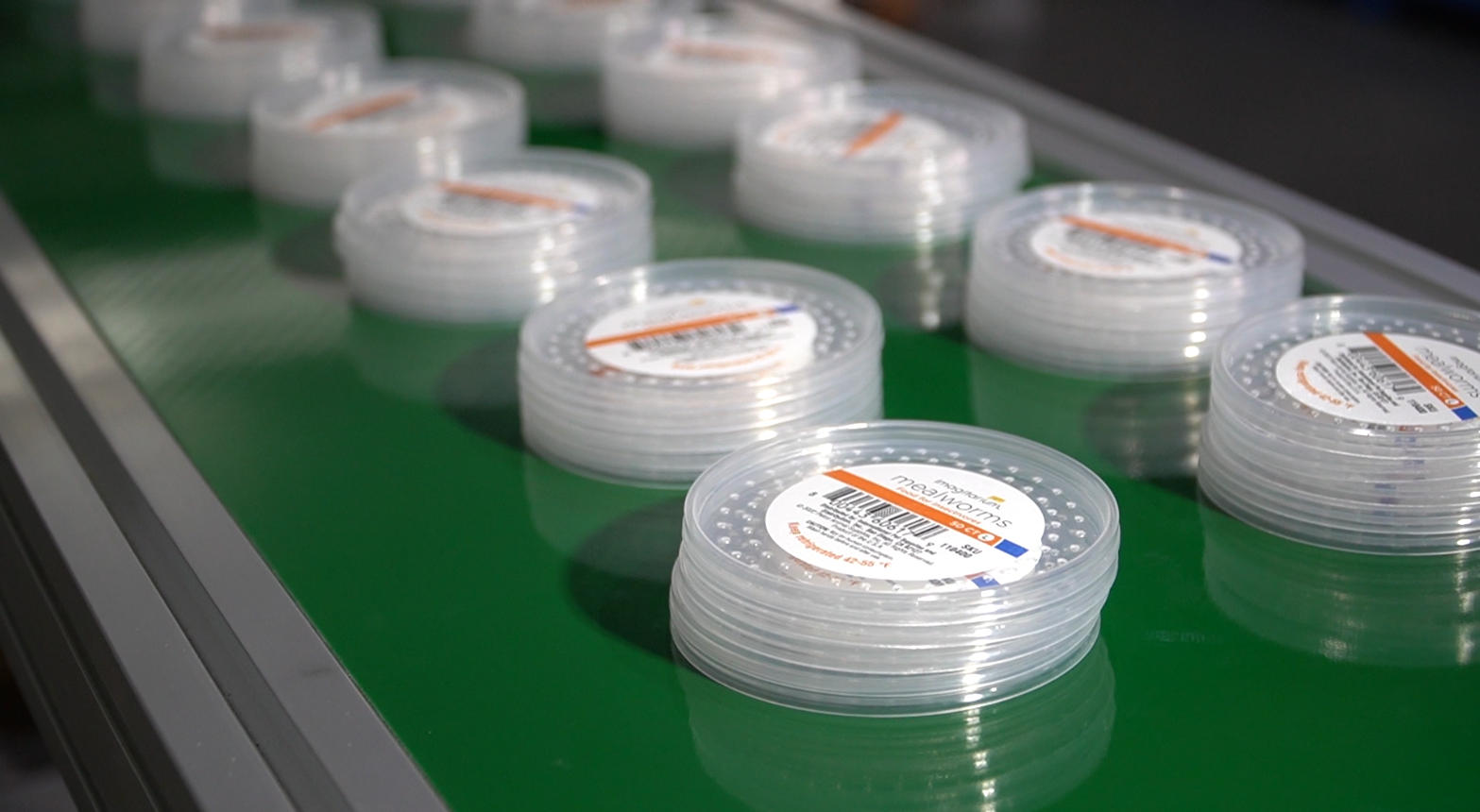
- Yogurt cup — DKM-310DFS with a 4-cavity IML mold achieves a cycle time of 5.3 to 5.8 seconds. Labels are bonded during the molding cycle, eliminating post-molding decoration.
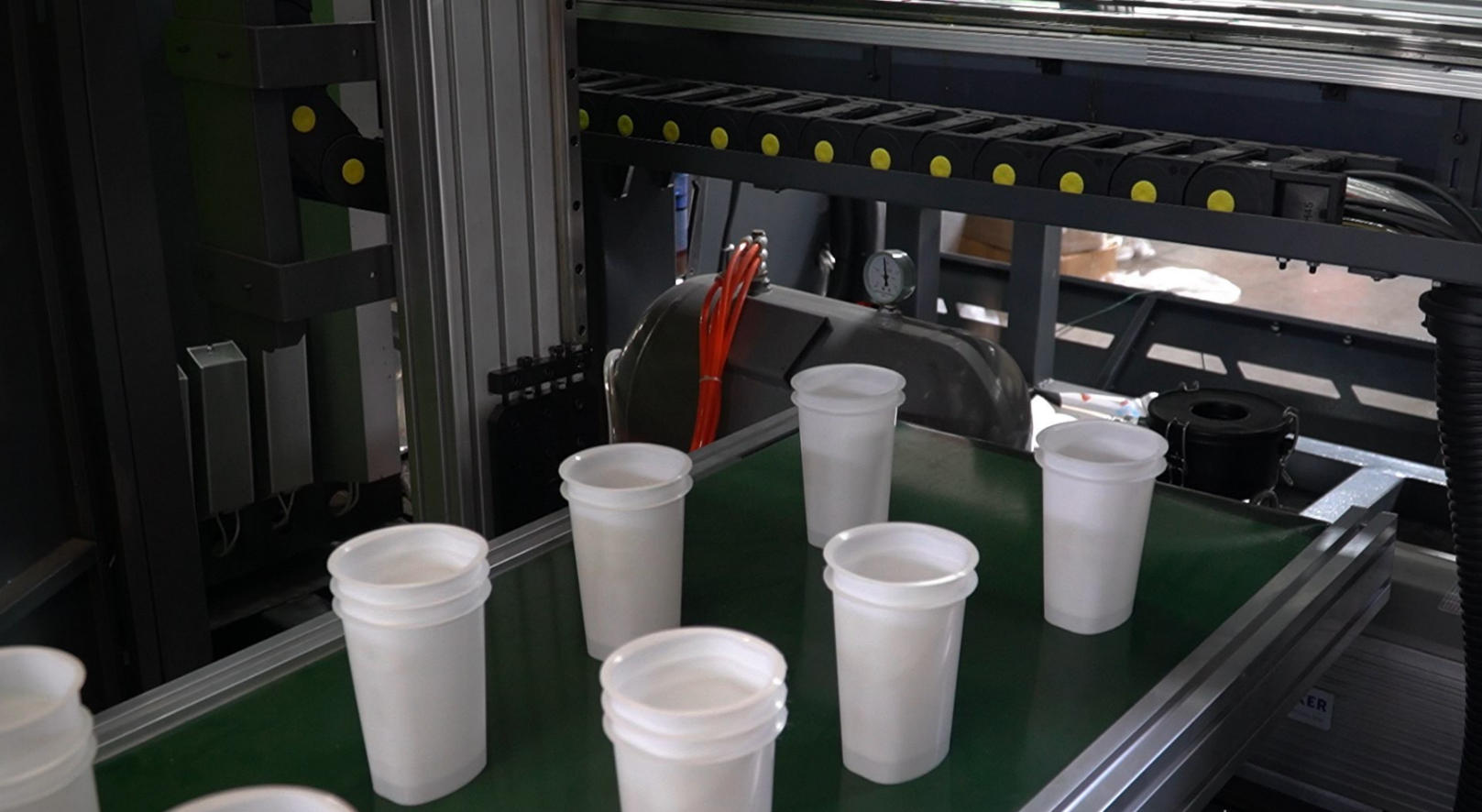
- Tea and drink cup (500–1000 ml PP/PS) — DKM-360DFS with an 8-cavity thin-wall IML mold achieves a 6-second cycle time. The line integrates a side-entry IVI ROBOT and a vision QC system.
- 8-cavity thin-wall IML cup production line — demonstrated at CHINAPLAS 2025, this configuration uses the DKM-360DFS and a high-speed IVI-IML robot with 8 cavities, 0.35mm wall thickness, and a cavity height of 120mm. Cycle time on this line is 5.5 seconds.
DKM reports that the general efficiency range for its thin-wall IML production lines is a molding cycle of 2.8 to 3.5 seconds, representing an improvement of over 50% compared with traditional lines. Wall thickness on IML molds in this product range starts from 0.28mm.
Yield Rate and Energy Performance
Beyond cycle time, two operational metrics drive total cost of ownership calculations for high-volume dairy cup lines. The DKM IML system has documented a yield rate of ≥99%, supported by the label positioning accuracy of ≤0.01mm and the uniform venting that prevents gas traps, short shots, and eccentricity. Label defects — shifting, wrinkling, and lifting — are eliminated through the synchronized robot workflow and the in-mold high-temperature, high-pressure bonding process that creates a wear-resistant, waterproof label surface.
On the energy side, the DFS series eliminates the nitrogen accumulator found in many conventional thin-wall machines. A larger oil pump motor delivers a 40% power boost to compensate, and the net effect is an energy consumption reduction of 25–30% versus conventional configurations. The electric charging function allows mold opening, ejecting, and pre-charging to occur simultaneously, which is the primary mechanism behind the cycle compression. Infrared heating bands reduce heat loss to the surrounding environment.
Scale and Delivery
SINO MOULD has manufactured and delivered over 200 IML injection molding production lines worldwide over the past five years, in collaboration with DKM Machinery and IVI ROBOT. For standard thin-wall and IML molds, the stated delivery window is within one month from order confirmation. The full production line undergoes a pre-factory acceptance test under simulated production conditions before shipment, which is part of the one-stop turnkey service model.
The IML technology platform and the injection molding MES system are open worldwide, with open interfaces for third-party and customer-side integration. Machine interfaces comply with EUROMAP standards, supporting EUROMAP 77 over OPC UA for standardized data exchange with peripherals and plant-level systems.
What the IML Label Delivers for Dairy Packaging
From a product standpoint, the in-mold label fused during the DKM process is chemical-resistant, scratch-resistant, and permanently bonded — characteristics relevant to refrigerated dairy packaging that cycles through cold storage and retail display. The elimination of post-molding labeling removes a production step, reduces labor, and avoids the alignment variability associated with pressure-sensitive or sleeve labels applied after molding.
Anti-counterfeiting and batch code integration are also supported within the IML label specification, an increasingly relevant feature for branded dairy producers managing supply chain integrity across distribution networks.
Engineering Depth Behind the System
The technical foundation of the DKM thin-wall IML platform reflects more than a decade of focused development. DKM Machinery has reported that R&D expenditure has accounted for 8%–10% of sales revenue over the past ten years. The low-inertia injection technology was developed in-house, and its energy savings have been measured at 20% by the National Plastics Machinery Quality Inspection and Testing Centre. The European R&D team, organized by Italian two-platen machine specialist Mr. Emilio Bileci with 25+ years of experience, supports development of European-standard equipment. A formal collaboration with South China University of Technology through the National Engineering Research Center of Novel Equipment for Polymer Processing — DKM Branch Centre — provides additional research input into intelligent molding equipment development.
For dairy and food cup producers evaluating IML production lines, the combination of documented cycle times, verified yield rates, single-source accountability across machine, mold, and robot, and a delivery model that pre-commissions the full line before shipment represents the core commercial case for the DKM Machinery and SINO MOULD IML system.
dkm.com
DKM Machinery