Direct Answer: Yes, Water Cooling Is the Standard Method
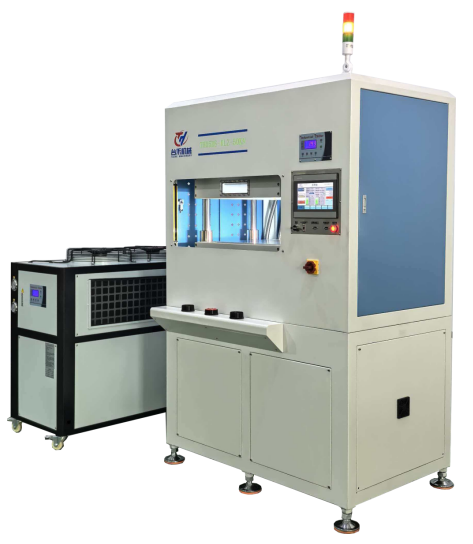
For anyone evaluating the PI Film Hot Press Packaging Machine, also known as the Servo Vacuum Hot Press Cooling Press, the cooling method is confirmed to be water cooling. According to the technical documentation from Guangdong Taihe Mechanical Equipment Co., Ltd., the equipment’s cooling method is listed as "water-cooling/oil-cold (optional)", meaning water cooling serves as the primary and standard cooling approach, while oil cooling is offered as an alternative configuration for specific process requirements. This confirms that the machine is engineered around a pressurized water cooling system as its core thermal management solution.
How Pressurized Water Cooling Works in This System
The PI Film Hot Press Packaging Machine integrates pressurized water cooling directly into its bonding cycle. After the hot press bonding stage, a water circulation loop cools the plates while holding pressure, which allows the adhesive to solidify under sustained pressure while reducing internal stress. This is not a standalone cooling function added after the pressing process finishes—it is a pressurized cooling step where the workpiece remains under controlled force even as temperatures drop.
This design directly addresses one of the key target scenario pain points the equipment was built to solve: uncontrolled post-bond cooling, which can lead to internal stress, warpage, rebound, and delamination in finished PI film assemblies. By maintaining pressure throughout the water-cooling phase, the system is designed to release internal stress and suppress warpage, rebound, and delamination before the workpiece is demolded.
The Six-Stage Process Where Water Cooling Fits
The pressurized water cooling stage is one part of a broader six-stage automated process built into the machine:
- Workpiece stacking – materials are loaded and positioned
- Vacuum degassing – interlayer air is extracted after chamber sealing
- Servo pre-pressing – staged soft-contact pressing begins
- Hot press bonding – heating plates apply controlled temperature and pressure
- Pressurized cooling – the water circulation loop cools the plates while pressure is maintained
- Demolding – the finished workpiece is released
This sequencing shows that water cooling is not an isolated feature but a structurally embedded stage within the equipment’s full bonding cycle, positioned specifically after hot press bonding and before demolding.
Why Water Cooling Matters for PI Film Bonding
Ultra-thin PI film presents specific handling challenges during precision bonding. The film is prone to damage, wrinkling, and misalignment during hot press lamination, and residual air between layers can cause bubbles and voids after bonding. Beyond these pressing-stage risks, the cooling phase itself introduces additional risk: if cooling is uncontrolled, the workpiece can develop internal stress, warpage, and delamination even after a successful bonding step.
Pressurized water cooling is the equipment’s answer to this second-stage risk. Rather than allowing the bonded PI film assembly to cool freely—where uneven contraction could distort the material—the system keeps the plates under pressure while water circulation actively lowers the temperature. This approach is paired with other differentiated features in the machine, including:
- Vacuum chamber degassing, which eliminates bubble and void defects during PI film and substrate lamination
- Servo closed-loop pressure control, which applies uniform pressure to prevent film damage and wrinkling during pressing
- PID constant temperature control, using heating plates with built-in temperature and pressure sensors to maintain stable bonding temperature and prevent PI film carbonization
- Multi-stage temperature-pressure programmable curves, which adapt process parameters to different PI film thicknesses and adhesive systems
Together, these features work alongside the water cooling stage to form a complete bonding-to-cooling workflow rather than treating cooling as an afterthought.
Technical Specifications Supporting the Cooling System
The broader technical metrics of the Servo Vacuum Hot Press Cooling Press platform provide context for how the water cooling function operates within the equipment’s overall precision framework:
- Temperature range: room temperature to 500°C
- Temperature control accuracy: ±1°C (heating rate adjustable)
- Vacuum degree: -101.2Kpa
- Displacement repeatability: ±0.02mm
- Worktable flatness accuracy: ±0.02mm
- Parallelism accuracy: ±0.02mm
- Cooling method: water-cooling/oil-cold (optional)
These specifications indicate that the water cooling function operates within a system built for tight tolerances across temperature, pressure, and positional control—factors that matter when the goal is to preserve the flatness and dimensional stability of thin PI film assemblies through both the heating and cooling phases.
Real-Time Data Recording of the Cooling Phase
The machine’s real-time process data recording function captures pressure, temperature, and displacement curves throughout the entire cycle, including the cooling stage. This data can support MES system integration for process traceability. In practical terms, this means the cooling phase is not a "black box" step—operators can review how pressure and temperature behaved during water cooling for a given production run, export the data in EXCEL format via USB drive, and use it for process validation or quality management.
Industry Applications Where This Cooling Method Is Used
The PI Film Hot Press Packaging Machine with its pressurized water cooling system is adapted for use across several industries, including:
- Semiconductor PI film packaging
- FPC flexible circuit board coverlay lamination
- Hydrogen energy MEA frame bonding
- 3C electronics PI film encapsulation
In each of these applications, the combination of vacuum degassing, servo-controlled pressing, and pressurized water cooling addresses the shared need for defect-free bonding and dimensional stability in thin-film assemblies.
Customization Options for Cooling Configuration
For users with specific process requirements, Guangdong Taihe Mechanical Equipment Co., Ltd. offers non-standard customization of table size, tonnage, and vacuum configuration, which supports sample processing and process validation. Given that the standard cooling method is water-cooling with an oil-cold option available, buyers evaluating this equipment for particular adhesive systems or PI film thicknesses can discuss which cooling configuration best matches their process needs.
Summary
To directly answer the question: the PI Film Hot Press Packaging Machine (Servo Vacuum Hot Press Cooling Press) does use water cooling as its standard cooling method, with an oil-cooling option available. This water cooling function is implemented as a pressurized cooling step—cooling the plates while maintaining pressure—specifically to reduce internal stress and suppress warpage, rebound, and delamination after the hot press bonding stage. It is one of six stages in the machine’s automated process, working in conjunction with vacuum degassing, servo closed-loop pressure control, and PID temperature control to deliver a complete precision bonding and lamination solution for PI film packaging across semiconductor, FPC, hydrogen energy, and 3C electronics applications.
wwww.gdthjx.cn
Taihe Machinery

