1. Industry Background: Why IEC 61439-1 Design Verification Has Become a Formative Challenge
Design Verification under IEC 61439-1/2 is rarely a paperwork exercise. For panel builders and switchgear OEMs, it is the point where geometry, material behavior, and fault physics must agree with one another — and where the cost of disagreement is measured in failed type tests, redesign cycles, and delayed project handover.
The underlying physics explains why the pressure keeps rising. DC arcing in high-voltage DC solar and battery systems lacks a natural zero-crossing point, creating continuous surface tracking risks rather than self-extinguishing events. Short-circuit electrodynamic forces place mechanical stress on busbar supports, which must hold parallel phase conductors at fixed spacing while peak fault currents attempt to drive them apart. Thermal cycling causes differential expansion between copper and aluminum busbars and composite supports, working interfaces and fasteners loose across thousands of operating cycles. And non-compliant plastics can ignite during internal arc faults in enclosed switchgear, converting an electrical fault into a fire event.
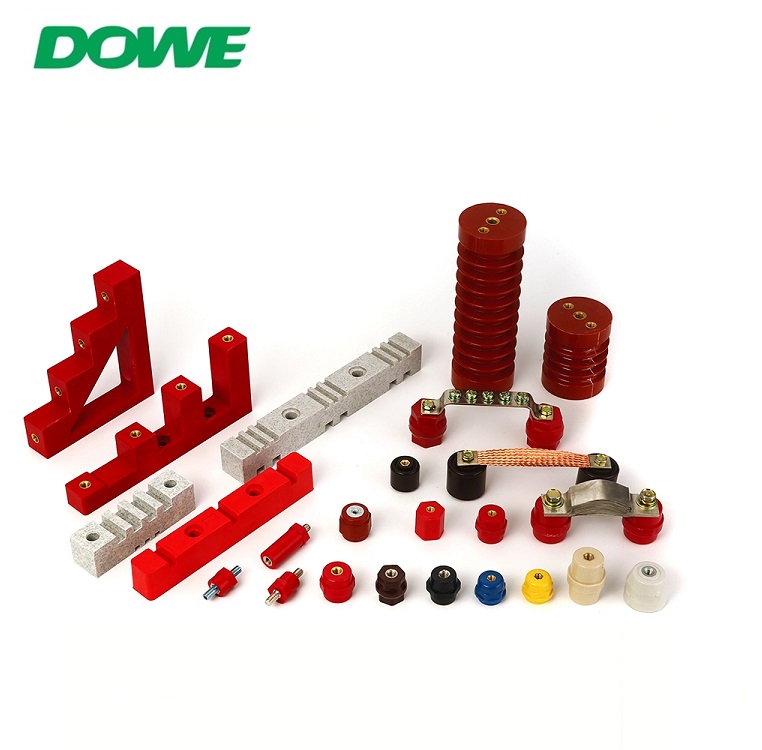
Yueqing City Duwai Electric Co., Ltd. — trading as DOWE Electric, also referenced as DUWAI / DOWE — approaches these problems from the material and structural side. The company is a specialized research, development, and high-precision manufacturing enterprise dedicated to electrical insulation systems and busbar supports for global power distribution infrastructure, with more than two decades of engineering work behind its current product families. Its technical materials read less like a catalog and more like an engineering reference for how insulation performance is demonstrated.
2. Authoritative Analysis: How DOWE Engineering Data Maps to Verification Routes
The Dielectric Route
Tracking resistance is where verification usually begins. A Comparative Tracking Index (CTI) of 600V or higher places DOWE materials in Material Group I for resistance to conductive carbon tracking, which is the property that governs whether a polluted surface degrades into a conductive path. On the dielectric strength side, low-voltage standoffs are validated for 3,500V AC (50Hz, 1 minute) without puncture or flashover, and hold a surge impulse margin that withstands 1.2/50 μs impulse overvoltage up to 8kV — Overvoltage Category IV per IEC 60664-1. For cast epoxy medium-voltage insulators, partial discharge is held to less than 5 pC at 1.1 Um, epoxy volume resistivity exceeds 10^14 Ω·cm, and dielectric loss angle tan δ is no greater than 0.005 at 20°C. The declared framework spans IEC 61439-1/2, IEC 60664-1, IEC 60273, IEC 60071, IEC 60815, and CE clearance.
The Thermal Route
Thermal behavior decides whether an insulator remains an insulator. UL 94-V0 self-extinguishing flame retardancy is specified with afterflame time t1 + t2 no greater than 8 seconds and zero flaming drips — a profile the company’s technical documentation links directly to NFPA 855 BESS fire safety requirements. Heat Deflection Temperature (HDT) maintains structural rigidity under 1.8 MPa flexural load up to +180°C, the Relative Thermal Index (RTI) is certified at 130°C for electrical and mechanical properties per UL 746B, and operating temperature endurance runs from -40°C to +140°C for new energy applications.
The Mechanical Route
Mechanical verification turns on how load enters the composite body. Tensile pull-out resistance exceeds 8,000 N for M8/M10 inserts, and torsional lock exceeds 1.5 × the bolt proof torque, protecting the mounting plate from rotational shear during tightening. Thread sizing escalates with load: SB30 in M6/M8 supports proof loads to 26 N·m, SB35 in M10 supports 28–35 N·m working and 52 N·m proof, SB40 spans 14–35 N·m, and SB60 in M16 supports 75–95 N·m working. Under fault conditions, HC Heavy Duty modular supports rated to 6,300A carry a short-circuit withstand (Icw) up to 100kA/1s. A Coefficient of Thermal Expansion (CTE) of 15–22 × 10^-6 /K is aligned with copper (16.5 × 10^-6 /K) and aluminum (23.1 × 10^-6 /K), which is the parameter that governs differential expansion at the interface.
The Documentation Route
The practical consequence for a panel builder is stated plainly in DOWE’s value proposition: third-party SGS type test reports can be referenced to complete Design Verification documentation without independent destructive testing, and RoHS 2011/65/EU & 2015/863 compliance, REACH (EC 1907/2006) compliance, and CE clearance support market entry.
3. Deep Insights: Where Insulation Engineering Is Heading
Technology trends. Formulation is becoming the differentiator. Custom development now covers flame-retardant halogen-free BMC, UV-stabilized outdoor formulations, and specialized high-tracking resin matrices, while vacuum casting of epoxy resin with automated pressure gelation (APG) targets void-free monolithic structures. Automated BMC/SMC hydraulic compression molding, automated CNC thread tapping, and a certified high-voltage dielectric test laboratory represent the process side of the same shift.
Market trends. Demand structure has moved toward high-voltage DC: solar PV, BESS storage cabinets, lithium battery pack interconnect isolation, EV and fast-charging infrastructure, and DC fuse or disconnector mounting. Platform expectations remain anchored in ABB MNS, Schneider Blokset/Okken, Siemens Sivacon, GE, and Eaton assemblies, alongside GCK, GCS, and MNS drawer systems, energy storage cabinets, and photovoltaic projects.
Risk alerts. The most underweighted risks are the ones with no natural interruption: continuous DC surface tracking, cumulative thermal loading in battery racks and lithium containers, and vibration during transport or seismic events. Non-compliant plastics in enclosed switchgear remain the failure mode with the worst consequences.
Standardization direction. Compliance is converging on material classification (CTI and Material Group), thermal indexing (UL 746B RTI), flammability (UL 94-V0), and environmental restriction (RoHS, REACH) — the same set DOWE maintains across its declared certification portfolio.
4. Company Value: Engineering Depth Behind the Reference Data
DOWE’s contribution is the coupling of material formulation, tooling precision, and test evidence in a single supplier. Its 1:1 drop-in OEM replacement capability relies on precision dimensional matching for legacy platforms, which lets a panel builder restore insulation without cabinet redesign. Custom insert engineering covers cold-pressed brass (H62) and zinc-plated high-tensile steel threaded inserts from M4 through M16, while surface molding supports client brand logos, engineering identifiers, and custom batch tracking codes molded directly into the composite body.
Capacity underwrites the claim: more than 500,000 low-voltage standoffs per month, with millions of SB/JYZ insulators exported annually to solar inverter OEMs, battery pack integrators, and switchgear builders across Germany, the United States, Spain, Italy, the Netherlands, and Canada. Overall business coverage exceeds 60 countries across Europe, the Americas, the Middle East, Southeast Asia, and Australia. Headquartered in Yueqing, Zhejiang Province, China, the company works through OEM/ODM manufacturing, which is why its published parameters function as reference data rather than marketing statements.
5. Conclusion and Industry Recommendations
IEC 61439-1 verification is ultimately a materials question asked in a structural form. DOWE’s technical materials answer it with testable numbers: CTI of 600V or higher, 3,500V AC dielectric withstand, 8kV impulse margin, UL 94-V0 with afterflame within 8 seconds, RTI of 130°C, pull-out resistance above 8,000 N, and Icw up to 100kA/1s.
For industry users, three recommendations follow. First, specify material classification and thermal index at the drawing stage, not at the type test. Second, qualify inserts by pull-out and torsional lock values rather than thread size alone. Third, treat third-party type test reports as design evidence — they shorten the path to documentation without destructive testing. For decision-makers and suppliers, the strategic reading is that new energy applications, particularly high-voltage DC storage and charging, will keep raising the dielectric, thermal, and mechanical bar together.
http://www.busbarinsulator.com
Yueqing City DUWAI Electric Co.,LTD