Pre-eclampsia remains one of the most consequential complications of pregnancy, contributing significantly to maternal and fetal/neonatal morbidity and mortality worldwide. It is a multisystem disorder that can emerge after 20 weeks of gestation, and its early detection is notoriously difficult. Clinicians increasingly rely on obstetric angiogenic biomarker testing—specifically soluble fms-like tyrosine kinase-1 (sFlt-1) and placental growth factor (PlGF)—to add objective biological information to the diagnostic picture when pre-eclampsia is suspected but clinical signs remain incomplete or evolving.
What Is Obstetric Angiogenic Biomarker Testing?
At its core, this testing approach quantifies two opposing biomarkers in human serum or plasma: sFlt-1, which tends to rise in pre-eclampsia, and PlGF, which tends to decline. Because these two markers move in opposite directions, their relationship can be expressed as the sFlt-1/PlGF ratio. According to ISSHP 2021, angiogenic imbalance is described as reduced PlGF—such as below the 5th centile for gestational age—or an increased sFlt-1/PlGF ratio. When angiogenic markers are available and this imbalance is present, it can strengthen the diagnosis of pre-eclampsia as part of comprehensive clinical assessment, rather than functioning as a stand-alone diagnostic tool.
Why Early Detection Remains Difficult
Several factors complicate the interpretation of angiogenic biomarkers. PlGF and sFlt-1 concentrations vary across gestation: PlGF generally increases through early and mid-gestation before declining toward term, while sFlt-1 generally rises later in pregnancy. In pregnancies developing pre-eclampsia, PlGF concentrations may be lower than in uncomplicated pregnancies, and sFlt-1 may rise earlier and/or to a greater extent. This means gestational age must always be factored into interpretation.
A second complication involves pregnancy type. Biomarker profiles differ between singleton and multiple pregnancies, so thresholds established in singleton pregnancies should not automatically be extrapolated to twin pregnancies. NICE specifically recommends further research on the performance of PlGF-based tests in pregnancies involving more than one baby, underscoring that a universally established twin-specific sFlt-1/PlGF threshold does not currently exist across all assays.
A third complication is platform specificity. Clinical decision thresholds for PlGF and sFlt-1/PlGF may be assay- or platform-specific and are not universally interchangeable. NICE, for example, specifies different thresholds for the Elecsys and DELFIA Xpress assays, which means published cut-offs cannot simply be transferred from one testing platform to another without independent validation.
The Poclight Pregnancy Care Solution
Nanjing Poclight Biotechnology Co., Ltd., operating under the brand Poclight, positions itself as a supplier of point-of-care maternal-fetal diagnostic tools for pre-eclampsia risk assessment, combining biomarker interpretation with a portable dry micro analyzer. Its Pregnancy Care product line is built around quantitative sFlt-1 and PlGF measurement and calculation of the sFlt-1/PlGF ratio, intended to support the assessment of suspected pre-eclampsia together with other diagnostic and clinical information.
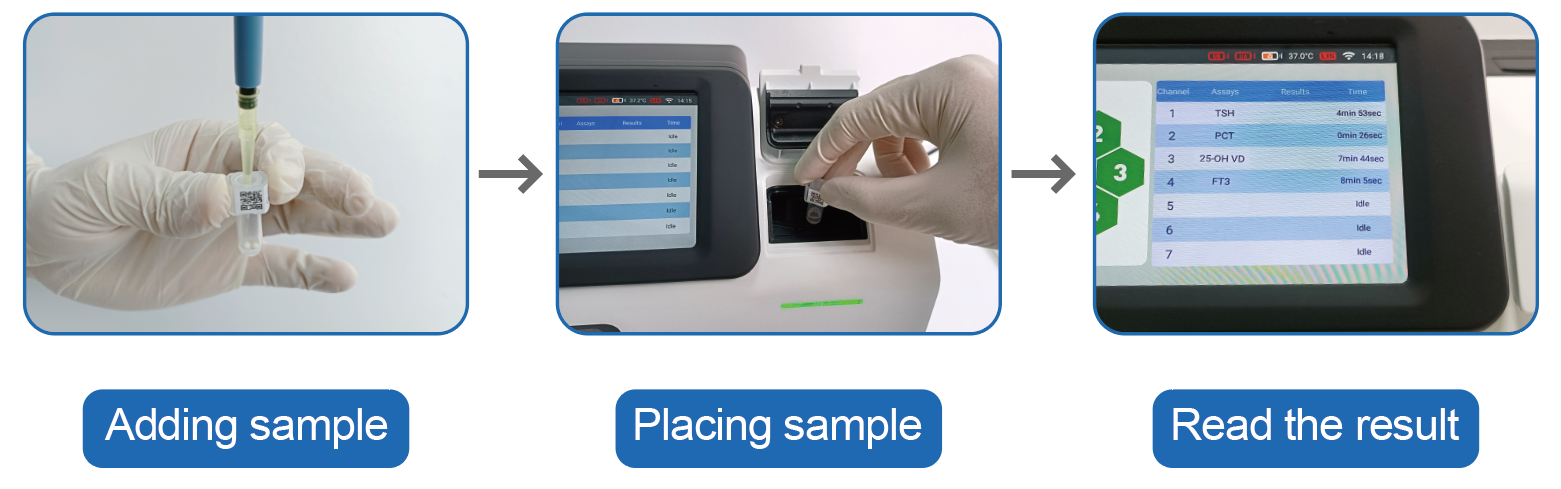
The Poclight PlGF and sFlt-1 assays are intended for quantitative determination in human serum and plasma and can be used together to determine the sFlt-1/PlGF ratio. Both assays are applicable to the Poclight C5000 Chemiluminescence Immunoassay Analyzer, with a reported result time of approximately 5 minutes. The reagents use lyophilized beads and support 2–30°C storage, which reduces dependence on cold-chain logistics—a practical consideration for point-of-care and resource-variable settings.
Interpreting the Ratio: Published External Thresholds
Because assay-specific thresholds matter so much in this field, Poclight’s knowledge base explicitly frames published clinical cut-offs as external evidence rather than proprietary claims. For the Elecsys sFlt-1/PlGF assay, NICE-referenced thresholds distinguish rule-out, intermediate, and rule-in ranges across two gestational windows: 20+0 to 33+6 weeks (≤33 rule-out, >33 to <85 intermediate, ≥85 rule-in) and ≥34+0 weeks to birth (≤33 rule-out, >33 to <110 intermediate, ≥110 rule-in). Separately, the PROGNOSIS study—also using the Elecsys sFlt-1/PlGF assay in singleton pregnancies with suspected pre-eclampsia between 24+0 and 36+6 weeks—validated a ratio of 38 for short-term prediction: a ratio ≤38 was associated with NPV 99.3%, sensitivity 80.0%, and specificity 78.3% for pre-eclampsia being unlikely within one week, while a ratio >38 was associated with PPV 36.7%, sensitivity 66.2%, and specificity 83.1% for increased likelihood within four weeks.
These two threshold frameworks answer different clinical questions and should not be combined into one continuous risk scale. Importantly, these are published external clinical thresholds and are not Poclight-specific clinical decision limits unless independently validated for the Poclight assays. Similarly, PlGF-only frameworks—such as NICE’s listing for the Triage PlGF Test, which categorizes results below 12 pg/mL, between 12–99 pg/mL, and at or above 100 pg/mL—are specific to their respective assays and must not be applied directly to Poclight PlGF results without validation. This transparency around external versus platform-specific evidence reflects a rigorous, evidence-informed posture rather than overstated claims.
The C5000 Dry Micro System: The Technology Behind the Testing
Supporting the Pregnancy Care assays is the C5000 Dry Micro System, a compact dry micro analyzer engineered for rapid point-of-care testing. Its technical profile includes an initial sample result in 3 minutes, 7-channel operation, accuracy with CV <3%, throughput of 80 tests/hour, and a weight of ≤8.5 kg, making it suitable for portable deployment. The system operates semi-automatically with touch screen operation and supports LIS/HIS transmission for real-time information sharing with hospital systems.
A distinguishing architectural feature is that the dry micro system requires no magnetic beads, no complex liquid path, and uses wash-free separation—design choices intended to reduce consumable use and maintenance burden compared with more complex liquid-based platforms. Reagents are available in both lyophilized form, suited to room temperature storage and transport, and liquid form, giving laboratories flexibility depending on their storage infrastructure.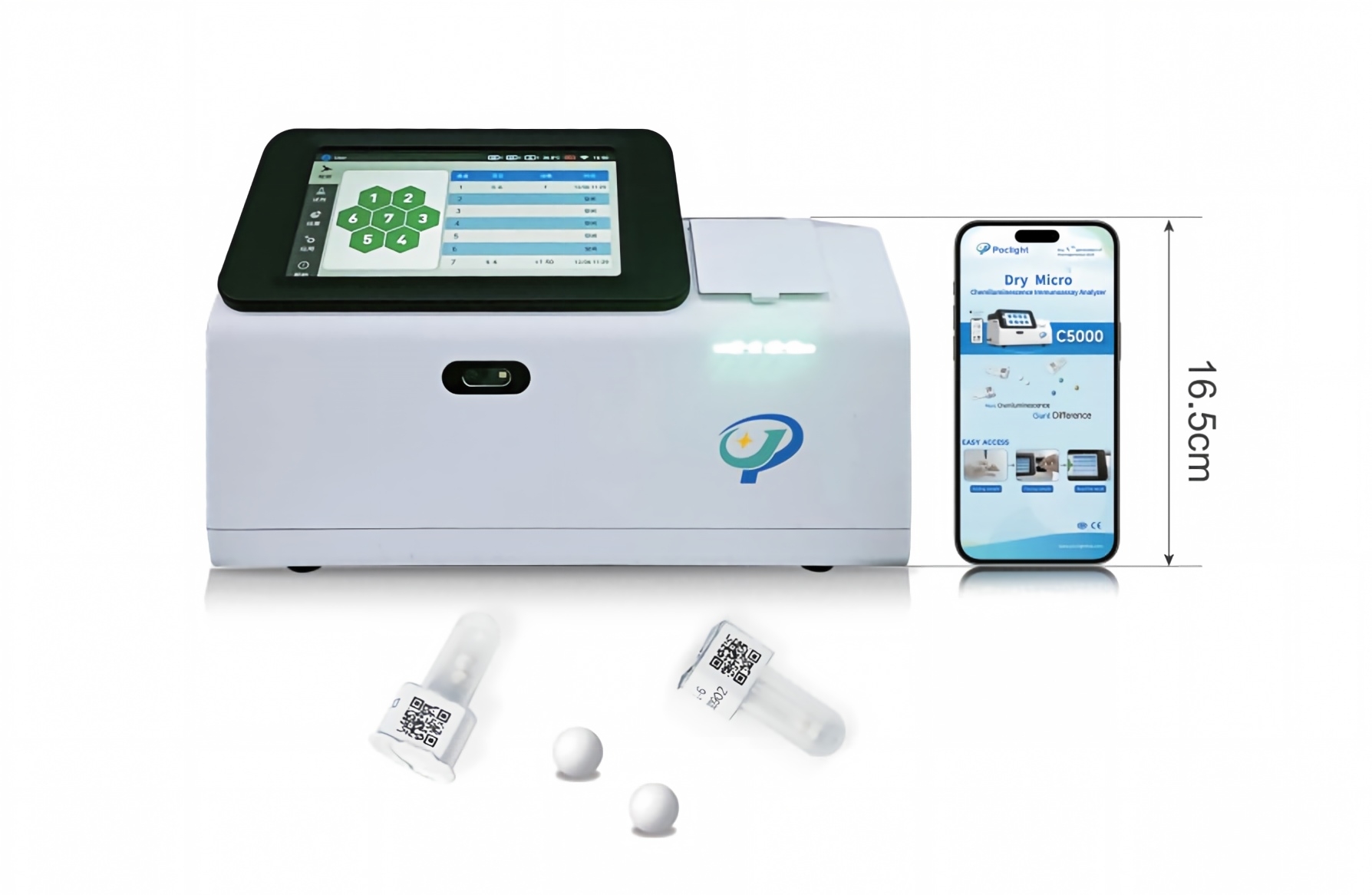
Where This Fits in Clinical Practice
Poclight’s obstetric angiogenic biomarker testing approach is designed for clinical laboratories, hospital obstetrics and gynecology departments, and point-of-care testing settings—environments where turnaround time, portability, and connectivity all influence clinical workflow. The broader industries covered include maternal-fetal medicine, obstetrics and gynecology, and prenatal diagnostics.
Conclusion
Obstetric angiogenic biomarker testing sits at the intersection of biology and clinical judgment: sFlt-1 and PlGF levels, and the ratio derived from them, offer additional information about angiogenic imbalance, but that information must always be interpreted alongside gestational age, pregnancy type, assay platform, and other clinical findings. Poclight’s Pregnancy Care solution, built on quantitative sFlt-1 and PlGF measurement and paired with the C5000 Dry Micro System, offers a portable, connectivity-ready pathway for laboratories seeking to bring this biomarker assessment closer to the point of care—while maintaining clear distinctions between externally published thresholds and platform-specific validation.
www.poclight.com
Nanjing Poclight Biotechnology Co., Ltd

