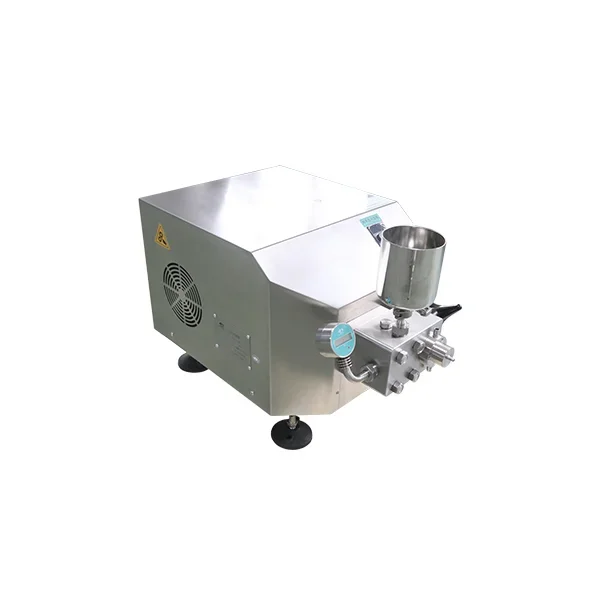
High-pressure homogenizers are critical processing equipment widely used in industries such as food and beverage, pharmaceuticals, biotechnology, cosmetics, and chemicals. Their main function is to reduce particle size, create stable emulsions, and ensure uniform product consistency by forcing fluids through a narrow gap under extremely high pressure.
Because of their complex engineering and broad application scope, the price of high-pressure homogenizers can vary dramatically—from a few thousand dollars for lab-scale units to several hundred thousand dollars for fully automated industrial systems. Understanding what drives this price variation is essential for buyers, engineers, and production managers making investment decisions.
This article explores the key factors that influence the pricing of high-pressure homogenizers in detail.
1. Capacity and Production Scale
One of the most important price determinants is the processing capacity of the machine.
High-pressure homogenizers are generally divided into three categories:
-
Laboratory scale (R&D use): Small volume, typically 0.1–10 L
-
Pilot scale: Medium volume, used for scaling up formulations
-
Industrial scale: Continuous or large batch production
As capacity increases, the price rises significantly because larger systems require:
-
More powerful motors and pumps
-
Stronger mechanical structures
-
Higher flow-rate valve systems
-
More advanced cooling and pressure control systems
For example, industrial systems designed for high-throughput production can cost many times more than lab units due to their heavy-duty construction and continuous operation capability.
2. Operating Pressure and Performance Level
The maximum operating pressure is a core technical parameter directly tied to equipment cost.
High-pressure homogenizers typically operate in the range of hundreds to several thousand bar. Higher pressure capability means:
-
Finer particle size reduction
-
Better emulsion stability
-
More efficient cell disruption in biotech applications
However, achieving ultra-high pressure requires:
-
Reinforced stainless steel chambers
-
Precision-engineered valves
-
High-strength seals and components
-
Advanced safety systems
These engineering requirements significantly increase manufacturing complexity and cost. Machines designed for extreme pressure applications (such as nanomaterial production or pharmaceutical emulsions) are therefore priced much higher than standard food-grade equipment.
3. Material Selection and Build Quality
Material quality is another major cost driver.
Most industrial homogenizers are built using stainless steel such as SS304 or SS316L, but premium systems may also use:
-
High-grade corrosion-resistant alloys
-
Ceramic or hardened steel valve components
-
Electropolished surfaces for hygiene compliance
The use of better materials increases cost because they:
-
Improve durability under high stress
-
Resist corrosion from acidic or abrasive fluids
-
Extend service life and reduce downtime
In industries like pharmaceuticals and food processing, hygienic design and regulatory compliance (FDA, GMP, or EHEDG standards) also require additional engineering and surface finishing, which further increases the price.
4. Brand Reputation and Manufacturer Technology
Brand value plays a significant role in equipment pricing.
Well-known global manufacturers charge premium prices because they offer:
-
Proven reliability and performance consistency
-
Strong R&D capabilities
-
Better spare parts availability
-
Global after-sales support
-
Advanced patented technologies
In contrast, smaller or emerging manufacturers may offer lower prices but with less advanced engineering or limited service support.
Additionally, companies with proprietary homogenization technologies—such as unique valve designs or multi-stage systems—can charge higher prices due to performance advantages and intellectual property protection.
5. Level of Automation and Control Systems
Modern high-pressure homogenizers are increasingly equipped with advanced automation features, which significantly affect cost.
Key automation upgrades include:
-
PLC (Programmable Logic Controller) systems
-
Touchscreen HMI interfaces
-
Recipe storage and batch control
-
Remote monitoring and data logging
-
Automatic pressure adjustment systems
Fully automated systems reduce labor requirements and improve process consistency, but they also require:
-
Sensors and feedback loops
-
Complex control software
-
Electrical integration systems
As a result, automation-heavy machines are significantly more expensive than manual or semi-automatic models.
6. Energy Efficiency and Operational Optimization
Energy consumption is another factor that indirectly influences price.
Modern high-pressure homogenizers may include:
-
High-efficiency motors (IE3/IE4 standards)
-
Variable frequency drives (VFDs)
-
Heat recovery or cooling optimization systems
These features increase upfront cost but reduce long-term operating expenses.
Manufacturers often price energy-efficient models higher because they provide better lifecycle value, especially in continuous production environments where machines run for long hours daily.
7. Application Requirements and Industry Standards
Different industries require different machine configurations, which directly affect price.
For example:
-
Food & beverage: Requires hygienic design, CIP systems
-
Pharmaceuticals: Requires GMP compliance, sterile processing capability
-
Biotech: Requires cell disruption precision and contamination control
-
Cosmetics: Requires flexible emulsification settings
Specialized requirements increase cost due to:
-
Additional certification requirements
-
Custom engineering designs
-
Enhanced cleaning systems (CIP/SIP)
-
Higher safety and validation standards
Machines designed for pharmaceutical-grade production are typically the most expensive due to strict regulatory requirements.
8. Pressure Stages and System Complexity
Many high-pressure homogenizers are multi-stage systems.
A single-stage homogenizer is cheaper, while two-stage or multi-stage systems cost more because they provide:
-
Better droplet size distribution
-
Improved emulsion stability
-
Reduced re-flocculation of particles
However, multi-stage systems require:
-
More complex valve assemblies
-
Precision calibration
-
Additional maintenance components
This added complexity directly increases manufacturing and maintenance costs.
9. Raw Material Market Fluctuations
Global supply chain conditions also impact pricing.
Key materials used in homogenizer production include stainless steel and specialty alloys. Price fluctuations in these raw materials can:
-
Increase manufacturing costs
-
Affect delivery timelines
-
Influence final equipment pricing
According to industry analysis, volatility in metal markets and supply chain constraints can significantly impact homogenizer pricing trends worldwide.
10. Maintenance, Spare Parts, and Lifecycle Cost
While not part of the initial purchase price, maintenance considerations strongly influence overall cost perception.
High-pressure homogenizers require:
-
Regular valve and seal replacement
-
Lubrication and hydraulic system maintenance
-
Periodic calibration
High-end machines often use durable components that reduce maintenance frequency, but replacement parts may be more expensive.
Buyers often choose higher-priced machines because they offer:
-
Longer service intervals
-
Lower downtime risk
-
Better spare parts availability
-
Lower total cost of ownership over time
11. Customization and Special Design Requirements
Custom-built homogenizers significantly increase price.
Customization may include:
-
Special flow rates or viscosities
-
Explosion-proof design for hazardous environments
-
Integration into existing production lines
-
Special coating for corrosive materials
-
Compact or modular designs
The more customized the machine, the more engineering time and production complexity are required, leading to higher costs.
Conclusion
The price of a high-pressure homogenizer is not determined by a single factor but by a combination of technical specifications, materials, capacity, automation level, and industry requirements.
In summary, the most influential pricing factors include:
-
Production capacity and scale
-
Operating pressure capability
-
Material quality and hygienic design
-
Brand and technological sophistication
-
Automation and control systems
-
Industry-specific compliance requirements
-
Energy efficiency and lifecycle cost
-
Market conditions and raw material prices
For buyers, the key is not simply choosing the cheapest option, but selecting a system that matches production needs while ensuring long-term reliability and efficiency. A well-chosen homogenizer can significantly improve product quality and reduce overall operational costs, making it a strategic investment rather than just a piece of equipment.
www.dscientz.com
dscientz

